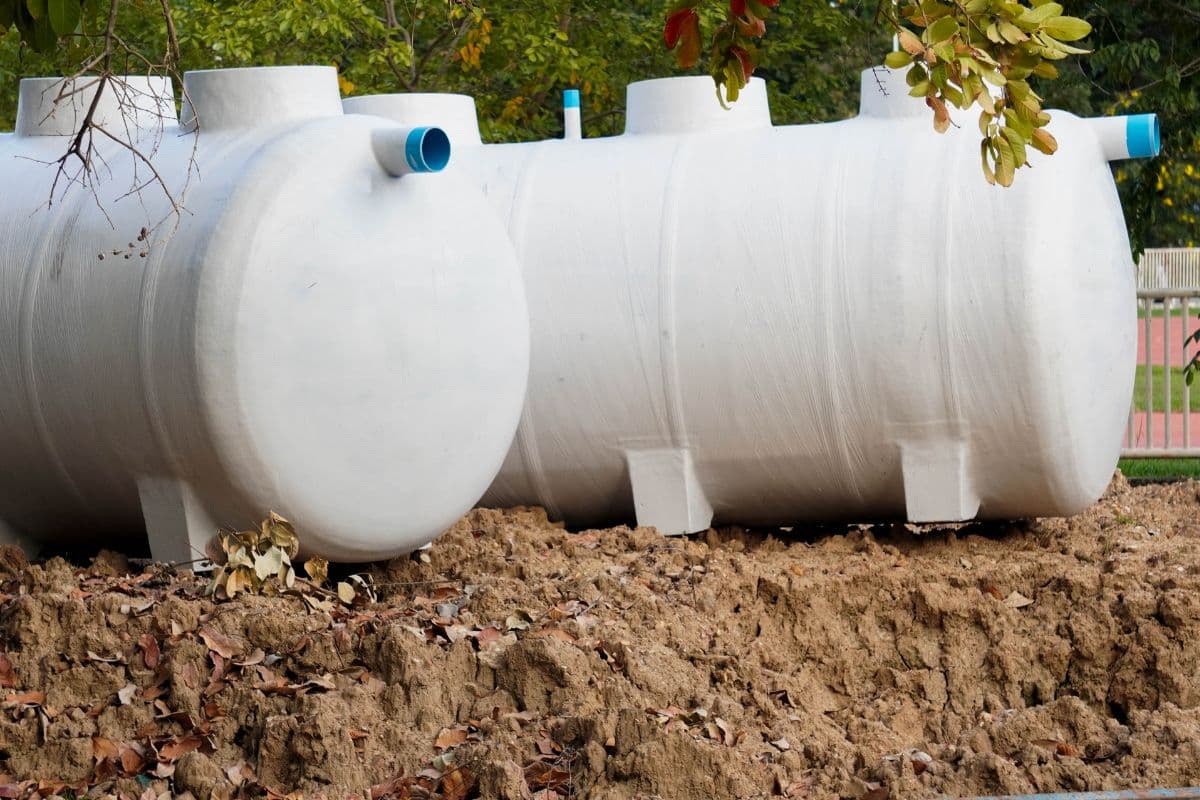
Septic tank size is the liquid capacity of the underground tank that collects and begins treating household wastewater, measured in gallons, and it determines how long wastewater remains in the tank before exiting to the drainfield, how frequently the tank needs to be pumped, and whether the system can handle peak water use events without sending partially settled effluent into the drainfield. Tank size requirements are set by local health department regulations and are calculated primarily from bedroom count rather than the actual number of occupants, because bedrooms represent potential occupancy that the system must be designed to handle regardless of current use. Choosing a tank that is larger than the code minimum costs only a few hundred dollars more at installation but meaningfully reduces pumping frequency, extends drainfield life by improving effluent quality, and provides a buffer for the peak flow events that cause backups in undersized systems. No residential septic tank can be too large, only too small, making the decision of whether to upsize from the minimum one of the highest-return choices available during new installation or replacement.
A 1 to 2-bedroom home needs a 750 to 1,000-gallon tank. A 3-bedroom home needs 1,000 gallons. A 4-bedroom home needs 1,200 to 1,500 gallons. A 5-bedroom home needs 1,500 to 2,500 gallons. This guide explains exactly how septic tank sizing works, what determines the right size for your home, when to go bigger than the minimum, and how tank size affects everything from pumping costs to drainfield longevity.
If you are new to septic systems, start with our complete guide to how septic systems work. To price out a tank-and-system install at the size your home actually needs, try our free septic tank cost calculator.
What Size Tank Do I Need? Find Your Situation
Match your specific situation to the recommended tank size and reasoning:
| Your Situation | Minimum Required | Recommended Size | Why Go Bigger |
|---|---|---|---|
| 1 to 2 bedroom home, 1 to 2 people | 750 to 1,000 gal | 1,000 gal | Most jurisdictions require 1,000 gal minimum regardless |
| 3 bedroom home, 4 or fewer people, no disposal | 1,000 gal | 1,000 gal | Standard minimum is appropriate for this scenario |
| 3 bedroom home, 5 or more people | 1,000 gal | 1,250 gal | Household exceeds the 2-per-bedroom assumption |
| 3 bedroom home, garbage disposal in daily use | 1,000 gal | 1,250 gal | Disposal increases solids load by 30 to 50 percent |
| 4 bedroom home, average household | 1,200 to 1,500 gal | 1,500 gal | Provides buffer for peak flow events and guests |
| 4 bedroom home, garbage disposal or water softener | 1,200 to 1,500 gal | 1,500 gal | Both add significant load above bedroom-count assumption |
| 5 bedroom home | 1,500 gal | 1,500 to 2,000 gal | Size for actual occupancy, not just bedroom minimum |
| 6 or more bedrooms | 2,000 gal | 2,000 to 2,500 gal | Large household with high peak flow potential |
| Planning to add a bedroom or in-law suite | Current minimum | Size for planned configuration | Future expansion will require more capacity anyway |
| Vacation home or Airbnb with variable occupancy | Bedroom minimum | One size up | Occupancy can spike well above assumed average |
| Home with frequent large gatherings | Bedroom minimum | One size up | Peak flow from guests regularly exceeds daily average |
| High water table or slow draining soil | Bedroom minimum | One size up | Drainfield processes effluent slower, more tank buffer helps |
| Mobile home, 2 bedrooms | 750 to 1,000 gal | 1,000 gal | Same rules as site-built, check local code |
| Replacing failed tank, drainfield still functional | Current code minimum | One size up from original | Opportunity to correct undersizing at lower cost than full replacement |
| New construction, budget is flexible | Code minimum | One to two sizes up | Cheapest time to upsize, highest long-term return |
Septic Tank Size by Number of Bedrooms
Building codes in virtually every state use bedroom count, not bathroom count and not the number of people currently living in the home, to determine minimum septic tank size. A 4-bedroom house is sized for 8 people (2 per bedroom) even if only 2 people live there now.
| Bedrooms | Minimum Tank Size | Est. Daily Flow (gal) | Typical For |
|---|---|---|---|
| 1–2 | 750–1,000 gallons | 150–300 | Cabins, small homes, starter homes |
| 3 | 1,000 gallons | 300–450 | Most common residential size in the US |
| 4 | 1,200–1,500 gallons | 450–600 | Standard family homes |
| 5 | 1,500 gallons | 600–750 | Larger homes |
| 6+ | 2,000–2,500 gallons | 750–1,000 | Large homes, multi-family, in-law suites |
Important: Many jurisdictions set 1,000 gallons as the absolute minimum regardless of bedroom count. Even a 1-bedroom home may require a 1,000-gallon tank by local code. Always check with your county health department before sizing a system.
These numbers assume standard water usage of approximately 75 gallons per person per day, which is the figure the EPA uses as a baseline for residential septic planning. The tank must hold at least 2 days of peak daily flow to allow adequate settling time for solids.
How to Calculate Your Actual Tank Size Need
The bedroom table gives you the minimum. Here is how to calculate whether you actually need more.
Estimate daily water use
Multiply the number of people in your household by 75 gallons per day. This is conservative. The actual US average is closer to 80 to 100 gallons per person per day, but 75 is the standard planning figure.
Multiply by 2
Your septic tank should hold at least twice your daily flow. This provides 48 hours of retention time, which is the minimum needed for solids to separate from liquids before effluent reaches the drainfield.
Round up to the nearest standard tank size
Septic tanks come in standard sizes: 750, 1,000, 1,250, 1,500, 2,000, and 2,500 gallons. Always round up, never down.
Example 1
A family of 4 in a 3-bedroom home. Daily flow: 4 × 75 = 300 gallons/day. Minimum tank: 300 × 2 = 600 gallons. Round up to 1,000 gallons. This matches the code minimum for 3 bedrooms.
Example 2
A family of 5 in a 4-bedroom home with a garbage disposal and daily washing machine use. Daily flow: 5 × 75 = 375 gallons, plus ~50% garbage disposal increase ≈ 560 gallons/day. Minimum tank: 560 × 2 = 1,120 gallons. Round up to 1,250 gallons, though 1,500 would provide a better safety margin.
When to Go Bigger Than the Minimum
A septic tank cannot be too big. It can only be too small. An oversized tank costs a few hundred dollars more at installation but provides years of extra capacity and fewer problems.
| Situation | Why You Need a Bigger Tank | How Much Bigger |
|---|---|---|
| Garbage disposal in daily use | Increases solid waste entering the tank by 30–50% | One size up from minimum |
| Home office with frequent visitors | Higher daily water use than bedroom count suggests | One size up |
| Frequent entertaining or large gatherings | Peak flow spikes exceed what the minimum can process | One size up |
| Plans to add a bedroom or in-law suite | Future expansion will increase occupancy and daily flow | Size for planned configuration |
| Hot tub or jetted tub | Large-volume water use events stress the system | One size up |
| Vacation rental or Airbnb | Occupancy fluctuates and can exceed assumptions | Size for max possible occupancy |
| High water table or challenging soil | Drainfield processes effluent slower—more tank retention helps | One size up for buffer |
| Water softener discharging to septic | Adds 50–100 gallons per regeneration cycle | One size up |
The cost difference is small. A 1,000-gallon concrete tank costs approximately $800 to $1,500. A 1,500-gallon concrete tank costs approximately $1,200 to $2,000. The $400 to $500 difference at installation is trivial compared to the $5,000 to $15,000 cost of replacing a failed system that was undersized. For full pricing by material, see our septic system installation cost guide.
Tank size is one of the inputs in our septic tank cost calculator, which estimates new installation costs based on home size, system type, and regional pricing.
Tank Size by Material
Tank size options vary by material. Here is what is available and how material choice intersects with sizing.
| Material | Available Sizes | Cost Range | Lifespan | Notes |
|---|---|---|---|---|
| Concrete | 750–3,000 gal | $800–$2,500 | 40+ years | Most common. Heavy, will not float. Available in largest sizes. |
| Plastic (polyethylene) | 500–1,500 gal | $500–$1,500 | 30–40 years | Lightweight, easy transport. Can shift in saturated soil. |
| Fiberglass | 750–2,000 gal | $1,200–$2,500 | 30–40 years | Lightweight, corrosion-proof. Most expensive per gallon. |
Concrete is the default choice for permanent residential installations. Plastic tanks are popular for smaller installations and sites with difficult access. For a full comparison, see our concrete vs plastic vs fiberglass septic tank guide.
How Tank Size Affects Pumping Frequency
A larger tank fills more slowly, which means you can go longer between pumpings. This is one of the strongest financial arguments for choosing a tank one size larger than the minimum.
| Tank Size | 2 People | 3 People | 4 People | 5 People |
|---|---|---|---|---|
| 750 gal | Every 3–4 yrs | Every 2–3 yrs | Every 1.5–2 yrs | Every 1–1.5 yrs |
| 1,000 gal | Every 4–5 yrs | Every 3–4 yrs | Every 2–3 yrs | Every 2 yrs |
| 1,250 gal | Every 5–6 yrs | Every 4–5 yrs | Every 3–4 yrs | Every 2–3 yrs |
| 1,500 gal | Every 6–8 yrs | Every 5–6 yrs | Every 3–5 yrs | Every 3–4 yrs |
| 2,000 gal | Every 8–10 yrs | Every 6–8 yrs | Every 5–6 yrs | Every 4–5 yrs |
These intervals assume no garbage disposal and standard water usage. A garbage disposal shortens each interval by approximately 30%. See our complete pumping schedule guide for a more detailed table.
The Math
Pumping costs $300 to $600 per visit. A family of 4 with a 1,000-gallon tank pumps every 2 to 3 years and spends $2,000 to $3,600 over 12 years. The same family with a 1,500-gallon tank pumps every 3 to 5 years and spends $1,200 to $2,400. The larger tank saves $600 to $1,200 in pumping costs alone. See our pumping cost guide.
How to Find Out What Size Tank You Have
If you already have a septic system and do not know the tank size, here is how to find out.
Check your property records
The original septic permit filed with your county health department lists the tank size, material, and installation date. Most counties keep these records permanently.
Check the tank itself
Concrete tanks often have the gallon capacity stamped on the lid or on the side near the top. Your pumping technician can read this during the next service visit.
Measure it
If no records exist and no stamp is visible, your septic professional can measure the interior dimensions while the tank is being pumped. Length × width × depth (in feet) × 7.48 = approximate capacity in gallons. A tank that is 8 feet long, 4 feet wide, and 4 feet deep holds approximately 958 gallons—roughly a 1,000-gallon tank.
Ask your pumping company
Experienced pumpers can often estimate tank size based on the volume of septage they remove. If they pump approximately 900 to 1,100 gallons, you have a 1,000-gallon tank.
For more methods, including finding the tank itself, see our guide to locating your septic tank.
Tank Size and System Type
The type of septic system affects how tank size is determined and whether additional tanks or chambers are needed.
Conventional gravity-fed systems
Use a single tank sized by the bedroom table above. This is the simplest configuration and accounts for roughly 70% of residential installations.
Aerobic treatment units (ATUs)
Often have multiple chambers within a single tank or use separate tanks for pre-treatment, aeration, and clarification. Total system volume is typically similar to a conventional system. See our aerobic vs anaerobic comparison.
Pump systems (mound, pressure distribution, sand filter)
Add a pump chamber or dosing tank after the septic tank. The septic tank is sized the same as conventional, but the pump chamber adds another 500 to 1,000 gallons of capacity.
Two-compartment tanks
Required by code in some states. These have an internal baffle dividing the tank into two chambers (typically 2/3 and 1/3 split). Total volume is the same as a single-compartment tank, but the two-chamber design provides better solids settling.
What Happens When a Tank Is Too Small
An undersized septic tank creates a cascade of problems, all of which cost more to fix than choosing a properly sized tank in the first place.
Solids escape to the drainfield
When the tank is too small, wastewater does not have enough retention time for solids to settle. Suspended solids flow into the drainfield, clogging pipes and soil pores. Once clogged, a drainfield cannot be unclogged. Replacement costs $5,000 to $15,000.
Frequent pumping
A tank that is too small fills to critical sludge levels faster, requiring pumping every 1 to 2 years instead of every 3 to 5 years. Each visit costs $300 to $600.
Backups during peak use
An undersized tank cannot handle the flow from a full house. Holiday gatherings, house guests, and simultaneous shower and laundry use push the system past capacity, causing slow drains or sewage backups.
Permit problems at resale
When you sell the home, the septic inspection may reveal that the tank is undersized for the bedroom count. This can stall a sale or require a costly system upgrade. See our guide on buying a home with a septic system.
Frequently Asked Questions
What size septic tank do I need for a 3-bedroom house?+
What size septic tank do I need for a 4-bedroom house?+
Can a septic tank be too big?+
What is the minimum septic tank size allowed?+
How do I know what size septic tank I have?+
Does adding a bedroom require a bigger septic tank?+
What size septic tank do I need for a mobile home?+
Does a garbage disposal affect what size tank I need?+
Glossary
Daily Flow
Daily flow is the estimated volume of wastewater a household produces per day measured in gallons per day, calculated by multiplying the number of occupants by the standard planning figure of 75 gallons per person per day, and it is the foundation for determining the minimum tank size needed to provide adequate retention time for solids to settle before effluent reaches the drainfield. The actual US average is closer to 80 to 100 gallons per person per day, meaning the 75-gallon planning figure is already conservative, which is one reason choosing a tank one size above the code minimum is a sound decision for most households. See also: How Often Should You Pump Your Septic Tank? and Septic System Installation Cost 2026.
Retention Time
Retention time is the number of hours wastewater spends inside the septic tank before exiting through the outlet pipe to the drainfield, and the minimum standard of 24 hours is required for basic solids settling while 48 hours is the preferred design target that the two-times-daily-flow sizing rule is based on. A tank that is undersized relative to household water use produces effluent with higher suspended solids because inadequate retention time prevents complete settling, and those solids entering the drainfield are the primary cause of premature biomat accumulation and drainfield failure. See also: Signs Your Drainfield Is Failing and How Long Does a Septic System Last?.
Perc Test (Percolation Test)
A perc test is a soil evaluation conducted at the proposed drainfield location that measures how quickly water drains through the soil, and its results affect tank sizing indirectly by determining what type of drainfield system is permitted and how large the drainfield area must be to handle the household's daily flow. Properties with slow percolation rates require larger drainfields and in some cases more complex system types, and a tank that is undersized relative to the daily flow makes the drainfield's job harder by sending effluent with higher suspended solids and less settling. See also: Septic System Installation Cost 2026 and Drainfield Replacement Cost.
Two-Compartment Tank
A two-compartment tank is a septic tank with an internal dividing baffle that creates two separate chambers, typically in a two-thirds and one-third split, where the first chamber handles initial solids settling and the second provides additional clarification before effluent exits to the drainfield. Required by code in some states and increasingly specified in new installations because research shows the two-chamber design produces cleaner effluent with fewer suspended solids than a single-compartment tank of the same total volume, which directly extends drainfield lifespan. See also: Complete Septic System Guide and Septic Tank Cleaning vs Pumping.
Fixture Unit Count
A fixture unit count is an alternative sizing method used when the number of water-using fixtures in a home exceeds what the bedroom count alone would suggest, assigning a standardized flow value to each fixture type and using the total to calculate the required tank size independently of the bedroom-based calculation, with the higher of the two methods determining the minimum permitted size. This method is particularly relevant for homes with multiple full bathrooms, wet bars, large laundry rooms, or commercial-grade kitchen equipment that generates water use well above the 75-gallons-per-bedroom assumption. See also: Septic System Installation Cost 2026.
Gallons Per Day (GPD)
Gallons per day is the standard unit of measurement for daily wastewater flow used in septic system design, calculated by multiplying the number of assumed occupants by the per-person daily water use figure of 75 gallons, and it is the basis for every tank sizing calculation and drainfield sizing calculation in residential septic planning. Understanding your household's actual GPD relative to your tank's capacity helps you evaluate whether your current system is appropriately sized and whether your pumping interval is correct given your actual water use patterns. See also: How Often Should You Pump Your Septic Tank? and Septic System Maintenance Checklist.
Standard Tank Sizes
Standard tank sizes are the common manufactured septic tank capacities available from most suppliers, typically 750, 1,000, 1,250, 1,500, 2,000, and 2,500 gallons, and sizing calculations should always round up to the next standard size rather than down to avoid creating an undersized system. Custom sizes outside this range are available but cost significantly more than standard sizes and offer no functional advantage for residential installations that fall within the standard range. See also: Concrete vs Plastic vs Fiberglass Septic Tanks and Septic System Installation Cost 2026.
Hydraulic Overload
Hydraulic overload occurs in a septic system when more wastewater enters the tank and drainfield than the system can process and discharge in a given time period, and an undersized tank contributes directly to overload by failing to provide adequate retention time during peak flow events such as holiday gatherings, simultaneous shower and laundry use, or multiple guests. Chronic hydraulic overload from an undersized tank sends partially settled effluent with elevated suspended solids to the drainfield, accelerating biomat accumulation and shortening drainfield life significantly compared to a properly sized system handling the same daily flow. See also: Slow Drains on a Septic System and Septic Dos and Don'ts.
Related Guides
On theseptic.guide
How Often Should You Pump Your Septic Tank?
The pumping schedule by tank size and household size, showing exactly how choosing a larger tank directly extends your service interval and reduces lifetime pumping costs.
Septic Tank Pumping Cost 2026
What pump-outs cost by tank size and region, and the math on how a larger tank pays for itself through reduced pumping frequency over the system's life.
Septic System Installation Cost 2026
Full cost breakdown for new installations by system type and tank material, including what upsizing from the minimum actually costs at installation.
Concrete vs Plastic vs Fiberglass Septic Tanks
A full comparison of the three tank materials available in standard sizes, covering lifespan, cost, installation conditions, and which is right for your property.
How Long Does a Septic System Last?
How tank size affects drainfield lifespan by determining effluent quality, and the full component-by-component lifespan breakdown.
Signs Your Drainfield Is Failing
What happens when a tank is undersized and sends partially settled effluent to the drainfield over years of inadequate retention time.
Drainfield Replacement Cost
The $5,000 to $15,000 consequence of chronic undersizing, priced out by system type and site conditions.
How to Find Your Septic Tank
How to locate and access your tank to confirm its size if you do not have property records available.
Aerobic vs Anaerobic Septic Systems
How tank sizing works differently for aerobic treatment units that use multiple chambers versus conventional gravity-fed single or two-compartment tanks.
Buying a Home with a Septic System
How to confirm that the existing tank is correctly sized for the bedroom count before closing, and what undersizing means for your negotiating position.
Garbage Disposal and Septic Systems
The full impact of garbage disposal use on tank sizing, pumping frequency, and drainfield health for homeowners deciding whether to use or remove their disposal.
Septic System Maintenance Checklist
The ongoing maintenance schedule that keeps any tank size functioning at its best, including pumping intervals, filter cleaning, and inspection timing.
Slow Drains on a Septic System
How an undersized tank contributes to the whole-house slow drains and backups that occur during peak flow events like holiday gatherings and house guests.
From Our Network
Best Sump Pumps 2026
For homes where basement sump pump discharge is currently routing to the septic system and adding to the hydraulic load, this guide covers how to choose and properly route a sump pump to protect the septic tank and drainfield.
Sump Pump Design Ideas for 2026
How to route basement drainage equipment away from the septic system, relevant for homeowners whose water softener or sump pump discharge is currently adding unnecessary volume to the tank.
External Resource
Need Help Sizing Your Septic System?
Connect with certified septic professionals in your area for system design, installation, and sizing consultations.
Get Free QuotesGet Expert Septic Help
Connect with qualified septic professionals in your area. Free quotes, no obligation.