If your home is not connected to a municipal sewer line, something is buried in your yard handling every flush, every load of laundry, and every drop that goes down your drains. Most homeowners assume they have a septic system. A surprising number are wrong.
Hundreds of thousands of homes across the United States still rely on cesspools: a far older and more primitive technology that provides zero treatment of household wastewater, carries serious environmental and health risks, and has been illegal to install anywhere in the country for decades. In Hawaii alone, approximately 88,000 cesspools collectively discharge an estimated 53 million gallons of raw sewage into the ground every single day. Suffolk County, New York, has roughly 250,000 of them.
Understanding which system you have, how each one actually works, and what the legal and practical differences mean for your wallet, your health, and your ability to sell your home is foundational to owning property on a private wastewater system. This guide covers all of it.
What a Septic System Is and How It Works
A septic system is an underground wastewater treatment system with two main components working in sequence: a septic tank and a drainfield.
Wastewater from your house flows into the septic tank, a sealed, watertight chamber typically made of concrete, fiberglass, or polyethylene. Inside the tank, solids settle to the bottom as sludge, fats and grease float to the top as scum, and anaerobic bacteria partially digest organic material. The clarified liquid in the middle zone, called effluent, exits through the outlet pipe and flows to the drainfield.
The drainfield is a network of perforated pipes or chambers buried in gravel-filled trenches, spread across a large area of soil. As effluent percolates through the gravel and into the surrounding soil, naturally occurring bacteria, physical filtration, and chemical processes remove remaining pathogens, nitrogen, phosphorus, and organic matter before the treated water reaches groundwater.
The two-stage design is the critical distinction. The tank performs primary treatment by separating solids from liquids and allowing bacterial digestion. The drainfield performs secondary treatment by distributing partially treated effluent across a large soil area for natural filtration. Neither component works properly without the other, and both are designed to work within specific capacity limits.
What a Cesspool Is and How It Works
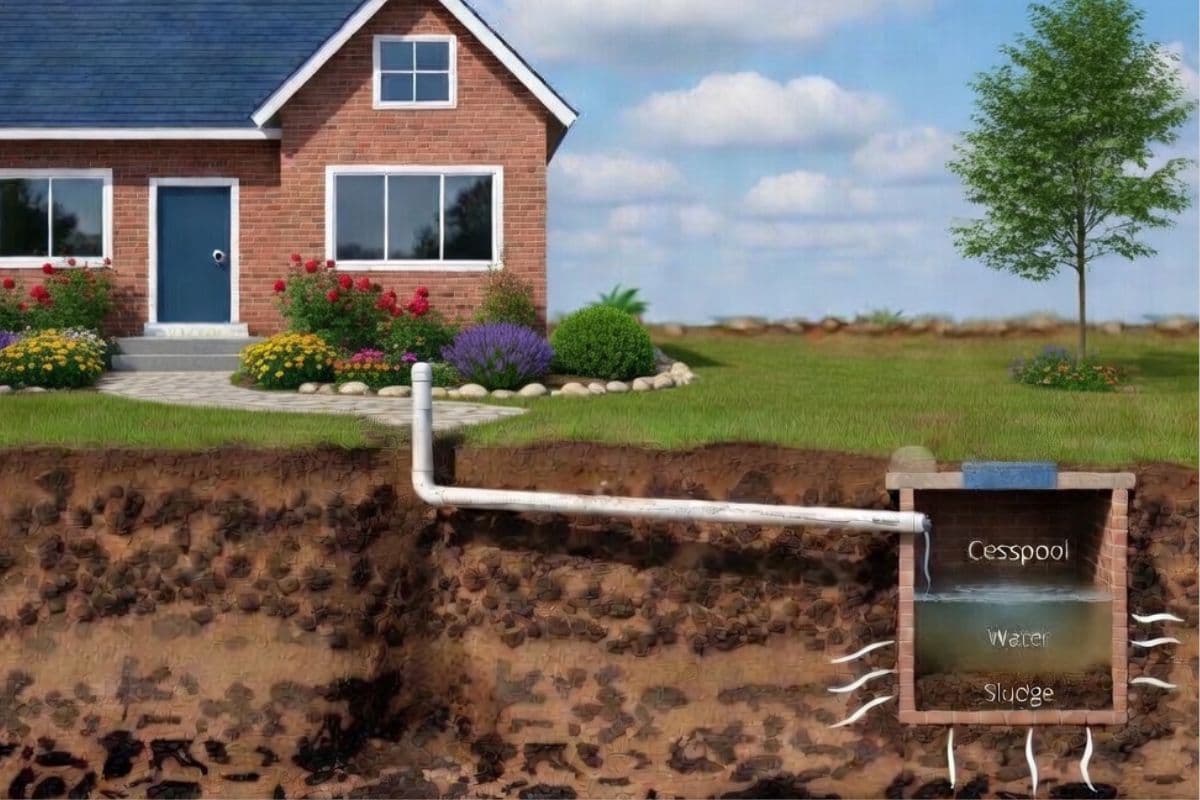
A cesspool is a far simpler and older design. It is a single underground pit, typically constructed from stacked concrete rings, brick, or stone, with perforated walls and an open or gravel-filled bottom. There is no sealed tank, no outlet pipe, and no drainfield.
All household wastewater, including toilet waste, sink water, laundry water, and everything else, flows directly into this pit. Liquids seep out through the perforated walls and the open bottom into the surrounding soil. Solids accumulate at the bottom until pumped out.
There is no treatment stage. Raw, untreated sewage contacts the surrounding soil directly. The soil immediately adjacent to the cesspool is the only barrier between your household waste and the groundwater.
The Single Most Important Distinction
A septic system treats wastewater while a cesspool merely collects it temporarily until it overflows or is pumped.
A properly functioning septic system's drainfield delivers effluent that has already been partially treated in the tank into a large soil filtration area where further biological and chemical treatment occurs before the water reaches groundwater. The EPA notes that a well-maintained septic system can actually help replenish groundwater supplies with treated water.
A cesspool delivers raw, untreated sewage directly into the soil immediately surrounding the pit with no distribution area and no design standard ensuring adequate filtration distance from groundwater. The concentrated discharge of raw waste into a small soil area overwhelms its natural filtration capacity.
According to the EPA, fluids seeping from large-capacity cesspools can exceed drinking water maximum contaminant levels for nitrates, total suspended solids, and coliform bacteria, and may contain phosphates, chlorides, grease, viruses, and chemical contaminants. These same risks apply at smaller scale to single-family residential cesspools.
Side-by-Side Comparison
| Feature | Cesspool | Septic System |
|---|---|---|
| Basic design | Perforated pit, open bottom | Sealed tank plus separate drainfield |
| Wastewater treatment | None | Partial in tank, further filtration in drainfield soil |
| Solids handling | Settle in pit, pump every 1–2 years | Contained in sealed tank, pump every 3–5 years |
| Effluent discharge | Raw sewage seeps into surrounding soil | Partially treated effluent distributed across drainfield |
| Groundwater contamination risk | High | Low when properly maintained |
| Nitrogen removal | None | Minimal (conventional) to 90%+ (advanced I/A systems) |
| New construction legal status | Illegal in all 50 states | Standard for off-sewer properties |
| Annual maintenance cost | $2,300 to $4,350 | $95 to $180 |
| Installation cost | $6,500 to $8,000 | $7,300 to $22,500+ |
| Lifespan | 10 to 40 years | 25 to 40+ years properly maintained |
| Structural collapse risk | Real, especially in older systems | Minimal |
| Real estate sale implications | Mandatory upgrade in many states | Inspection typically required |
| Mortgage impact | May cause lender complications | Generally straightforward |
How to Tell Which System You Have
Many homeowners genuinely do not know whether they have a cesspool or a septic system. Here are reliable ways to find out.
Check your county health department records. When any on-site wastewater system was installed, it should have been permitted. Your county health department maintains records indexed by property address and tax parcel ID. A phone call with your address typically reveals what was installed, when, and in some cases the original design drawing. See our guide to finding your septic tank for how to locate and access these records.
Look at your property age. Homes built before the mid-1970s in areas without municipal sewer were almost certainly built with cesspools. This does not mean the property still has a cesspool, as many have been upgraded, but it is a strong flag worth investigating.
Walk your yard looking for the physical layout. A septic system has a tank with two access points (inlet side and outlet side) and a separate drainfield area, usually visible as a slightly elevated or slightly different-looking section of yard at some distance from the tank. If you can find the access point but see no evidence of a separate drainfield, you likely have a cesspool. A single concrete ring or lid with no secondary dispersal area is the clearest physical indicator.
Look for the number of access points. A septic tank typically has two risers or buried lids. A cesspool typically has one. Multi-ring Long Island cesspool systems may have multiple access points, but they connect to overflow rings, not a true drainfield.
Review your closing documents. Documentation from when you purchased the property should include any permits and inspection reports. If you find a permit referencing a single-chamber pit with no drainfield, you have a cesspool.
Have a professional inspection performed. A licensed septic inspector can open the access point, assess the interior, probe for a drainfield, and tell you definitively what type of system is in place. This is the most reliable method and is worth doing before purchasing any older home in an area without municipal sewer. See our septic inspection guide for what a proper inspection covers.
Where Cesspools Are Still Found
Cesspools are concentrated in specific regions and property types.
Long Island, New York has the largest known concentration of residential cesspools in the country. Approximately 75 percent of Suffolk County is unsewered, with roughly 360,000 on-site systems, of which an estimated 250,000 are cesspools. New York banned new cesspool construction in 1973, and after July 1, 2019, any cesspool requiring replacement must be upgraded to a compliant system rather than replaced with a new cesspool.
Hawaii has approximately 88,000 active cesspools. Groundwater provides 99 percent of Hawaii's domestic water supply, making cesspool contamination a uniquely acute public health problem. Hawaii passed Act 125 in 2017 requiring all cesspools to be converted or connected to sewer by 2050. The EPA has ordered the closure of more than 3,900 large-capacity cesspools and assessed approximately $5.6 million in penalties since the 2005 closure deadline.
Rhode Island passed the Cesspool Act of 2007, which mandates that all cesspools in the state be replaced over time. Cesspools within 200 feet of water bodies, shorelines, or drinking water supply intakes had to be converted by January 1, 2014. All others must be converted within one year of any property sale closing on or after January 1, 2016.
Connecticut, Massachusetts, and New Jersey all have significant numbers of older homes with cesspools. Massachusetts Title 5 regulations require cesspools exhibiting hydraulic failure, located too close to water supplies, or posing an environmental threat to be upgraded. Many New Jersey counties require cesspool certification or conversion as a condition of property sale.
Rural areas nationally occasionally have cesspools on very old properties, particularly those predating local permitting requirements and in states with historically limited code enforcement. If your home is pre-1960 and in a rural area, it is worth verifying what type of system you have.
State-by-State Cesspool Regulations at a Glance
| State | Key Rule |
|---|---|
| New York | No new cesspool construction since 1973. No cesspool replacements with new cesspools after July 1, 2019. Many counties require inspection and may require upgrade at point of sale. |
| Hawaii | All cesspools must be converted by 2050 (Act 125, 2017). Large-capacity cesspools banned and required to close by 2005. |
| Rhode Island | All cesspools must be converted; within 200 feet of water bodies by 2014, all others within one year of property sale (closing after Jan 1, 2016). |
| New Jersey | Many counties require cesspool certification before sale. Failed systems must be upgraded. |
| Massachusetts | Cesspools failing inspection, near water supplies, or posing environmental threat must be upgraded under Title 5. |
| Connecticut | New cesspool construction prohibited. Existing cesspools regulated by local health departments with conversion required in many circumstances. |
| All other states | New cesspool construction prohibited. Existing cesspools subject to local and state health department rules. Consult your county health department for specific requirements. |
The Real Cost Difference Over Time
Cesspools appear cheaper upfront. Installing a cesspool costs approximately $6,500 to $8,000, compared to $7,300 for a basic septic system and up to $22,500 or more for larger or advanced systems. But the installation price tells a deeply misleading story.
A septic system needs pumping every three to five years at $300 to $700 per service. Annual maintenance cost: roughly $95 to $180.
A cesspool needs pumping every six weeks to several months for a heavily used system, because it receives everything, solids, liquids, and grease, in a single chamber that must rely entirely on adjacent soil absorption for drainage. That soil saturates far faster than a properly designed drainfield distributed across a large area. According to Bob Vila, while a septic system costs an average of $95 to $180 per year to pump, a cesspool can cost between $2,300 and $4,350 per year in pumping costs alone.
Over a decade, the maintenance cost difference between a cesspool and a septic system is roughly $21,000 to $42,000. Over the life of a property, the septic system is far less expensive to own despite its higher installation cost, and that does not include the cost of cesspool replacement when the surrounding soil eventually reaches permanent saturation, which typically occurs within 10 to 30 years depending on usage and soil conditions.
Environmental and Public Health Consequences
A cesspool does not just affect the property it sits on. Untreated sewage seeping into groundwater moves with the water table and can travel significant distances, contaminating wells, reaching streams and lakes, and degrading coastal waters.
Hawaii illustrates the scale of this problem starkly. The state's 88,000 cesspools together discharge an estimated 53 million gallons of raw sewage into the ground daily, threatening drinking water supplies, coral reefs, fisheries, and recreational coastal waters across the islands.
On Long Island, the Nature Conservancy has documented that conventional cesspools and septic systems are not designed to prevent reactive nitrogen from entering groundwater aquifers. Nitrogen from human waste converts to nitrate as it moves through soil and travels through groundwater until it reaches surface waters or drinking water wells. Suffolk County has elevated nitrate levels in portions of its drinking water, and research has linked these elevated levels to increased rates of certain cancers in affected communities.
The EPA identifies disease-causing pathogens and nitrates as the most serious documented problems from failing on-site systems. For homes with both a cesspool and a private well, the CDC recommends annual testing of well water for total coliform bacteria, nitrates, and pH. See our guide to buying a home with a septic system for how well and system proximity is evaluated during real estate due diligence.
The Structural Safety Risk
Old cesspools can collapse, and when they do, the consequences are severe. This is a dimension of cesspool ownership that most comparison articles skip entirely.
The pit structure, typically built from stacked concrete rings, brick, or stone mortar, degrades over decades. In cold climates, water seeps into micro-cracks, freezes, expands, and widens the damage year after year. Root intrusion through deteriorating joints accelerates structural failure. Cesspools are most vulnerable to collapse when they are empty, because there is no liquid pressure against the walls from inside. Rainy weather and fast thaws add external hydrostatic pressure from saturated soil.
When an old cesspool collapses, it creates a sewage-filled sinkhole that can open suddenly and without visible warning. In May 2017, a cesspool in Huntington, Long Island, collapsed while workers were adding an overflow ring, creating a sinkhole that buried 59-year-old Edward Sinnott under 15 feet of dirt and mud. Emergency responders worked for six hours before recovering his body. Wikipedia documents six separate cesspool collapse incidents in Suffolk County since 1998, resulting in two additional deaths and multiple serious injuries.
This structural risk does not exist in a properly constructed modern septic tank, which is a sealed, engineered container designed to maintain integrity for decades.
If You Have a Cesspool: Maintaining It in the Short Term
If your cesspool is functioning and you are not yet in a position to convert, here is how to extend its life and reduce the risk of early failure.
Pump on schedule. Most residential cesspools should be pumped every one to two years depending on household size and water use. Do not wait for symptoms. By the time you notice slow drains or odors, you are already behind.
Conserve water aggressively. Every gallon entering the cesspool is a gallon the surrounding soil must absorb. Fix leaky faucets and running toilets immediately. A running toilet can add 200 or more gallons per day to your cesspool. Spread laundry loads throughout the week rather than doing them all at once. Install low-flow showerheads and faucet aerators. The less water your household sends into the cesspool, the longer the surrounding soil retains its absorption capacity.
Never use a garbage disposal. Garbage disposal use dramatically increases the volume of solids entering the cesspool and accelerates both pumping frequency and soil saturation. If you have one, stop using it.
Keep the three Ps rule strictly. Only pee, poop, and toilet paper should enter the cesspool. Paper towels, wipes marketed as flushable, feminine hygiene products, diapers, dental floss, and anything else non-biodegradable accumulates as solid waste and does not break down. Every non-biodegradable item flushed compresses the time before the cesspool needs pumping.
Keep cooking grease out of drains. Grease solidifies as it cools, coats the perforated walls and open bottom of the cesspool, and blocks the absorption mechanism. Collect cooking grease in a container and dispose of it in the trash.
Avoid harsh chemical drain cleaners. Strong chemicals can kill the beneficial bacteria in the cesspool that help break down organic matter, speeding accumulation of solids.
Keep vehicles and heavy equipment off the cesspool area. The weight can crack the concrete rings or collapse the pit structure. Mark the location so contractors and landscapers know where it is.
Keep deep-rooted trees and shrubs away. Root intrusion through deteriorating joints is a leading cause of structural damage. The cesspool location should be in an area of lawn, not near mature trees.
Have the structure assessed every few years. Ask your service provider to assess the structural integrity of the walls and lid when they pump. Early detection of cracking or deterioration allows repair before catastrophic failure. Cesspool lid replacement and crack sealing are manageable repair costs. Complete structural collapse is not.
Converting a Cesspool to a Septic System: What Actually Happens
Conversion is not simply removing the cesspool and dropping in a septic tank. Understanding what is involved helps homeowners plan realistically.
Site evaluation and permitting. Before any work begins, a licensed engineer or soil scientist evaluates the property. They assess soil type, percolation rate, depth to groundwater, available area, and setback distances from the well, house, property lines, and water features. A perc test is typically required. The engineer produces a system design, which is submitted to the county health department for a permit. This phase alone can take four to eight weeks. See our septic permit guide for a full walkthrough of the permitting process.
Excavation. The installation requires significant excavation. The old cesspool pit must be pumped out and either decommissioned in place (filled with clean fill) or removed. Excavation for the new septic tank and drainfield trenches typically disrupts a large portion of the yard, sometimes covering hundreds or thousands of square feet depending on the drainfield design.
System installation. A new septic tank, typically concrete, fiberglass, or plastic, is set in the excavation and connected to the home's plumbing. The drainfield trenches are excavated, lined with gravel, and perforated pipes are laid. The system is then backfilled.
Inspection and final approval. Most jurisdictions require inspection at one or more stages before backfilling. After final inspection passes, the health department issues a certificate of compliance. The yard is restored with topsoil and seeding or sod.
Timeline and disruption. From permit application to finished installation, a standard residential conversion typically takes six to twelve weeks. The actual excavation and installation work usually spans two to five days. Expect the yard to be significantly disrupted during and after the work, with full turf restoration taking weeks to months.
Conversion costs vary significantly by location, site conditions, and required system type. In most areas, a standard conversion runs $8,000 to $15,000. On Long Island, where advanced nitrogen-reducing I/A OWTS systems are now required and labor and permitting costs are high, the typical cost is $15,000 to $25,000. Some areas offer financial assistance. See our septic financial assistance guide for programs that may offset conversion costs.
Cesspools, Mortgages, and Real Estate
This is one of the most practically important dimensions of cesspool ownership and one of the least covered topics online.
Can you get a mortgage on a home with a cesspool?
The short answer is that it depends on the loan type, the lender, and whether the cesspool is legally permitted and functioning in the local jurisdiction.
FHA does not have a specific written rule prohibiting mortgages on properties with cesspools. FHA's catch-all guideline states that any individual sewage system that is acceptable to the local health department is also acceptable to FHA. If the local health department permits the existing cesspool to remain in service, FHA will generally allow it. However, individual lenders and investors within the FHA program may have overlays, meaning stricter internal policies, that prohibit loans on cesspool properties regardless of FHA's baseline rules. Always confirm with the specific lender, not just FHA guidelines.
Conventional loans backed by Fannie Mae or Freddie Mac are generally the most flexible for on-site wastewater systems, requiring inspections only if an appraiser identifies concerns. A functioning cesspool that is locally permitted will typically not prevent conventional financing on its own.
USDA loans have some of the most stringent requirements for on-site systems and may require documentation that the system meets local standards.
The practical complication arises in states and counties where the cesspool requires conversion at or shortly after point of sale. If the cesspool must be upgraded as a condition of the transaction or within one year of closing, lenders and buyers must factor that cost into the transaction. Some lenders will escrow funds for the conversion. Others will require it to be completed before closing. Still others may withdraw from the transaction entirely if the upgrade cost makes the property's condition difficult to underwrite. A buyer using FHA financing in Rhode Island, for example, where conversion is required within one year of any sale closing after January 1, 2016, needs to understand that commitment before making an offer.
The clearest practical advice: before making any offer on a property with a cesspool, determine whether local regulations require conversion at or after sale, get a written conversion cost estimate from a licensed contractor, and confirm with your specific lender whether they will finance the property with the cesspool in its current condition.
Cesspools and Selling Your Home
For sellers, a cesspool creates disclosure obligations and potentially significant transaction complications.
All states require disclosure of known material defects. A cesspool that is failing, in a state requiring conversion at point of sale, or in a location where it is creating groundwater contamination is a material defect that must be disclosed.
In states where conversion is required on sale, such as Rhode Island, the negotiation centers on who pays for the upgrade and whether it happens before or after closing. Neither party is legally required to pay; the law specifies only that it must happen within one year of the closing date. In practice, most transactions either require the seller to complete the conversion before closing, or the buyer accepts the obligation with a price reduction equivalent to or greater than the estimated conversion cost.
For sellers who have the time to plan, completing the conversion before listing is almost always the better financial outcome. A home marketed with a modern compliant septic system sells more cleanly, qualifies for a wider pool of buyers and loan types, and avoids the price concession pressure that comes with a buyer discovering a cesspool during due diligence. See our guide to selling a home with a septic system for how these transactions play out.
Frequently Asked Questions
What is the main difference between a cesspool and a septic system?
How do I know if I have a cesspool or a septic system?
Are cesspools still legal?
Why do cesspools need to be pumped so much more often than septic tanks?
Can a cesspool contaminate my drinking water well?
How much does it cost to convert a cesspool to a septic system?
What happens if I buy a house with a cesspool?
Can you get a mortgage on a house with a cesspool?
Is a cesspool dangerous?
What does a cesspool smell like compared to a septic system?
Glossary
Cesspool
A cesspool is an underground pit designed to collect household wastewater by allowing the liquid portion to seep directly into surrounding soil through perforated walls and an open bottom, while solids accumulate at the bottom until pumped out. Cesspools provide no treatment of wastewater before it enters the soil. They were standard on-site wastewater systems for homes built before the 1970s in areas without municipal sewer. New cesspool construction has been prohibited across all 50 states for decades due to the contamination risks they pose to groundwater and public health. The term is sometimes used interchangeably with cesspit, though in British usage these terms have distinct meanings.
Cesspit
In American usage, cesspit and cesspool are effectively interchangeable terms referring to the same perforated pit design that allows liquid seepage into surrounding soil. In British English, a cesspit specifically refers to a sealed holding tank that stores waste without any seepage, requiring frequent emptying. Homeowners in the United States encountering either term in property records can treat them as describing the same type of system: a single-chamber pit providing no wastewater treatment.
Leaching Pool
A leaching pool is a term used primarily in Long Island and the Northeast to describe a cesspool or a component of a cesspool system designed to allow effluent to leach into surrounding soil. Many older Long Island properties have a primary cesspool connected to one or more overflow leaching pools or rings that receive overflow when the primary pool fills. This multi-ring arrangement is often mistaken for a septic system with a drainfield, but it is not. The liquid passing through leaching pools is still raw, untreated sewage, not the partially treated effluent that a septic tank produces. A true septic drainfield receives only the clarified effluent that exits the sealed tank through the outlet baffle.
Large-Capacity Cesspool
A large-capacity cesspool is defined by the EPA as a cesspool serving multiple residential units, such as an apartment building or duplex, or a non-residential facility capable of serving 20 or more persons per day. Large-capacity cesspools were banned nationwide by the EPA in December 1999 under the Safe Drinking Water Act, with all existing ones required to close by April 5, 2005. The EPA has been actively enforcing this ban, ordering the closure of more than 3,900 large-capacity cesspools in Hawaii and assessing approximately $5.6 million in penalties since 2005. Single-family residential cesspools serving only one household are not large-capacity cesspools under the federal definition.
Innovative/Alternative Onsite Wastewater Treatment System (I/A OWTS)
An innovative or alternative onsite wastewater treatment system, abbreviated I/A OWTS, is an advanced septic system providing a higher level of treatment than a conventional system, with particular emphasis on nitrogen removal. These systems are increasingly required on Long Island and in other nitrogen-sensitive coastal areas as replacements for both failing cesspools and conventional septic systems. I/A OWTS systems can remove up to 90 percent of the nitrogen that conventional systems allow to pass into groundwater. New York's Nassau County SEPTIC program requires I/A OWTS installation for all cesspool replacements and provides grants of up to $20,000 to offset the higher cost of these advanced systems.
Drainfield
A drainfield, also called a leach field or soil absorption system, is the network of perforated pipes or chambers buried in gravel-filled trenches that receives septic tank effluent and distributes it across a large area of soil for final treatment and dispersal. The drainfield is a defining component of a septic system that has no equivalent in a cesspool. Its purpose is to distribute liquid across a broad soil area where biological, physical, and chemical processes remove remaining pathogens and contaminants before the water reaches groundwater. The absence of a drainfield is the clearest distinguishing characteristic of a cesspool: it is the structural difference that explains why a cesspool discharges raw waste into a concentrated area while a septic system distributes partially treated effluent across a managed filtration zone.
Nitrate Contamination
Nitrate contamination in this context refers to elevated nitrate levels in groundwater resulting from the passage of untreated or undertreated wastewater through soil near a cesspool or failing septic system. Nitrogen from human waste and urine converts to nitrate as it moves through soil, and nitrate travels easily through groundwater without being filtered. Unlike many contaminants attenuated by soil, nitrate can travel significant distances from its source and persist in groundwater for years. At high concentrations it poses health risks including methemoglobinemia in infants, and long-term exposure through drinking water has been associated with elevated cancer risks. In Long Island communities with high cesspool density, elevated groundwater nitrate has been linked to increased rates of certain cancers in affected populations.
Related Guides
Continue learning about septic systems and wastewater system comparisons.
Complete Septic System Guide
How the entire septic system works, the role of each component, and what every homeowner needs to know.
How to Find Your Septic Tank
How to locate your septic tank or cesspool, access county records, and identify what type of system you have.
Septic System Inspection Guide
What a proper inspection covers and why it is critical before buying any property with an on-site wastewater system.
Septic System Permit Guide
The permitting process for new septic systems, relevant when converting a cesspool to a compliant system.
Septic System Installation Cost
Full price breakdown for new septic system installation by type and region.
Septic System Financial Assistance
Federal grants, state programs, and low-interest loans that can offset cesspool-to-septic conversion costs.
Buying a Home with a Septic System
How to evaluate a septic or cesspool property before closing, including well proximity and system condition.
Selling a Home with a Septic System
How cesspool disclosure, conversion requirements, and system condition affect your sale.
Aerobic vs. Anaerobic Septic Systems
How aerobic treatment units compare to conventional anaerobic systems in treatment quality, cost, and maintenance.
Concrete vs. Plastic vs. Fiberglass Septic Tanks
Tank material comparison relevant when choosing a system for cesspool replacement.
What Happens If You Never Pump Your Septic Tank
The timeline of neglect from year one through system failure, relevant for both cesspool and septic system owners.
Need Help with Your System?
Whether you need a cesspool inspection, conversion estimate, or septic system service, connect with licensed professionals in your area.
Get Free QuotesGet Expert Septic Help
Connect with qualified septic professionals in your area. Free quotes, no obligation.