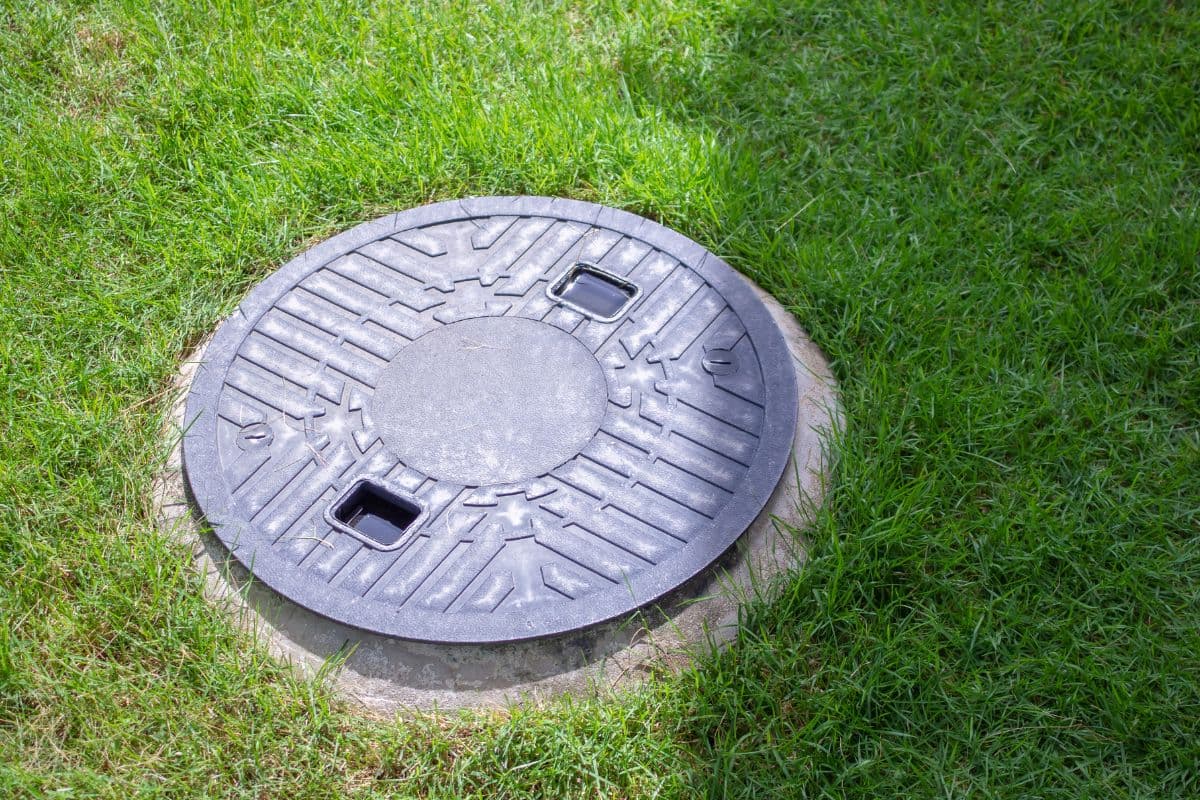
Finding a septic tank is the process of locating the buried concrete, plastic, or fiberglass tank on a residential property that collects and begins treating household wastewater, along with its access lids, the distribution box, and the drainfield boundaries — all of which are underground and invisible without records or a systematic search. Most homeowners need to find their septic tank before scheduling a pump-out, after purchasing a home with no maintenance records, when a septic problem develops and the system components need to be inspected, or when planning landscaping or construction projects near the system. The fastest and most reliable method is checking property records and the as-built drawing filed with the local health department, which gives the exact location with measurements in five minutes. When no records exist, following the sewer line from where it exits the house foundation and probing the soil with a metal rod every two feet is the next most reliable hands-on approach.
Your septic tank is buried 5 to 25 feet from your house, typically 6 inches to 4 feet underground. The fastest way to find it is to check your property records or call your local health department for the as-built drawing.
If no records exist, follow the sewer line from where it exits your house and probe the soil every 2 feet until you hit a flat, hard surface.
Here are five methods, ranked from easiest to most effort. Most homeowners find their tank using the first or second method.
Which Method Should I Use?
Match your situation to the fastest and most reliable starting point:
| Your Situation | Best Starting Method | Time Required | Cost |
|---|---|---|---|
| Just bought a home, have inspection report | Method 1 — Check records | 5 minutes | Free |
| New homeowner, no inspection report | Method 1 — Call county health department | 15 minutes | Free |
| Have rough idea where tank is, want to confirm | Method 2 — Follow sewer line and probe | 15 to 30 minutes | $15 to $30 for probe |
| No idea where tank is, no records available | Method 2 — Follow sewer line from house | 15 to 30 minutes | $15 to $30 for probe |
| Yard has obvious visual clues (green grass, depression) | Method 3 — Visual inspection first | 10 minutes | Free |
| Concrete tank installed before 1990 | Method 4 — Metal detector | 30 minutes | $0 if borrowed, $20 to $50 to rent |
| Plastic or fiberglass tank, no records | Method 2 — Soil probe (metal detector won't work) | 15 to 30 minutes | $15 to $30 for probe |
| All DIY methods failed | Method 5 — Professional locate | 30 to 60 minutes | $100 to $400 |
| Need tank located and pumped at same visit | Method 5 — Call pumping company | 1 to 2 hours | Included in pump-out |
| Planning construction or landscaping near system | Method 1 first, Method 5 if needed | Varies | Free to $400 |
| Preparing home for sale, need documentation | Method 1 — Get official as-built drawing | 15 minutes | Free to $50 |
Method 1: Check Your Records
5 Minutes
This is the fastest and most reliable method. You may already have the information without realizing it.
Where to Look
- Your home inspection report from when you purchased the property. The septic system location is almost always documented in the inspection.
- Your property deed or closing documents. Some include a site plan showing the septic layout.
- The as-built drawing or septic permit filed with your local health department or county building department. This is the most detailed record and shows exactly where the tank, distribution box, and drainfield were installed. Most counties retain these records for all addresses. Call your county health department and provide your address.
- Your county's online property records portal. Some jurisdictions have digitized septic permits and make them available online.
What You're Looking For
A diagram showing the tank's position relative to the house, with measurements — distance from the foundation, direction from a specific corner. The diagram should also show the drainfield location and any replacement drainfield area.
If records exist, this method takes five minutes and gives you an exact location. Skip to After You Find It at the bottom.
Method 2: Follow the Sewer Line From the House
15 to 30 Minutes
If records aren't available, this is the most reliable hands-on method.
Step 1
Find where the main sewer line exits your house. Go to your basement or crawlspace and look for a 4-inch diameter pipe — usually PVC, sometimes cast iron in older homes — heading through the foundation wall toward the yard. In homes without basements, check where the main drain exits through the slab or foundation on the side of the house facing the yard.
Step 2
Go outside and stand at the point where that pipe exits the foundation. The sewer line runs in a straight line (or close to it) from this point toward the septic tank. Mark this starting point.
Step 3
Walk in a straight line away from the house in the direction the pipe was heading. The tank is typically 10 to 25 feet from the foundation, though it can be as close as 5 feet.
Step 4
Use a thin metal soil probe (available at hardware stores for $15 to $30) and push it into the ground every 2 feet along the line. Push gently to a depth of about 4 feet. When you hit something flat and hard — concrete, fiberglass, or plastic — you've likely found the tank.
Step 5
Once you hit the tank, probe around its edges to determine the tank's outline. A standard residential tank is approximately 4.5 feet wide by 8 feet long. The access lids are usually on top, centered along the length.
Safety note: Probe gently. You don't want to crack a pipe or damage the tank. If you feel hollow space or the probe drops suddenly, stop and mark the spot. You may be directly over a lid or access port.
Method 3: Look for Visual Clues in the Yard
10 Minutes
Your yard often shows signs of where the septic system is buried. Walk the area 5 to 30 feet from the house and look for these indicators.
Greener or Taller Grass
A strip of grass that's greener or taller than the surrounding lawn can indicate a shallow-buried tank or a drainfield below. The extra moisture and nutrients from the system fertilize the grass directly above it.
Depression or Dip in the Soil
Over time, the soil above a septic tank can settle, creating a subtle low spot. This is especially noticeable in older installations.
Slight Mound or Raised Area
Some tanks — especially newer ones with risers — create a barely perceptible raised area.
Bare Patches
A very shallow-buried tank can prevent root growth and create a bald spot where grass doesn't grow.
Snow Melting Faster
The biological activity inside the tank generates slight warmth. In cold climates, snow will melt first directly above the tank.
Visible Lids, Caps, or Cleanout Pipes
If the previous owner installed risers, you may see green or black circular lids at ground level. Small 4 to 6 inch PVC pipes sticking up slightly above the ground are inspection ports.
Unexplained Electrical Box
An electrical box or conduit running from the house into the yard with no obvious purpose may power a pump for an aerobic system or a pump chamber.
Method 4: Use a Metal Detector
30 Minutes
If your tank has metal components — rebar in concrete, metal lids, metal handles, or a cast iron inlet/outlet pipe — a metal detector can help locate it. This works best for concrete tanks (which contain rebar) and older tanks with metal fittings.
Sweep the metal detector across the suspected area in a grid pattern, 5 to 25 feet from the house. Mark any hits and cross-reference with the sewer line direction from Method 2.
A strong, consistent signal over a rectangular area (roughly 4.5 by 8 feet) is likely the tank.
Note: Metal detectors won't find plastic or fiberglass tanks with no metal components. For those, the soil probe method (Method 2) is more reliable.
Method 5: Call a Professional
$100 to $400
If the first four methods don't work, or if you'd rather not probe your yard yourself, a septic professional can locate the tank using specialized equipment.
| Method | Cost |
|---|---|
| Sewer line camera inspection | $100 – $300 |
| Electronic transmitter | $150 – $300 |
| Ground-penetrating radar | $300 – $500 |
A sewer line camera inspection feeds a small camera through the sewer cleanout inside the house and pushes it through the pipe until it reaches the tank, confirming the exact direction and distance.
An electronic transmitter is flushed down the toilet or inserted into the sewer line. The technician uses a receiver above ground to follow the signal directly to the tank.
Ground-penetrating radar scans the soil and produces images of buried objects. This is the most expensive option but the most reliable for hard-to-find tanks.
A professional locate typically takes 30 to 60 minutes and includes identifying the tank, lids, distribution box, and drainfield boundaries.
After You Find It: 4 Things to Do Immediately
1. Mark the Location Permanently
Don't rely on memory. Options include driving a small stake near (not into) the tank, placing a decorative rock or garden feature as a marker, recording GPS coordinates on your phone, or drawing a simple map with measurements from two fixed points (house corners work well).
The goal is that anyone — including a future pumping crew, a home buyer, or your spouse — can find the tank without starting from scratch.
2. Install Risers
If your tank lids are buried below ground, installing risers ($200 to $400) brings the access lids to ground level permanently. This eliminates digging fees ($50 to $200) at every future pumping visit and makes routine inspections trivial.
Risers pay for themselves in two to three service visits. This is the single best upgrade you can make after locating your tank. Learn more about risers in our best tank risers review.
3. Schedule a Pump-Out
If you don't know when the tank was last pumped, have it pumped now. Starting with a clean tank gives you a baseline and lets the technician inspect the tank interior, baffles, and effluent filter while it's accessible.
They can also confirm your tank size and note any issues. See our pumping schedule guide for recommended intervals.
4. Start a Maintenance File
Create a folder (physical or digital) for your septic records. Include the tank location map, pump-out receipts, inspection reports, and any repair records. This documentation protects your property value and simplifies your next home sale.
Frequently Asked Questions
How deep is a septic tank buried?
How far is a septic tank from the house?
Can I find my septic tank myself?
What does a septic tank lid look like?
How much does it cost to have a septic tank located?
Should I install risers after finding my tank?
Glossary
As-built drawing
An as-built drawing is a diagram filed with the local health department at the time of septic installation showing the exact location, dimensions, and layout of the tank, distribution box, drainfield trenches, and all connecting pipes as they were actually constructed on the property. It is the single most reliable document for locating a septic system and should be the first resource checked before any hands-on search, as it gives precise measurements from fixed reference points like house corners that allow accurate location without any digging. See also: Buying a Home with a Septic System and Septic System Maintenance Checklist.
Soil probe
A soil probe is a thin metal rod typically three to four feet long that is pushed vertically into the ground to detect buried objects by feel, and it is the most practical and inexpensive tool for locating a septic tank when no property records are available. When the probe contacts the flat hard surface of a tank lid or tank wall, the resistance feels distinctly different from pushing through soft soil, and probing in a grid pattern along the expected sewer line route allows most homeowners to locate the tank within 30 minutes. See also: How Often Should You Pump Your Septic Tank? and Septic Tank Pumping Cost 2026.
Riser
A septic tank riser is a vertical pipe or shaft that extends from the buried tank lid up to ground level, eliminating the need to excavate the yard at every future service visit and saving $50 to $200 in digging fees each time the tank is pumped or inspected. Installing risers immediately after locating a buried tank is the highest-return upgrade a septic homeowner can make, with the one-time cost of $200 to $400 typically recovered within two to three pump-out visits. See also: Best Septic Tank Risers and Septic Tank Pumping Cost 2026.
Sewer cleanout
A sewer cleanout is an access point in the sewer line between the house and the septic tank, typically a capped vertical pipe at or near ground level on the exterior of the house or in the basement, used for clearing blockages and for inserting a camera or electronic transmitter to locate the tank. Finding the sewer cleanout is often the starting point for both the hands-on soil probe method and the professional camera location method, because it gives the direction and depth of the sewer line before it enters the ground toward the tank. See also: Septic System Repair Cost and Slow Drains on a Septic System.
Ground-penetrating radar (GPR)
Ground-penetrating radar is a non-invasive professional location technology that transmits electromagnetic pulses into the ground and interprets the reflected signals to create images of buried objects, making it the most accurate method for locating septic tanks when all other methods have failed. It costs $300 to $500 for a residential locate and is the preferred method for properties where the tank's location cannot be determined by records, visual clues, or soil probing because of deep burial, unusual siting, or extensive landscaping that has obscured all surface evidence. See also: Septic Inspection Cost.
Inspection port
An inspection port is a small four to six inch diameter pipe extending from the septic tank or drainfield to ground level, capped with a removable plastic cover, used for quick visual checks of water levels and component condition without opening the main tank access lid. Finding an inspection port cap at ground level is a strong indicator that the main tank access lid is nearby — typically within one to two feet — and that risers may have been partially installed on the property. See also: Septic System Maintenance Checklist and Signs Your Drainfield Is Failing.
Distribution box (D-box)
A distribution box is a small watertight underground chamber located between the septic tank outlet and the drainfield that receives effluent and divides it equally among the multiple drainfield trench lines, and it is usually the second component located after the tank itself when mapping a septic system. Finding the distribution box matters because it confirms the drainfield direction and boundaries, and a D-box that is cracked, unlevel, or partially blocked is one of the most common and least expensive septic repairs when caught early during a routine inspection. See also: Signs Your Drainfield Is Failing and Septic System Repair Cost.
Frost line
The frost line is the maximum depth at which soil freezes during winter in a given geographic location, and it determines the minimum burial depth required for septic tanks, sewer lines, and drainfield components to prevent freezing and pipe damage in cold climates. In northern states the frost line can reach three to four feet below grade, which directly affects how deep you need to probe when searching for a buried tank and explains why some tanks are significantly harder to find than others in cold regions. See also: Septic System Winter Care and Septic System Installation Cost 2026.
Related Guides
On theseptic.guide
Best Septic Tank Risers
The first upgrade to make after locating a buried tank, eliminating excavation fees at every future service visit and making routine maintenance permanently easier.
Septic Tank Pumping Cost 2026
What to budget for the pump-out that should follow immediately after locating a tank with no known service history, by tank size and region.
How Often Should You Pump Your Septic Tank?
The pumping schedule to establish once you have located and confirmed your tank size, by household size and tank capacity.
Septic Inspection Cost
What a professional inspection costs and why scheduling one immediately after locating a previously unmaintained tank gives you a complete baseline picture of the system's condition.
Septic System Maintenance Checklist
The complete ongoing maintenance schedule to follow once you have located all system components and established their condition.
Buying a Home with a Septic System
The full homebuyer's guide to septic due diligence including how to obtain the as-built drawing, what to look for during the pre-purchase inspection, and how to negotiate if problems are found.
Septic Tank Size Guide
How to confirm your tank's capacity once it has been located and opened, and whether it is correctly sized for the number of bedrooms in your home.
Signs Your Drainfield Is Failing
After locating the tank, the next step is locating and assessing the drainfield — this guide covers what warning signs to look for once you find it.
Complete Septic System Guide
How every component of the system works and where each one is typically located relative to the tank, useful for understanding what else to locate after finding the tank itself.
Septic System Repair Cost
What repairs cost when a professional locate reveals component problems such as a cracked lid, damaged riser, or inaccessible access point.
Septic Dos and Don'ts
Now that you know where the tank and drainfield are, this guide covers the physical property rules including what cannot be built, parked, or planted over those areas.
Selling a Home with a Septic System
How having a documented, located, and maintained system with an accessible as-built drawing strengthens your position when selling.
From Our Network
Sump Pump Design Ideas for 2026
For homeowners locating both a septic system and basement drainage equipment on the same property, this guide covers how to integrate sump pump discharge routing away from the drainfield area.
Best Sump Pumps 2026
Once you have located your septic drainfield, ensuring that sump pump discharge is routed away from that area is one of the most important steps in protecting long-term drainfield performance.
External Resource
Get Expert Septic Help
Connect with qualified septic professionals in your area. Free quotes, no obligation.