Quick answer:
The best dishwasher detergent for septic systems is Seventh Generation Free and Clear — phosphate-free, EPA Safer Choice certified, enzyme-based, and free of chlorine bleach, synthetic fragrances, and dyes. For homeowners who prefer pods with full ingredient transparency, Grab Green Fragrance Free is the runner-up. For a no-wrapper powder format at the lowest per-load cost, Nellie's Dishwasher Powder is the top pick. For sensitive households with zero fragrance requirements and no PVA wrapper, Ecover Zero tablets are the right choice.
Every dishwasher load sends detergent chemistry directly into your septic tank. Research published in the Journal of Environmental Management found that phosphate levels above approximately 0.5 percent begin causing bacterial die-off in septic tanks within 24 to 48 hours — yet most homeowners on septic have never thought about what is actually in their dishwasher detergent. This guide explains which ingredients actually harm septic systems, which common brands are safe and which are not, and reviews the four best options available on Amazon.
This article is the dishwasher-specific companion to our best septic-safe cleaning products guide, which covers hand dish soap, bathroom cleaners, floor cleaners, and other household products.
What Makes a Dishwasher Detergent Safe for Septic Systems
A septic tank is a biological system. Anaerobic bacteria in the tank digest solid waste continuously, and the health of that bacterial colony determines how well the system functions and how long it lasts. The wrong dishwasher detergent, used daily, suppresses that colony over time. The damage is cumulative, not immediate, which is why most homeowners do not connect the product choice to system problems until years later.
Phosphates
The primary threat. Levels above 0.5 percent begin causing bacterial suppression within 24 to 48 hours. Most modern US dishwasher detergents are now phosphate-free, but verifying on the label before buying is always worth doing.
Chlorine Bleach
Sodium hypochlorite kills anaerobic bacteria on contact. Products using oxygen-based bleaching agents (sodium percarbonate) instead are significantly safer for septic bacteria.
Synthetic Fragrances and Dyes
Serve no cleaning function and add unnecessary chemical load to the tank at every cycle. Fragrance-free and dye-free formulas are better for both septic health and household wellbeing.
Petroleum-Based Surfactants
Slow-biodegrading surfactants persist in the tank between pump-outs rather than breaking down. Plant-derived surfactants from coconut, corn, or palm sources biodegrade more rapidly.
Biodegradable Enzymes — Actively Beneficial
Protease, amylase, and lipase break down food residue on dishes and continue working inside the septic tank as well, supplementing the tank's existing biological processes.
A safe dishwasher detergent for septic is phosphate-free, chlorine bleach-free, uses plant-derived biodegradable surfactants, is fragrance-free and dye-free, and ideally carries EPA Safer Choice certification or EU Ecolabel as third-party verification that every ingredient has been independently screened. The EPA's Safer Choice product database allows you to verify certification status before buying.
Is [Brand] Safe for Septic Systems? Common Brands Answered
This is one of the most searched questions in this category. Here are direct answers for the brands homeowners ask about most.
Is Cascade safe for septic systems?
Cascade's phosphate-free variants are acceptable but not ideal. Cascade Complete ActionPacs and Cascade Free and Clear are phosphate-free and do not contain chlorine bleach, which clears the basic safety threshold. However, most Cascade variants contain synthetic fragrances, and none carry EPA Safer Choice certification. For a healthy, well-maintained system running once daily, Cascade Free and Clear is unlikely to cause harm. For homeowners who want to minimize every source of bacterial stress on their tank, the four products reviewed below are more thoroughly vetted choices.
Is Finish safe for septic systems?
Finish Quantum and Finish Powerball are phosphate-free, which is the most important threshold. However, Finish products typically contain synthetic fragrances and some variants include chlorine-based ingredients. Finish does not carry EPA Safer Choice certification. Acceptable for occasional use on a healthy system, but not a recommended daily driver for septic households who want to be deliberate.
Is Method dishwasher detergent safe for septic systems?
Method dishwasher detergents are plant-based, biodegradable, and phosphate-free, making them a reasonable choice for septic systems. They are better than mainstream conventional brands. They are not EPA Safer Choice certified but do carry third-party environmental credentials. Method performs well on normal household loads and is widely available, making it a practical middle-ground option if the four reviewed products are not accessible.
Is Mrs. Meyer's dish soap safe for septic systems?
Mrs. Meyer's Clean Day hand dish soap is included in our best septic-safe cleaning products guide as the top kitchen dish soap pick. Note that Mrs. Meyer's hand dish soap and any Mrs. Meyer's dishwasher detergent are different products with different chemistry profiles. Hand dish soap that reaches the septic tank is already highly diluted in drain water. Dishwasher detergent is more concentrated. The plant-based, biodegradable, phosphate-free formulation of Mrs. Meyer's products generally qualifies as septic-safe, but their dishwasher-specific formulations should be verified individually.
Is Seventh Generation dishwasher detergent safe for septic systems?
Yes, and it is the top recommendation in this guide. Seventh Generation Free and Clear dishwasher detergent packs are EPA Safer Choice certified, USDA Certified Biobased at 79 percent, phosphate-free, chlorine bleach-free, and free of synthetic fragrances and dyes.
Is Dawn dish soap safe to use in the dishwasher?
Dawn is a hand dish soap, not a dishwasher detergent. It should never be used in an automatic dishwasher. Hand dish soaps produce suds that overflow dishwashers and can damage the machine. Dawn is not rated or tested for use in automatic dishwashers and does not belong in one, septic system considerations aside.
Dishwasher Detergents to Avoid With a Septic System
| Product Type | Ingredient to Avoid | Why It Harms Septic |
|---|---|---|
| Any detergent with phosphates | Sodium tripolyphosphate | Bacterial die-off above 0.5% within 24-48 hours |
| Detergents with chlorine bleach | Sodium hypochlorite | Kills anaerobic bacteria on contact |
| Antibacterial dishwasher products | Triclosan, benzalkonium chloride | Destroys beneficial bacteria indiscriminately |
| Heavily fragranced detergents | Synthetic fragrance compounds | Unnecessary daily chemical load on bacterial colony |
| Old-formula or imported detergents | Phosphates (still legal in some markets) | Same bacterial suppression risk as above |
| Detergents marketed as “sanitizing” | Usually contain chlorine | Sanitizing chemistry that harms tank bacteria |
Quick Reference: Top Picks
| Detergent | Format | Certifications | Per Load Cost | Best For |
|---|---|---|---|---|
| Seventh Generation Free and Clear | Packs / Powder / Gel | EPA Safer Choice, USDA Biobased 79%, B Corp | $0.20 to $0.35 | Best overall |
| Grab Green Fragrance Free | Pods | Leaping Bunny, Made in USA | $0.25 to $0.40 | Best pods, full ingredient disclosure |
| Ecover Zero | Tablets | EU Ecolabel | $0.30 to $0.45 | Best for sensitive households, no PVA |
| Nellie's Dishwasher Powder | Powder | Leaping Bunny, B Corp | $0.20 to $0.30 | Best powder, lowest cost per load |
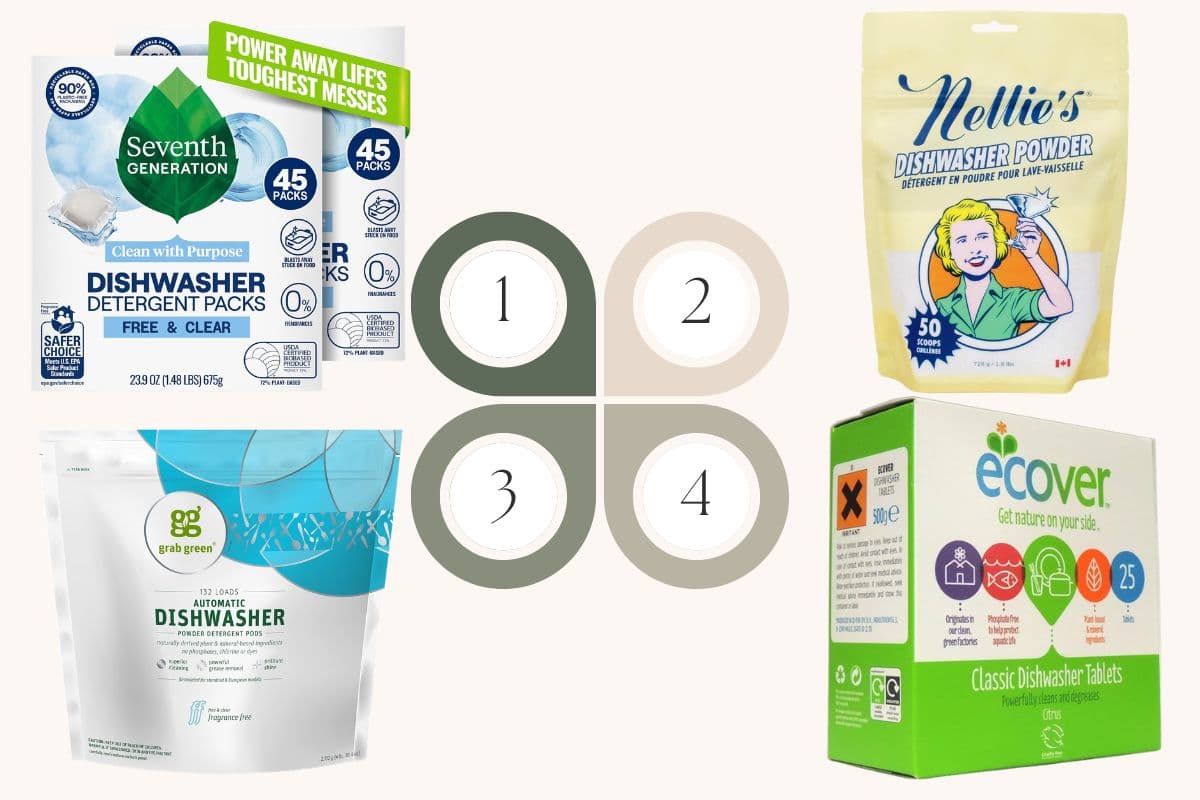
Detailed Reviews
#1 Seventh Generation Free and Clear — Best Overall
Best for: Most households on septic. EPA Safer Choice certified, widely available, multiple format options, proven performance.
Seventh Generation has produced EPA Safer Choice certified cleaning products for over 30 years and its dishwasher detergent line is the most thoroughly certified in the septic-safe category. The Free and Clear packs carry EPA Safer Choice certification, USDA Certified Biobased Product status at 79 percent biobased content, and are manufactured by a Certified B Corporation. This is the most rigorously verified dishwasher detergent choice for septic system owners.
The formula is phosphate-free, chlorine bleach-free, and free of synthetic fragrances and dyes. It uses a plant-based enzyme system including protease and amylase that cuts through grease and food residue without harsh chemistry. The enzymes continue working after entering the septic tank, supplementing the tank's natural biological processes. Independent testing confirms it handles 24-hour dried-on food without pre-rinsing.
Four formats are available. The Free and Clear packs and powder are the best choices for septic households. The Power Plus variant adds oxygen bleach (sodium percarbonate, not chlorine bleach) for tougher loads and is acceptable for occasional use. The gel format is the least concentrated option and the least preferred for septic use.
Pros
- EPA Safer Choice certified, the strongest third-party verification available
- USDA Certified Biobased Product at 79 percent
- Phosphate-free, chlorine bleach-free, no fragrances, no dyes
- Plant-based enzyme system beneficial to septic tank biology
- Available in packs, powder, gel, and Power Plus formats
- Certified B Corporation
- Among the lowest per-load costs of certified septic-safe options
Cons
- Packs use PVA wrapper film with mixed biodegradability evidence in some scenarios
- May need supplemental rinse aid in hard water areas for spot-free results
- Power Plus citrus variant contains fragrance; use Free and Clear for maximum septic safety
#2 Grab Green Fragrance Free — Best Pods for Septic Systems
Best for: Households that prefer pods and want full ingredient transparency, a completely fragrance-free formula, and a US-made product.
Grab Green was built around one principle: list every ingredient and its purpose on every package, which the brand calls True Transparency. For septic system owners evaluating what enters their tank, this is genuinely valuable. The fragrance-free pods are plant and mineral-based, phosphate-free, phthalate-free, chlorine-free, dye-free, and free of masking agents. Made in the United States.
Active cleaning ingredients include sodium citrate (chelating agent, softens hard water), sodium carbonate peroxide (oxygen bleach, not chlorine bleach), sodium silicate, linear alcohol ethoxylate, and amylase and subtilisin enzyme blend. The enzyme system targets both starch and protein residues. The oxygen-based bleaching chemistry is significantly safer for septic bacteria than chlorine bleach at household concentrations.
Independent household testing shows these pods perform comparably to Cascade Platinum on grease and stuck-on food despite using plant and mineral-derived chemistry. The velcro-closure bag packaging keeps unused pods fresher longer than most zip-close alternatives.
The pods use PVA wrapper film. For homeowners who want to eliminate every non-biodegradable input to the tank, the Nellie's powder or Ecover Zero tablets are wrapper-free alternatives. For homeowners who want pods with the cleanest ingredient profile available, Grab Green is the right choice.
Pros
- Full ingredient disclosure on every package, rare in this category
- Phosphate-free, phthalate-free, chlorine-free, dye-free, fragrance-free
- Oxygen bleach (sodium percarbonate) rather than chlorine bleach
- Dual enzyme system targets both starch and protein soils
- Made in the USA
- Available in large bulk quantities for lower per-load cost
- Velcro closure bag keeps pods fresh
Cons
- PVA wrapper, same biodegradability caveats as other pod products
- Not EPA Safer Choice certified, though ingredient profile is comparable
- Pods can harden if stored for extended periods in humid conditions
#3 Ecover Zero — Best for Fragrance-Sensitive Households
Best for: Households with fragrance allergies, chemical sensitivities, or young children. The only option on this list with zero fragrance AND no PVA wrapper.
Ecover is a Belgian cleaning products company that adopted phosphate-free, plant-based formulations in the 1980s, before these were marketing positions. The Zero line contains no fragrance of any kind — not even naturally-derived fragrance — which makes it the strictest choice for households where any scent compound is a concern, and also the lowest possible fragrance chemical load on the septic tank.
EU Ecolabel certification applies criteria comparable to EPA Safer Choice for ingredient safety, biodegradability, and environmental lifecycle impact. While not listed in the US EPA Safer Choice database, EU Ecolabel is a rigorous and credible third-party verification.
The tablets use individual foil wrapping rather than PVA film. Each tablet must be unwrapped before placing in the dishwasher, which is slightly less convenient than pods, but it means there is no PVA film entering the septic system. For homeowners who want to minimize every non-biodegradable input to their tank, this is the cleanest format choice on the list.
Cleaning performance is solid for standard household loads. For stubborn baked-on food, pairing with a natural rinse aid improves results. The tablet dissolves cleanly without residue on glassware or inside the machine.
Pros
- Zero fragrance of any kind in the formula
- Individually foil-wrapped tablets, no PVA wrapper enters the septic system
- EU Ecolabel certified, rigorous third-party verification
- Plant-based and mineral ingredients, phosphate-free, chlorine bleach-free
- No dyes
- Cardboard box packaging, recyclable
Cons
- Individual foil wrapping requires unwrapping each tablet before use
- Not US EPA Safer Choice certified (EU Ecolabel is the equivalent)
- Slightly higher per-tablet cost than some US alternatives
- May underperform on very heavy baked-on loads without a rinse aid
#4 Nellie's Dishwasher Powder — Best Powder and Best Value Per Load
Best for: Households that want adjustable dosing, the lowest per-load cost, no PVA wrapper, and minimal packaging.
Nellie's is a Canadian cleaning brand built around concentrated, plant and mineral-based formulas with minimal packaging. The dishwasher powder is made with sodium carbonate, sodium percarbonate, sodium metasilicate, and biodegradable enzymes. Phosphate-free, chlorine-free, fragrance-free, dye-free. Leaping Bunny certified and B Corp aligned.
The powder format is the most underrated choice for septic households for one specific reason: adjustable dosing. With a pod or tablet, you use the same chemistry regardless of load size, water hardness, or soil level. With Nellie's powder and the included measuring scoop, you use exactly as much as each load actually needs. For half-full loads or soft water conditions, routinely using less than a full pod equivalent's worth of chemistry adds up to meaningful tank protection over years of daily use.
Nothing but biodegradable powder enters the septic system. No PVA, no foil, no wrapper of any kind. This is the cleanest possible format for minimizing non-biodegradable inputs to the tank.
Nellie's dissolves in both hot and cold water cycles and works in standard and European dishwashers. One bag provides 50 loads. For households running the dishwasher daily, a bag lasts six to eight weeks depending on dosing. In hard water conditions, pairing with a rinse aid prevents spotting on glassware.
Pros
- Adjustable dosing, the only format that lets you reduce chemistry precisely per load
- Lowest per-load cost of the four reviewed products
- Phosphate-free, chlorine-free, fragrance-free, dye-free
- Sodium percarbonate (oxygen bleach) not chlorine bleach
- No wrapper of any kind entering the septic system
- Leaping Bunny certified, B Corp aligned
- Minimal, resealable packaging
- Works in standard and European dishwashers
Cons
- Powder requires measuring, less convenient than pods or tablets
- May underperform on very heavy loads in hard water without rinse aid
- Less widely available in physical retail than Seventh Generation
Dishwasher Habits That Protect Your Septic System
The right detergent matters, but how you use the dishwasher matters just as much. These four habits reduce the total chemistry and water volume your system receives from dishwashing every week.
Run full loads only. A modern dishwasher uses approximately 3 to 5 gallons per cycle regardless of how many dishes are inside. Running half-full loads doubles the per-dish water and chemistry load on the septic system. Wait until the machine is full before running it.
Do not run the dishwasher and washing machine simultaneously. Two high-volume appliances running at the same time creates a water surge that reduces settling time in the tank, increases turbulence, and can push solids toward the drainfield before they settle. See our septic system maintenance guide for a staggered appliance use schedule.
Scrape dishes, do not pre-rinse. The enzymes in all four of the detergents reviewed here need food soil to work against. Pre-rinsing dishes removes what the enzymes are designed to attack and runs additional water through the system before the cycle even starts. Scrape solids into the trash and load.
Use eco or normal cycle when possible. Heavy-duty and sanitizing cycles use more water and higher temperatures. The eco cycle uses less water and is sufficient for most everyday loads with the detergents reviewed here.
Frequently Asked Questions
What is the best dishwasher detergent for septic systems?
Is Cascade safe for septic systems?
Is Finish dishwasher detergent safe for septic systems?
What dishwasher detergent ingredients are harmful to septic systems?
Are dishwasher pods safe for septic systems?
Is it safe to use a dishwasher with a septic system?
Does rinse aid harm a septic system?
How often does dishwasher detergent affect a septic tank pumping schedule?
Glossary
Phosphates (Sodium Tripolyphosphate)
Phosphates are chemical compounds historically used in dishwasher and laundry detergents as water softeners and cleaning boosters. In septic systems, phosphate concentrations above approximately 0.5 percent begin disrupting the microbial balance of the tank by altering pH and chelating mineral ions that bacteria depend on. Phosphates were banned from US consumer dishwasher detergents by most states between 2010 and 2012, making the majority of modern formulations significantly safer than their predecessors. Phosphates also contribute to the phosphorus load in effluent reaching the drainfield, where excess phosphorus promotes algae blooms in nearby waterways.
Chlorine Bleach (Sodium Hypochlorite)
Chlorine bleach kills bacteria by disrupting cellular membranes and enzyme systems. In dishwasher detergents it may be included as a whitening or sanitizing agent. It is equally destructive to the beneficial anaerobic bacteria in a septic tank as to pathogens on dishes. Products labeled chlorine bleach-free use alternative whitening agents, typically oxygen-based bleach (sodium percarbonate), which is significantly safer for septic bacteria at household concentrations. Any dishwasher detergent containing sodium hypochlorite should be avoided for regular use in a septic-served home.
EPA Safer Choice
EPA Safer Choice is a voluntary certification program that independently reviews every ingredient in a cleaning product for safety to human health, aquatic life, and the environment, including biodegradability. Products carrying the EPA Safer Choice label have been screened against criteria that go beyond manufacturer claims and typical label language. For septic system owners, EPA Safer Choice is the most reliable single indicator that a dishwasher detergent will not harm the tank's bacterial ecosystem. The certification is searchable via the EPA's online Safer Choice database.
Enzyme-Based Detergent
Enzyme-based dishwasher detergents use biological enzymes, typically protease, amylase, and lipase, to break down food residue. Protease digests protein-based soils such as egg and meat. Amylase digests starch-based soils such as pasta and rice. Lipase digests fat-based soils such as cooking oil and dairy. These are the same enzyme types found naturally in a healthy septic tank's biological environment. Enzyme-based detergents are not only safe for septic systems but mildly complementary to tank biology because the enzymes continue working once they enter the tank.
Polyvinyl Alcohol (PVA)
Polyvinyl alcohol is the water-soluble polymer film used to encase dishwasher pods and laundry pods. It dissolves during the wash cycle, making pods easy to use without unwrapping. PVA is marketed as biodegradable and does eventually break down, but some research has raised questions about whether it fully degrades in all wastewater treatment scenarios. For residential septic systems, PVA is a low-priority concern compared to the chemistry inside the pod. Homeowners who prefer to eliminate every non-biodegradable input can choose powder or foil-wrapped tablets.
Oxygen Bleach (Sodium Percarbonate)
Sodium percarbonate is an oxygen-based bleaching agent that releases hydrogen peroxide when dissolved in water. Unlike chlorine bleach, it does not acutely kill anaerobic bacteria at typical dishwasher detergent concentrations and biodegrades into harmless byproducts: water, carbon dioxide, and sodium carbonate. It is used in several septic-safe detergents as a safer alternative to chlorine bleach for whitening and stain removal.