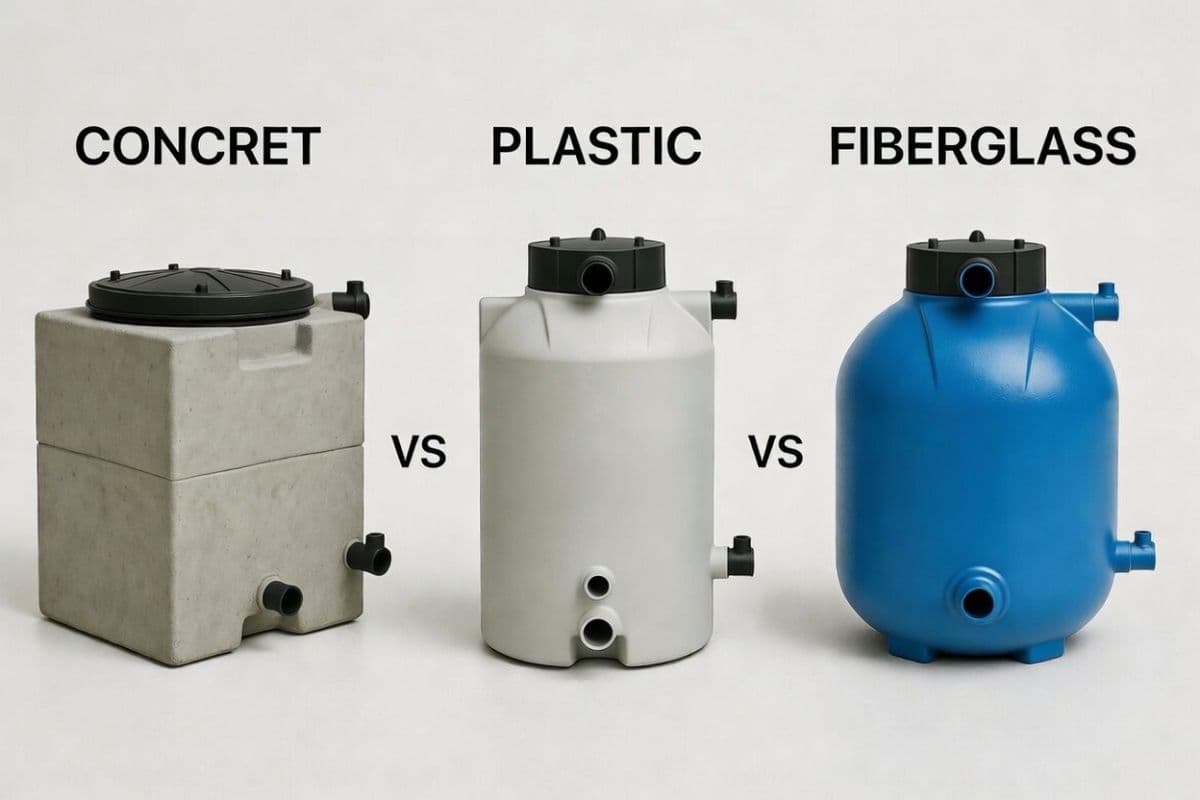
Concrete septic tanks cost $800 to $2,000, last 40+ years, and are the most durable option. Plastic tanks cost $500 to $1,200, last 30 to 40 years, and are the easiest to install. Fiberglass tanks cost $1,200 to $2,000, last 30 to 40 years, and offer the best balance of weight and durability.
For most residential installations, concrete is the best overall choice. For difficult-access sites or DIY-friendly installs, plastic is the most practical.
That's the summary. The rest of this guide breaks down exactly why each material works, where it fails, and which one is right for your specific property and soil conditions.
Septic tank material selection is the decision of which structural material (concrete, polyethylene plastic, or fiberglass) will be used to manufacture the buried tank that holds and begins treating a home's wastewater. All three materials perform the same function: they receive raw sewage from the home, hold it long enough for solids to separate from liquids, and pass clarified effluent to the drainfield. The material choice affects the tank's weight, structural durability, corrosion resistance, installation requirements, and susceptibility to flotation in high water table conditions, but it does not affect how the septic system treats waste or how often it needs to be pumped. The right material for a given property is determined primarily by three factors: water table level, site access for installation equipment, and local health department code requirements.
Side-by-Side Comparison
| Factor | Concrete | Plastic (Polyethylene) | Fiberglass |
|---|---|---|---|
| Tank cost (1,000 gal) | $800 – $2,000 | $500 – $1,200 | $1,200 – $2,000 |
| Lifespan | 40 – 50 years | 30 – 40 years | 30 – 40 years |
| Weight (1,000 gal) | 8,000 – 10,000 lbs | 200 – 400 lbs | 250 – 350 lbs |
| Installation difficulty | Requires heavy equipment (crane/hoist) | Manual placement possible | Manual placement possible |
| Risk of floating | Very low (heaviest option) | High in saturated soil | Moderate (lighter than concrete) |
| Risk of cracking | Moderate (over decades) | Low (flexible material) | Low (rigid but resilient) |
| Corrosion resistance | Moderate (can erode in acidic soil) | Excellent | Excellent |
| Can be driven over | Yes (properly installed) | No (will crush) | No (will crush) |
| Availability | Widely available everywhere | Widely available (Home Depot, Lowe's) | Less widely available |
| Repairability | Can be patched and sealed | Difficult to repair | Difficult to repair |
| Local code acceptance | Accepted everywhere | Most areas (check local codes) | Most areas (check local codes) |
This table is the most complete material comparison available for septic tanks. Save it, print it, or bring it to your contractor.
Concrete Septic Tanks
Concrete has been the standard septic tank material for over a century. According to industry data from the National Precast Concrete Association, precast concrete tanks are manufactured to ASTM C 1227 specifications, which require watertight construction and standardized structural integrity testing.
Why Choose Concrete
Longest lifespan. A properly manufactured and installed concrete tank can last 40 to 50 years. Many concrete tanks from the 1970s and 1980s are still in service today with no structural issues.
Heaviest option — that's a good thing. At 8,000 to 10,000 pounds for a 1,000-gallon tank, concrete will not float in saturated soil. This is critical in areas with high water tables or seasonal flooding. Lighter tanks can literally float out of the ground when the surrounding soil is waterlogged, which is a catastrophic failure.
Can handle surface traffic. A properly installed concrete tank buried at the correct depth can withstand occasional vehicle traffic above it. Plastic and fiberglass tanks cannot.
Universally accepted. Every jurisdiction in the United States accepts concrete septic tanks. Some municipalities actually require concrete.
Repairable. Small cracks can be sealed with hydraulic cement or specialized concrete sealant. This extends the tank's life without full replacement.
Drawbacks of Concrete
Requires heavy equipment. You need a crane, boom truck, or excavator with hoist capability to place a concrete tank. This increases installation labor cost by $500 to $1,500 compared to plastic.
Can crack over time. Ground shifting, tree root pressure, or poor manufacturing can cause cracks that allow groundwater infiltration or sewage leaks. Cracks are repairable if caught early but can lead to failure if ignored.
Susceptible to corrosion in acidic conditions. Hydrogen sulfide gas produced during anaerobic digestion can slowly erode the concrete above the water line inside the tank. This process takes decades but is accelerated in tanks that aren't pumped regularly. Acidic soil conditions can also affect the exterior.
Cost. Concrete tanks cost 30 to 60 percent more than equivalent plastic tanks when you factor in the heavier equipment needed for delivery and installation.
Plastic (Polyethylene) Septic Tanks
Plastic tanks became widely available in the 1980s and have gained significant market share, particularly for new construction and replacement projects.
Why Choose Plastic
Lowest cost. Plastic tanks are the most affordable option, both for the tank itself and for installation. The lighter weight means no crane is needed, reducing labor costs significantly.
Easiest to install. At 200 to 400 pounds for a 1,000-gallon tank, plastic can be moved by two people and placed with a standard excavator or even rolled into position manually. This makes them ideal for remote sites with limited equipment access.
Corrosion-proof. Plastic will not corrode, rust, or degrade from hydrogen sulfide exposure inside the tank or acidic soil outside. This gives plastic an advantage in regions with aggressive soil chemistry.
One-piece construction. Plastic tanks are rotomolded as a single piece with no seams or joints. This eliminates the risk of leaking at connection points, which is a common failure mode in older concrete tanks with separate lids.
Widely available. You can buy plastic septic tanks at Home Depot, Lowe's, and most building supply stores.
Drawbacks of Plastic
Flotation risk. This is the single biggest concern with plastic tanks. In areas with high water tables or during periods of heavy rain, the buoyancy of a lightweight plastic tank can cause it to literally float out of the ground when the surrounding soil becomes saturated. Proper installation includes anchoring the tank with straps to a concrete pad or using anti-flotation measures, but this adds cost and complexity.
Cannot be driven over. A vehicle, riding mower, or heavy equipment passing over a buried plastic tank can crush it. The tank must be installed in an area with no surface traffic.
Vulnerable during installation. Plastic tanks can be damaged — cracked, dented, or deformed — during backfilling if the fill material contains rocks or if heavy equipment operates too close. Proper backfill with clean sand or pea gravel is essential.
Not accepted everywhere. Some municipalities and counties require concrete tanks and do not approve plastic. Always check local codes before purchasing.
Difficult to repair. Unlike concrete, plastic tanks generally can't be patched or sealed when damaged. A cracked plastic tank usually means replacement.
Fiberglass Septic Tanks
Fiberglass tanks occupy the middle ground between concrete's durability and plastic's convenience.
Why Choose Fiberglass
Strong and lightweight. Fiberglass is rigid (unlike flexible plastic) but much lighter than concrete. At 250 to 350 pounds for a 1,000-gallon tank, it's easy to install without heavy equipment while still offering structural integrity that resists soil pressure and deformation.
Excellent corrosion resistance. Fiberglass will not rust, corrode, or degrade from chemical exposure. It's impervious to hydrogen sulfide and acidic soil.
Lower flotation risk than plastic. While still lighter than concrete, fiberglass tanks are designed with specific anti-flotation features and are less likely to shift in saturated soil than plastic tanks.
Long lifespan. Fiberglass tanks can last 30 to 40 years with proper maintenance, comparable to plastic and approaching concrete's longevity.
Drawbacks of Fiberglass
Highest tank cost. Fiberglass tanks typically cost the same as or more than concrete tanks, without the weight advantage that makes concrete so stable.
Limited availability. Fiberglass tanks aren't stocked at big-box stores and may need to be ordered from specialty suppliers. In some regions, finding a fiberglass tank can be difficult.
Cannot be driven over. Like plastic, fiberglass tanks will not withstand surface traffic.
Difficult to repair. Fiberglass repairs require specialized materials and techniques. Most homeowners can't DIY a fiberglass tank repair.
What About Steel Septic Tanks?
Steel tanks are no longer installed in new residential systems. If your property has an existing steel tank, it should be replaced.
Steel corrodes from both the inside (from wastewater and hydrogen sulfide) and the outside (from soil moisture). Steel tank lids are particularly dangerous because they deteriorate faster than the tank body and can collapse under the weight of a person walking over them.
If you have a steel tank, schedule a replacement with a licensed installer as soon as possible.
How to Choose the Right Material for Your Property
The decision comes down to five site-specific factors:
Water table level. If your property has a high water table or is prone to seasonal flooding, concrete is the safest choice. Its weight prevents flotation. Plastic tanks in high water table areas require anti-flotation measures that add cost and still carry some risk.
Site access. If heavy equipment can't reach the installation site — steep terrain, narrow access, remote location — plastic or fiberglass is the practical choice because they can be carried or rolled into position.
Local codes. Some jurisdictions mandate concrete. Check with your local health department or building code office before purchasing any tank.
Soil conditions. Acidic soil or high-sulfate soil can accelerate concrete deterioration. In these conditions, plastic or fiberglass may outlast concrete despite concrete's general durability advantage.
Budget. If upfront cost is the primary constraint and your site conditions are suitable, plastic offers the lowest total installed cost. If you can afford the higher installation cost, concrete provides the longest lifespan and fewest long-term concerns.
Quick Decision Guide
| Your Situation | Best Material |
|---|---|
| High water table or flood-prone area | Concrete |
| Standard suburban lot, good soil, easy access | Concrete |
| Remote property, limited equipment access | Plastic or fiberglass |
| Acidic soil or high sulfate groundwater | Plastic or fiberglass |
| Tight budget, suitable site conditions | Plastic |
| Local code requires concrete | Concrete |
| Want the best balance of cost and durability | Fiberglass |
Lifespan and Maintenance by Material
| Factor | Concrete | Plastic (Polyethylene) | Fiberglass |
|---|---|---|---|
| Expected lifespan | 40 to 50 years | 30 to 40 years | 30 to 40 years |
| Pumping interval | Every 3 to 5 years | Every 3 to 5 years | Every 3 to 5 years |
| Primary aging threat | Hydrogen sulfide corrosion above waterline | UV exposure if above grade; physical damage during backfill | Delamination or surface crazing over decades |
| Crack risk | Moderate (ground shift, root pressure, age) | Low (flexible material absorbs movement) | Low (rigid but resilient) |
| Repairability | Yes — hydraulic cement or epoxy injection | No — cracked tanks require replacement | No — requires specialized materials, typically replaced |
| Inspection method | Camera inspection or pump-out visual | Camera inspection or pump-out visual | Camera inspection or pump-out visual |
| Recommended inspection frequency | Every 3 years | Every 3 years | Every 3 years |
| Corrosion from hydrogen sulfide | Yes — accelerated without regular pumping | None | None |
| Corrosion from acidic soil | Yes — exterior surface can degrade | None | None |
| Flotation risk over lifespan | Very low | Increases if anti-flotation measures fail or degrade | Low to moderate |
| End-of-life indicator | Interior wall erosion, baffle failure, crack leaks | Deformation, lid failure, pipe joint separation | Surface crazing, joint separation, structural flex |
| Replacement cost at end of life | $800 to $2,000 (tank) plus installation | $500 to $1,200 (tank) plus installation | $1,200 to $2,000 (tank) plus installation |
Frequently Asked Questions
Which type of septic tank lasts the longest?
Can a plastic septic tank float out of the ground?
Are plastic septic tanks as good as concrete?
How much does a septic tank cost by material?
Do I need to replace my steel septic tank?
Can I choose my tank material, or does the installer decide?
Glossary
Related Guides
On theseptic.guide
Septic System Installation Cost 2026
Complete price breakdown by system type, tank material, and all components, including how concrete, plastic, and fiberglass tank costs compare when total installed cost is calculated rather than tank price alone.
Complete Septic System Guide
The foundational reference covering how septic systems work, what each component does, and what every homeowner needs to know before making any tank or system decision.
Septic Tank Size Guide
How to determine the correct tank capacity for your household, and how tank size interacts with material choice when selecting a replacement or new installation tank.
How Often Should You Pump Your Septic Tank?
Pumping intervals by tank size and household size, and why consistent pumping is the single most important factor in reaching the full lifespan of any tank material.
Septic Tank Pumping Cost 2026
What pump-outs cost by tank size and region, relevant for calculating the 20-year maintenance cost of any tank material choice.
How Long Does a Septic System Last?
Expected lifespan by system type and component, including how tank material affects the overall system lifespan and what typically fails first in each material type.
Aerobic vs Anaerobic Septic Systems
How tank material selection differs between conventional anaerobic systems and aerobic treatment units, which often use fiberglass or plastic pre-treatment chambers rather than standard concrete tanks.
Septic System Repair Cost 2026
Full pricing for tank repairs by type, including concrete crack sealing, baffle replacement, and full tank replacement costs for all three materials.
How to Find Your Septic Tank
Methods for locating your buried tank to determine its material and condition, particularly useful when buying a home with unknown tank history.
Buying a Home with a Septic System
How to evaluate tank material, age, and condition before closing, including what a steel tank discovery means for your negotiating position and timeline.
Selling a Home with a Septic System
How tank material and age factor into pre-listing inspection results and buyer negotiations, including when tank replacement before listing makes financial sense.
Septic Inspection Cost 2026
What a full septic inspection covers by material type, including how inspectors evaluate concrete tanks for interior corrosion and plastic tanks for deformation and joint separation.
Drainfield Replacement Cost 2026
What drainfield replacement costs when a failed or leaking tank has allowed solids to reach and clog the drainfield, the most expensive consequence of delayed tank replacement.
Signs Your Drainfield Is Failing
How a deteriorating tank of any material contributes to drainfield failure by allowing partially settled effluent or solids to reach the drainfield before adequate treatment.
Best Septic Tank Risers
Riser compatibility by tank material, including which risers work with concrete lids versus plastic tank access ports and how to bring any tank type to ground level for easier service access.
From Our Network
Best Sump Pumps 2026
For properties where high water table conditions are driving the tank material decision, this guide covers below-grade water management options that reduce hydrostatic pressure and flotation risk for any tank type.
Does Homeowners Insurance Cover Basement Flooding?
Homes with failing or leaking septic tanks sometimes experience sewage backup into below-grade spaces. This guide covers how insurance treats water and sewage damage in basements alongside the tank replacement decision.
External Resource
Need Help Choosing a Tank Material?
Connect with licensed septic installers in your area who can evaluate your site conditions and recommend the right material.
Get Free QuotesGet Expert Septic Help
Connect with qualified septic professionals in your area. Free quotes, no obligation.