How Hard Water Affects Your Septic System: What Homeowners Actually Need to Know
SG / The Septic Guide / Updated March 2026 · 13 min read
Quick answer: Hard water itself — the dissolved calcium and magnesium in your water supply — does not damage a septic system. In fact, calcium and magnesium from softener regeneration may slightly improve drainfield soil percolation. The real concern is what hard water treatment introduces into the system: softener brine containing concentrated sodium chloride and the water volume from regeneration cycles. A properly sized, demand-initiated regeneration softener using the correct salt type on a properly sized septic system poses minimal risk. An oversized, timer-based softener discharging 80 to 150 gallons of sodium-laden brine twice a week into a small or stressed system is a genuine problem — primarily through hydraulic overload and long-term sodium accumulation in drainfield soil.
The Most Important Distinction: Hard Water vs. Hard Water Treatment
Most homeowners who search for information about hard water and septic systems are asking the wrong question. The question is not whether hard water damages a septic system — it does not. Calcium and magnesium are natural minerals that pass through the system without disrupting the bacterial treatment process. Research from the Water Quality Research Foundation and studies cited by the University of Minnesota Extension both confirm that hard water minerals at typical residential concentrations do not impair septic tank function or drainfield performance.
What does treating hard water do to the septic system?
The answer depends entirely on what treatment method you use, how it is sized, and how it is configured. This guide covers each treatment option honestly so you can make the right decision for your specific situation.
How a Water Softener Interacts With a Septic System
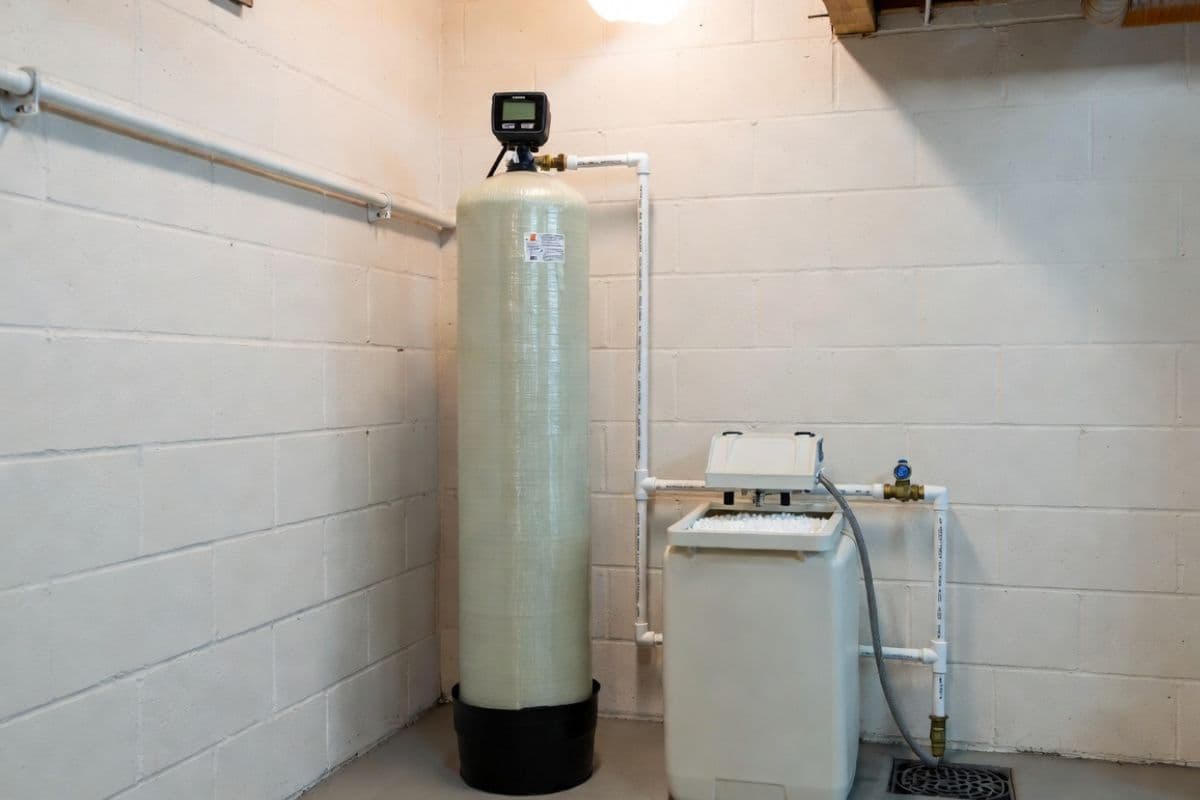
A conventional ion exchange water softener removes hardness minerals (calcium and magnesium) from water by exchanging them for sodium ions on a resin bed. When the resin becomes saturated with calcium and magnesium, it must be regenerated by flushing it with a concentrated salt (brine) solution. This brine — containing the accumulated calcium, magnesium, sodium chloride, and water — is then discharged to drain, which on a property with a septic system means into the septic tank.
There are three distinct ways this affects the septic system: hydraulic loading, salt concentration effects on bacteria and soil, and tank settling disruption.
Hydraulic Loading From Regeneration
Penn State Extension's guidance on water softening notes that each regeneration cycle uses approximately 50 gallons of water. More recent industry sources place the range at 50 to 150 gallons per cycle for standard timer-based softeners, with demand-initiated regeneration softeners using significantly less.
A timer-based softener regenerating twice per week adds 100 to 300 gallons of water to the septic system per week beyond normal household use. For perspective, a family of four generates approximately 1,050 to 1,400 gallons of wastewater per week from normal household use. Twice-weekly softener regeneration represents an additional 7 to 21 percent above that baseline.
The concern is not the volume itself but the rate. Regeneration cycles typically discharge this water over 1 to 3 hours — a concentrated burst that can push partially treated effluent from the septic tank into the drainfield before adequate settling has occurred. The Minnesota Water Resources Center notes that studies have shown the large volume of water from regeneration cycles may displace partially treated water in the septic tank and push it into the drainfield, potentially damaging the field — particularly for older or undersized systems.
The Fix: A demand-initiated regeneration (DIR) softener regenerates only when its resin has actually been exhausted by measured water usage — not on a fixed schedule. DIR softeners regenerate 30 to 50 percent less frequently than timer-based models, reducing both water and salt discharge to the septic system proportionally. For any household with a septic system, a DIR softener is the appropriate choice over a timer-based unit.
Sodium and Chloride Effects on Drainfield Soil
The chloride in softener brine is the component that most concerns environmental agencies. Unlike most contaminants, chloride cannot be removed by drainfield soil treatment — it passes through unchanged and enters groundwater. Minnesota and Wisconsin have documented elevated chloride levels in groundwater in areas with high residential water softener use, which is why the Minnesota Department of Health actively recommends against unnecessary softening and advocates for demand-initiated regeneration systems to minimize chloride discharge.
For the drainfield itself, the primary concern is sodium and its effect on soil structure. Sodium in high concentrations causes clay particles in soil to swell and disperse, reducing the soil's hydraulic conductivity — its ability to absorb and percolate water. This effect is measured by the Sodium Adsorption Ratio (SAR) of the soil. At high enough sodium concentrations over time, a clay-bearing drainfield soil becomes less permeable, reducing the drainfield's effective absorption capacity.
The key qualifier is "high enough concentrations over time." Research from the Water Quality Research Foundation's 2012 study found that brine discharge from properly operated water softeners — discharging approximately 50 gallons per regeneration cycle — did not cause overflow or measurable drainfield impairment in the test systems. The risk is primarily associated with:
- Oversized softeners regenerating more frequently than necessary
- Timer-based softeners regenerating on a schedule rather than on demand
- Clay-heavy drainfield soils (particularly montmorillonite clay) that are more sensitive to sodium
- Small or undersized drainfields with limited buffer capacity
The Fix: Use potassium chloride (KCl) instead of sodium chloride (NaCl) as the regeneration salt. Potassium does not cause the clay swelling that sodium does, and potassium is a soil nutrient rather than a structural disruptor. Potassium chloride costs $25 to $40 per 40-pound bag versus $6 to $10 for sodium chloride — approximately three to four times more expensive — but eliminates the soil structure concern entirely for septic owners with clay-bearing drainfields.
Tank Settling Disruption
Brine solution is significantly denser than normal household wastewater. When the concentrated brine from a regeneration cycle enters the septic tank, it sinks rapidly to the bottom — where the sludge layer normally settles. This density stratification can temporarily disrupt the tank's normal three-layer structure (scum on top, clarified effluent in the middle, sludge on the bottom) by lifting sludge particles into suspension.
The Ontario Onsite Wastewater Association's technical document on water softeners and onsite sewage systems notes that this settling disruption has been theorized to cause solids carryover into the drainfield. However, the document also notes that for a properly maintained water softener at typical residential concentrations, the brine is sufficiently diluted by other household wastewater to remain below threshold levels for measurable impact on anaerobic digestion.
The practical implication: avoid scheduling softener regeneration cycles to coincide with other high-water-use activities. Regeneration should occur during low-use periods — typically the middle of the night — not simultaneously with laundry, dishwasher cycles, or multiple showers.
Hard Water Does Not Kill Septic Bacteria — But Can Brine?
This is one of the most searched questions on this topic and it deserves a clear, research-based answer.
At the sodium chloride concentrations that reach a septic tank from a properly functioning, normally sized residential water softener, the brine does not kill septic bacteria in meaningful quantities. The brine solution itself — before dilution — is highly concentrated salt water. But by the time the regeneration discharge mixes with the household's full daily wastewater volume in the septic tank, the salt concentration is diluted to levels well below the threshold for bacterial disruption.
The Water Quality Research Foundation study, an 18-month project conducted with participation from the Water Quality Association, NOWRA, and NSF International, concluded that brine discharge from well-operated water softeners does not harm the bacterial activity required for septic tank treatment.
The scenario where bacterial disruption becomes a concern is an oversized or malfunctioning softener discharging an unusually high volume of concentrated brine in a short period into a small tank — a scenario outside the range of normal residential installations.
The aerobic system distinction: Aerobic septic systems — which use air injection to support aerobic bacterial treatment — are more sensitive to chemical inputs than conventional anaerobic systems. The Ontario Onsite Wastewater Association notes that while some studies show no discernible effect on aerobic treatment unit performance from softener backwash, increased chloride levels can impair the nitrification process in aerobic systems designed to provide nitrogen treatment. If you have an aerobic septic system, consult the system manufacturer and your local health department before adding a salt-based softener. The risk profile is meaningfully different from a conventional gravity-flow anaerobic system.
Mound systems are also more sensitive than standard drainfields because they rely on precise hydraulic loading rates to distribute effluent across a constructed sand bed. A large brine discharge can temporarily saturate a mound system's distribution network in ways that would not affect a standard leach field. If your property has a mound system, a DIR softener and potassium chloride are not just recommended — they are effectively required for safe coexistence.
The Comparison: Different Treatment Options and Septic Risk
| Treatment Type | Salt/Chemical Discharge | Water Volume Added | Septic Risk Level |
|---|---|---|---|
| Timer-based softener (NaCl) | High — concentrated NaCl brine 2–3x/week | 100–300 gal/week | Moderate to High |
| DIR softener (NaCl) | Moderate — same concentration, less frequent | 50–150 gal/week | Low to Moderate |
| DIR softener (KCl) | Moderate — potassium chloride instead of sodium | 50–150 gal/week | Low |
| Salt-free conditioner (TAC) | None | None | Negligible |
| Point-of-use RO (drinking only) | None to whole house | Minimal waste water | Negligible |
The cleanest option from a septic standpoint is a salt-free conditioner (template assisted crystallization), which adds no salt, no water volume, and no chemical burden to the septic system. However, salt-free conditioners prevent scale formation — they do not actually remove hardness minerals from the water. Soap will still not lather as well, laundry results will still reflect hard water, and skin and hair will not feel as different as they do with true ion exchange softening.
For wells with hardness above 12 to 15 GPG where true softening is needed for appliance protection and quality of life, a DIR softener with potassium chloride is the appropriate choice for a household on a septic system. For wells with moderate hardness (7 to 12 GPG) where scale prevention is the primary goal, a salt-free conditioner avoids all septic interaction entirely.
See the water softeners and septic systems guide for the full treatment comparison with specific product guidance.
State Restrictions on Softener Brine Discharge to Septic Systems
Several states and counties have moved beyond recommendations to actual regulatory restrictions on water softener brine discharge to septic systems. This is not a universal rule but it affects enough homeowners to be worth checking before installation.
Massachusetts: Title 5, the state's onsite sewage regulations, restricts discharge from water softeners into septic systems without specific prior approval from the local board of health.
California: Multiple water districts prohibit softener brine discharge due to groundwater salinity and chloride concerns — particularly in coastal and agricultural areas where groundwater quality is actively managed.
Connecticut: Published guidance discourages softener brine discharge to septic systems; some county-level jurisdictions have more specific restrictions.
Minnesota: The Minnesota Department of Health strongly recommends against unnecessary softening and advocates for demand-initiated regeneration to minimize chloride discharge to groundwater, consistent with statewide chloride impairment concerns.
What to do: Before installing any water softener on a property with a septic system, contact your county health department and ask specifically whether any restrictions apply to softener brine discharge. Do not assume that because your neighbor has a softener, no restrictions apply — local rules vary significantly even within a single county.
Sizing the Softener Correctly to Protect the Septic System
An improperly sized softener is the single most common cause of softener-related septic problems. Both undersizing and oversizing create issues.
An undersized softener exhausts its resin quickly and regenerates more frequently than necessary — adding more brine and more water to the septic system than a correctly sized unit would.
An oversized softener has excess capacity that causes the resin to sit too long between regenerations on a timer-based system — which can cause channeling and inefficient salt use, also resulting in more brine per cycle than necessary.
Daily grain demand = Water hardness (GPG) × Number of people × 75 gallons per day
A softener should be sized to regenerate every 3 to 5 days under normal usage. For a family of four with 12 GPG hardness:
- Daily demand: 12 GPG × 4 people × 75 gallons = 3,600 grains per day
- 3-day capacity needed: 3,600 × 3 = 10,800 grains minimum
- With 30% efficiency buffer: 10,800 × 1.3 = 14,040 grains
- A 24,000-grain softener is appropriate for this household
An oversized 64,000-grain softener on the same household would regenerate half as often but discharge the same salt and water concentration per cycle with more waste — and on a timer-based system, might regenerate on schedule regardless of actual usage, adding unnecessary brine load to the septic system.
Practical Recommendations: How to Have Both a Softener and a Healthy Septic System
These are the specific practices that minimize softener impact on a septic system, ranked by importance:
Use a demand-initiated regeneration softener, not a timer-based model. This is the single most important decision. DIR softeners regenerate 30 to 50 percent less frequently, reducing both water and salt discharge to the septic system.
Use potassium chloride salt if your drainfield soil has significant clay content. Potassium chloride eliminates the sodium-related soil structure concern. If you do not know your drainfield soil type, potassium chloride is the safer default.
Size the softener correctly for your household and hardness level. Use the formula above. An improperly sized softener wastes salt and adds more brine than necessary to the system.
Schedule regeneration for the middle of the night when household water use is zero. This prevents the regeneration discharge from combining with other high-use activities to create a single large hydraulic load.
Do not run high-water-use appliances on regeneration days — or at minimum, stagger them. Laundry, dishwasher cycles, and long showers should not coincide with scheduled or anticipated regeneration cycles on timer-based units.
Have your septic tank pumped on schedule — every 3 to 5 years for most households. A softener adds incrementally more settled material to the tank over time. Staying current on pumping prevents the accumulation from becoming a problem.
Check local regulations before installation. If you are in Massachusetts, California, Connecticut, Minnesota, or an area with documented groundwater chloride concerns, confirm your county’s specific rules before proceeding.
Frequently Asked Questions
Does hard water damage a septic system?
No. Hard water — water containing dissolved calcium and magnesium — does not damage a septic system. These minerals pass through the tank and drainfield without disrupting bacterial activity. Research from the Water Quality Research Foundation and the University of Minnesota confirms this. The concern is not hard water itself but the brine discharged during water softener regeneration cycles, which contains concentrated sodium chloride and adds hydraulic load to the system.
Can I use a water softener with a septic system?
Yes, with the right equipment and practices. A demand-initiated regeneration softener using potassium chloride salt poses minimal risk to a properly sized septic system. The practices that create problems are timer-based regeneration (which adds unnecessary brine volume), sodium chloride salt in clay-bearing drainfield soil (which can reduce soil percolation over time), and scheduling regeneration to coincide with other high-water-use activities. See the water softeners and septic systems guide for the full guidance.
Does softener brine kill septic bacteria?
At the concentrations that reach a septic tank from a properly functioning residential softener, no. The brine solution is highly concentrated before it enters the tank, but it is diluted by the full volume of household wastewater. The Water Quality Research Foundation's 18-month study found no measurable impact on septic tank bacterial activity from well-operated water softener discharge. The scenario where bacterial disruption is a real concern is an oversized or malfunctioning softener discharging unusually large volumes of concentrated brine into a small tank.
Is potassium chloride safer than sodium chloride for septic systems?
Yes, primarily because potassium does not cause the clay particle swelling that sodium does in drainfield soil. Potassium is a soil nutrient and does not degrade hydraulic conductivity in clay-bearing soils the way sodium can over time. Potassium chloride costs $25 to $40 per 40-pound bag versus $6 to $10 for sodium chloride. For households with clay-heavy drainfield soil, the cost premium is worthwhile. For households with sandy or gravelly drainfield soil that is not sensitive to sodium, sodium chloride is acceptable with a properly sized and maintained DIR softener.
How much water does a water softener add to a septic system?
A standard timer-based softener adds 50 to 150 gallons per regeneration cycle, typically regenerating two to three times per week — adding 100 to 450 gallons per week to the system. A demand-initiated regeneration softener uses 30 to 50 percent less water overall by regenerating only when the resin is actually exhausted. Penn State Extension estimates approximately 50 gallons per cycle for a properly sized softener. For most modern septic systems sized to current code, this volume is accommodated within the design capacity, but it is a meaningful addition to older or undersized systems.
Do aerobic septic systems handle water softener brine differently than conventional systems?
Yes. Aerobic systems introduce oxygen to support aerobic bacterial treatment and are considered more sensitive to chemical inputs including high-sodium brine. Some research indicates that elevated chloride levels can impair the nitrification process in aerobic systems designed for nitrogen treatment. If you have an aerobic septic system, consult your system manufacturer and local health department before installing a salt-based softener. A salt-free conditioner or a DIR system with potassium chloride is the lower-risk choice for aerobic system owners.
Should I discharge softener brine to a dry well instead of the septic system?
In some jurisdictions this is permitted and preferred. Directing brine to a separate dry well or dedicated discharge point eliminates the impact on the septic system entirely. However, the brine still enters the soil and eventually groundwater — which is the reason several states have restrictions on softener brine discharge regardless of where it goes. Check with your county health department before installing a dry well for brine discharge. In areas with documented groundwater chloride concerns, even dry well discharge may be restricted.
What are the signs that a water softener is stressing a septic system?
Slow drains or backups after softener regeneration cycles are the most direct sign. Unusually frequent need for tank pumping — less than 3 years between pumpings for a normal household — can indicate excess solids accumulation from brine settling disruption. If a septic inspector finds little or no distinct sludge and scum layer separation in the tank, that is a sign that brine density is disrupting normal settling. A drainfield becoming progressively slower to drain over years in clay soil may indicate sodium accumulation affecting hydraulic conductivity — though this is difficult to distinguish from normal drainfield aging without professional assessment.
Glossary
Demand-Initiated Regeneration (DIR)
A water softener control system that triggers the regeneration cycle based on actual measured water volume processed rather than on a fixed time schedule. A DIR softener measures how many grains of hardness have been removed since the last regeneration and initiates a new cycle when the resin approaches exhaustion. Compared to timer-based systems, DIR softeners regenerate 30 to 50 percent less frequently, using proportionally less salt and water and discharging proportionally less brine to the septic system. The Minnesota Department of Health and University of Minnesota Extension both specifically recommend DIR softeners as the appropriate choice for households concerned about chloride discharge to groundwater and septic systems.
Sodium Adsorption Ratio (SAR)
A measure of the relative concentration of sodium compared to calcium and magnesium in a water or soil solution, used to assess the risk of sodium-induced soil structure degradation. High SAR values in drainfield soil indicate elevated sodium relative to divalent ions, which can cause clay particles to swell and disperse, reducing the soil's hydraulic conductivity and its ability to absorb and percolate septic effluent. Potassium chloride does not contribute to elevated SAR the way sodium chloride does, which is one reason it is preferred for septic system owners with clay-bearing drainfields.
Ion Exchange
The process used by conventional water softeners to remove hardness. Water passes through a bed of resin beads charged with sodium or potassium ions. Calcium and magnesium ions in the water replace the sodium or potassium ions on the beads. The softened water — now lower in hardness but higher in sodium or potassium — exits the softener for household use. When the resin becomes saturated with calcium and magnesium, it is regenerated by flushing with a concentrated salt solution, which restores the sodium or potassium charge and discharges the accumulated calcium, magnesium, and excess salt as brine.
Hydraulic Loading
The total volume of water entering a septic system within a given time period. Septic systems are designed for a specific daily hydraulic load based on household size. Water softener regeneration cycles add to this load — both through the water used in the regeneration process and through the effluent produced. Systems that receive regular regeneration discharge, particularly from timer-based softeners, experience higher average hydraulic loading than systems without softeners. Properly sized DIR softeners keep this additional loading within the range that most modern systems can accommodate without stress.
External Resource
Penn State Extension's guidance on Water Softening at extension.psu.edu provides one of the most balanced and research-cited consumer-facing treatments of this topic, covering the hydraulic loading calculation, the sodium addition per grain per gallon of hardness removed, and the specific recommendation to consider the additional drainage field load from regeneration cycles when sizing both the softener and the septic system. It is the most authoritative free resource available for homeowners trying to navigate this question honestly.