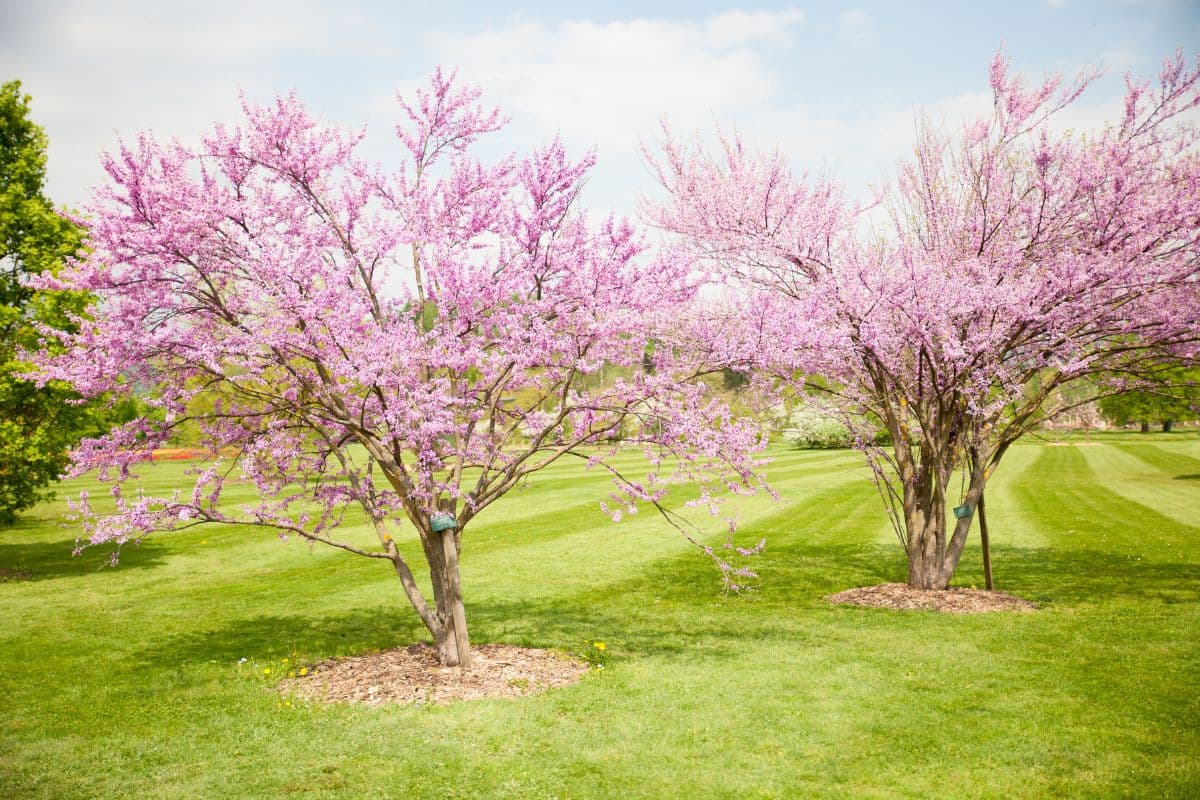
The most common landscaping question homeowners with septic systems ask is some version of: “Can I plant a tree near my drainfield?” The answer is yes, with conditions. The more useful question is which tree, how far away, and what you need to understand about why most trees are genuinely risky.
Almost every guide on this topic offers a list of safe species and stops there. This one goes deeper. It covers why the drainfield's nutrient content makes roots travel farther than normal, why shading is a second problem beyond root intrusion that rarely gets mentioned, how to actually solve the privacy screening problem that most homeowners are trying to solve in the first place, and the species-level root information you need to make an informed decision rather than a guess.
Why Choosing the Right Tree Actually Matters
Your drainfield is not just a passive piece of underground infrastructure. It releases effluent continuously, and that effluent is warm, moist, and loaded with nitrogen, phosphorus, and oxygen. Those are exactly the resources tree roots are looking for. Every tree within reach of that nutrient gradient has some motivation to grow toward it.
This is why generic “safe distance” rules are less reliable than they appear. A willow at 60 feet will still send roots toward your drainfield. A silver maple at 40 feet will too. The safe distance for an aggressive species is not a moderate buffer, it is a very large buffer or no planting at all.
The species that are genuinely lower risk near a septic system share a specific set of characteristics. They have compact, fibrous root systems that do not spread aggressively. They have moderate to low water demand, so they are not actively seeking out moisture sources the way high-demand species do. They reach a smaller mature size, which limits the total volume and spread of their root system. And they grow at a moderate pace rather than rapidly, because fast-growing trees develop root systems that expand quickly and aggressively.
There is one more factor that almost no guide mentions: the drainfield's elevated nutrient levels act as a magnet that can pull roots from farther away than the tree's normal maximum root spread. A redbud planted 20 feet from the drainfield edge in nutrient-poor soil might behave exactly as expected. The same redbud 20 feet from a drainfield in nutrient-rich conditions may push roots farther toward the nutrient source than it otherwise would. This is why the clearance distances in this guide include a buffer beyond the standard mature-height rule.
The Shading Problem Nobody Talks About
Root intrusion gets all the attention, but there is a second way trees harm septic systems that almost no planting guide covers: shading.
Drainfields depend on evapotranspiration, the combined process of water evaporating from the soil surface and being released through plant leaves, to remove moisture from the system. A drainfield that stays shaded loses a significant portion of its evaporative capacity. This is particularly important in wetter climates and in spring when soil saturation is already high.
The Clemson University Extension and WSU Extension both note that drainfields need sunlight for optimal performance. Dense shade from trees planted around the drainfield perimeter can reduce treatment efficiency and contribute to saturation problems that look like drainfield failure even when the pipes and soil are intact.
The practical implication is that safe tree selection is not just about root aggressiveness. It is also about where you plant relative to the drainfield's sun exposure. A row of tall evergreens along the north edge of the drainfield blocks winter sun at the exact time of year when evapotranspiration matters most. The same trees along the south edge of a large property, far enough away to be well clear of the root and shading concerns, are a different situation entirely.
How to Use This Guide
The species profiles below are organized by tree type and use case. Each one includes the root system characteristics, the recommended minimum clearance from the nearest drainfield edge, the USDA hardiness zone range, and an honest assessment of the risk level.
“Minimum clearance” means from the nearest drainfield component, not from the tank. The tank itself is a solid, sealed vessel that is less vulnerable than the perforated drainfield pipes. The clearance distances apply to the drainfield edge, the distribution box, and the inlet pipe from the house to the tank.
All distances assume PVC pipe or well-installed clay tile with intact joints. Older systems with deteriorated clay pipe, Orangeburg, or cast iron have more vulnerability. If your system uses older pipe materials, add an additional 25 to 50 percent to the clearance distances listed here.
The Lower-Risk Species: Profiles and Clearance Distances
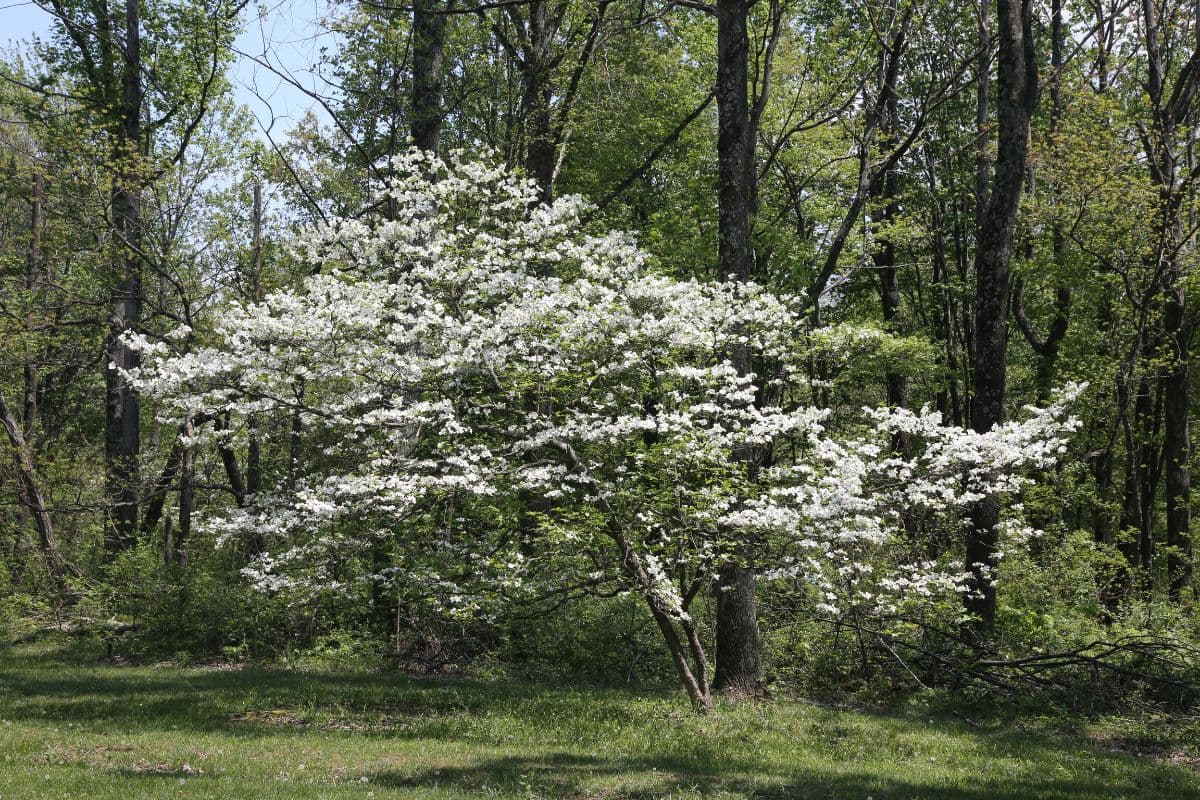
Flowering Dogwood (Cornus florida)
Root system: Fibrous, shallow. Roots typically reach 12 to 24 inches in depth and spread roughly to the canopy edge. Not a moisture-seeker. Does not extend roots aggressively beyond the canopy in normal soil conditions.
Flowering dogwood is the most consistently recommended ornamental tree for near-septic planting across university extension programs. Its fibrous root system stays in the upper soil layers and does not send out the deep tap roots or long-distance feeder roots that cause the worst damage. It tolerates the slightly alkaline soil conditions that develop over drainfields from effluent chemistry.
The one caution: dogwood has moderate water needs and appreciates consistent moisture. In very dry conditions, it may push roots somewhat beyond normal spread in search of water. This is another reason to maintain adequate clearance rather than planting right at the minimum distance.
Kousa dogwood (Cornus kousa, Zones 5 to 8) behaves similarly and is often more disease-resistant. Pacific dogwood (Cornus nuttallii, Zones 7 to 9) is a good option for the Pacific Northwest.
Eastern Redbud (Cercis canadensis)
Root system: Shallow surface roots that spread to roughly the canopy width, plus a tap root that can go deeper in loose soil. Roots are described as “opportunistic,” meaning a tap root that finds effluent will follow it. Not aggressive under normal conditions, but not fully passive either.
Eastern redbud is a popular choice for near-septic planting and generally lives up to the recommendation, but it warrants a slightly greater clearance than dogwood because of that opportunistic tap root. The standard guidance of 15 to 20 feet reflects normal soil conditions. Given that drainfield effluent acts as a nutrient attractant, 25 to 30 feet provides more appropriate margin.
Western redbud (Cercis occidentalis, Zones 7 to 10) is the native alternative for western states and has similar root characteristics.
Japanese Maple (Acer palmatum)
Root system: Shallow, fibrous, and compact. One of the genuinely non-aggressive root systems among ornamental trees. Roots stay close to the tree and do not extend deeply or send out long-distance feeders under normal conditions.
Japanese maple is one of the safest ornamental trees for use near septic systems and the species most consistently cited across horticultural and septic extension literature as appropriate. Its compact root system, moderate size at maturity, and low water demand make it a reliable choice.
One note: some sources incorrectly warn against all maples near septic systems. This warning accurately applies to silver maple and red maple, which are aggressive water-seekers with extensive root systems. It does not apply to Japanese maple, which is in the same genus but behaves very differently. Verify that you are planting Acer palmatum specifically, not a native maple species.
Dwarf Japanese maple varieties that mature under 10 feet can be planted with slightly less clearance, around 10 to 15 feet from the drainfield edge, because their total root volume is smaller at maturity.
Serviceberry (Amelanchier species)
Root system: Shallow, fibrous, and non-aggressive. Serviceberry roots stay close to the base and do not seek moisture at distance.
Serviceberry is one of the most septic-safe ornamental trees available and is native across a wide range of North American climates. It offers four-season interest: white flowers in early spring, edible berries in early summer (though you should not harvest berries directly over the drainfield), orange-red fall foliage, and attractive winter branch structure.
Common serviceberry (Amelanchier canadensis), Juneberry (Amelanchier laevis), and downy serviceberry (Amelanchier arborea) are all appropriate. Multi-stem forms naturally stay smaller and lower-risk than single-stem tree forms.
Ornamental Cherry (Prunus species)
Root system: Shallow, fibrous, and non-aggressive for ornamental varieties. Not a significant moisture-seeker. Roots typically extend to just beyond the canopy edge in normal conditions.
Ornamental cherries are widely used near septic systems and generally perform well at appropriate clearances. The range of mature sizes across varieties makes matching the clearance to the specific tree important. Yoshino cherry (Prunus x yedoensis) reaches 25 to 40 feet and needs 35-foot clearance. Kwanzan cherry reaches 25 to 30 feet. Weeping ornamental cherries in the 10 to 15-foot range can be used at 20 feet clearance.
Fruit-bearing cherry trees have moderately more aggressive root systems than ornamental varieties and should be planted at 30-foot minimum clearance. Do not harvest fruit from any tree planted close enough to the drainfield that its roots might be interacting with the effluent zone.
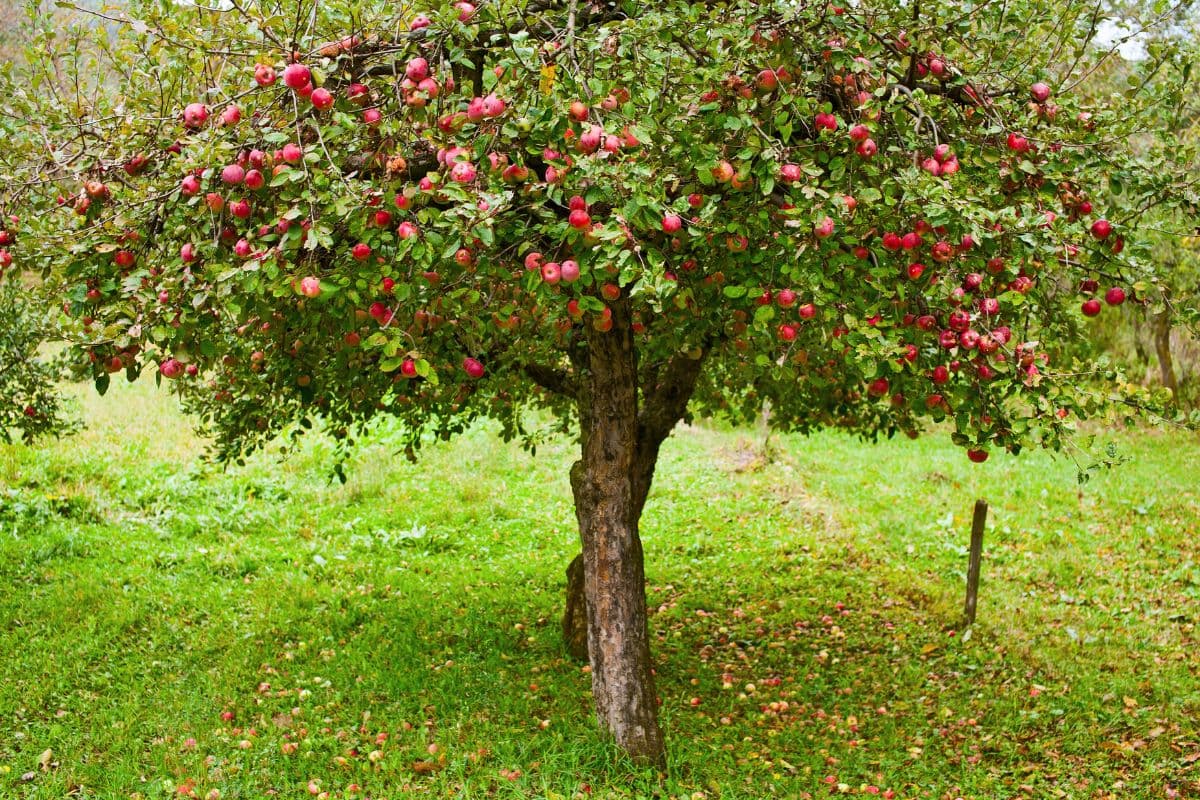
Crabapple (Malus species)
Root system: Shallow, fibrous, and stays within approximately the canopy spread. Roots extend mostly in the top 12 to 18 inches of soil, roughly matching the canopy spread.
Crabapple is a reliable near-septic option in cold climates where dogwood and redbud may not perform well. The Sargent crabapple (Malus sargentii) is one of the most compact varieties, reaching only 6 to 10 feet at maturity, making it particularly well-suited for smaller properties. Most modern ornamental crabapple cultivars have been selected for disease resistance and compact growth, which also corresponds to less aggressive root systems.
Eastern Red Cedar (Juniperus virginiana)
Root system: Moderately deep tap root with lateral fibrous roots. The tap root does not seek moisture the way willows and poplars do, but it can penetrate deeper than pure fibrous-root species. The lateral roots are not aggressive.
Eastern red cedar is a native evergreen that provides excellent year-round screening and wildlife habitat. Its roots are intermediate between the shallow ornamentals above and the aggressive water-seekers to avoid. The tap root makes it less ideal than dogwood or Japanese maple, but at 35-foot clearance from the drainfield edge, it performs safely in most systems with PVC or intact modern pipe.
Eastern red cedar is also notably drought-tolerant once established, which reduces its motivation to seek out the drainfield's moisture compared to water-demanding species.
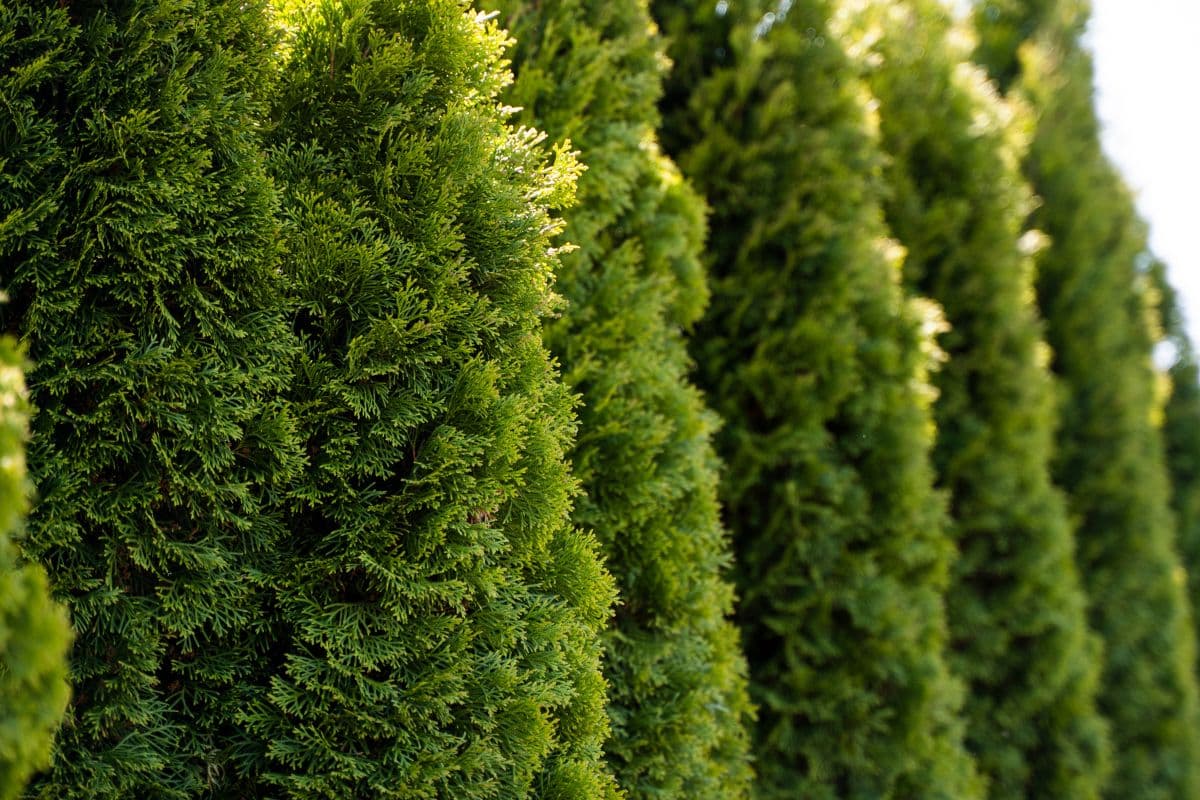
Emerald Green Arborvitae (Thuja occidentalis ‘Emerald Green’)
Root system: Very shallow. Roots reach approximately 8 inches in depth. Lateral spread extends to roughly the branch tips. Not a moisture-seeker and not considered to have invasive roots.
Emerald Green arborvitae is the most commonly used privacy screening tree in residential landscapes and one of the more septic-safe evergreen options available. Its shallow, confined root system is not aggressive, and its compact spread means the total root volume at maturity is relatively small.
The important caveat is that all arborvitae should be kept back from the drainfield even though the root system is shallow, because the roots spread laterally to the branch tips and those tips can be closer to the drainfield than they appear at time of planting. At 12 to 15-foot mature height, the mature-height rule gives 12 to 15 feet, but 20 to 25 feet is a more comfortable margin given the nutrient attraction effect.
Also note that Emerald Green arborvitae shades the area in front of it, which means positioning along the north or west side of the drainfield creates less shading impact than positioning to the south or east.
Thuja Green Giant (Thuja standishii x plicata)
Root system: Fibrous, shallow for its size. Roots are typically 3 to 4 feet deep with lateral spread to 10 to 15 feet. Not considered to have invasive or aggressive roots, but the mature size is much larger than Emerald Green, which means greater total root volume and a larger shading footprint.
Thuja Green Giant is one of the most popular privacy trees in the country and it is commonly recommended as septic-safe because of its shallow, non-aggressive roots. That root assessment is accurate. The problem is its mature height. At 50 to 60 feet, the mature-height rule puts the correct planting distance at 50 to 60 feet from the drainfield edge. That is a substantial buffer that many residential properties cannot provide.
Homeowners who want arborvitae-style privacy screening closer to the drainfield are better served by Emerald Green arborvitae at the smaller clearance distances, or by a layered planting of Emerald Green with native shrubs.
Sourwood (Oxydendrum arboreum)
Root system: Shallow, fibrous, and non-aggressive. Sourwood is slow-growing and has a compact root system that stays within the canopy spread.
Sourwood is less commonly planted than dogwood or redbud but is consistently cited by university extension programs as appropriate for near-septic use. Its slow growth rate means the root system expands slowly, which combined with its shallow fibrous roots makes it one of the more reliable choices. It offers outstanding fall color and attractive white flower clusters in midsummer.
American Holly and Nellie Stevens Holly
Root system: Fibrous and relatively shallow. Holly roots are generally considered non-aggressive and not significant moisture-seekers.
Holly trees provide year-round screening with dense evergreen foliage and, for female plants, attractive red berries. The root system is fibrous and not known for aggressive spread. Holly trees also tolerate the slightly higher soil pH that develops around drainfields from effluent chemistry better than many acid-loving alternatives.
The Privacy Screening Problem, Solved
The most common reason homeowners want trees near a septic system is privacy screening. They need something tall, dense, and fast-growing to block a neighbor's view or a road. This is an entirely reasonable goal, and it conflicts directly with the two main concerns: root aggressiveness and shading. Here is how to approach it.
Strategy 1: Emerald Green Arborvitae at Correct Distance
If the property allows 20 to 25 feet of clearance from the drainfield edge, Emerald Green arborvitae planted in a row works well. Space them 3 to 4 feet apart for a dense screen. At 12 to 15 feet of mature height, they do not create serious shading problems from most directions.
Strategy 2: Mixed Native Hedge
Rather than a single row of tall trees, a layered planting of compact native shrubs like inkberry holly, spicebush, and native viburnums at the correct clearance provides year-round screening without the root or shading risks of large trees. This approach works particularly well when the area to be screened is close to the system.
Strategy 3: Position Trees Relative to Sightline
If the thing to be screened is on a different side of the property from the septic system, larger trees at proper clearance can provide the screening without positioning them directly adjacent to the drainfield. Think about the geometry of the sightline before assuming you need a tree right next to the system.
Strategy 4: End-of-Line Positioning
The distribution box sends effluent down the drainfield lines, and the far ends are drier and lower in nutrients than the near ends closest to the tank. Trees planted beyond the far end of the drainfield face less root attraction risk than trees planted alongside the active treatment zone.
What Not to Do: Leyland Cypress
Leyland cypress is extremely popular for privacy screening and is fast-growing and dense. However, it can reach 60 to 70 feet at maturity and has documented disease issues in many regions. Given its mature size and shading footprint, it requires the same 60-foot clearance as Thuja Green Giant. For most properties, that makes it impractical for near-septic screening.
Distance Reference Table
| Species | Mature Height | Min. Clearance | Risk Level |
|---|---|---|---|
| Japanese maple (dwarf) | 8–15 ft | 10–15 ft | Low |
| Emerald Green arborvitae | 12–15 ft | 20–25 ft | Low–Mod |
| Serviceberry | 15–25 ft | 20 ft | Low |
| Sargent crabapple | 6–10 ft | 15 ft | Low |
| Japanese maple (standard) | 15–25 ft | 15–20 ft | Low |
| Flowering dogwood | 15–30 ft | 20–25 ft | Low–Mod |
| Eastern redbud | 20–30 ft | 25–30 ft | Low–Mod |
| Ornamental cherry | 25–40 ft | 30–35 ft | Low–Mod |
| Sourwood | 25–35 ft | 25–30 ft | Low–Mod |
| Nellie Stevens holly | 15–25 ft | 20–25 ft | Low–Mod |
| American holly | 20–40 ft | 25–30 ft | Low–Mod |
| Eastern red cedar | 30–50 ft | 35 ft | Moderate |
| Standard crabapple | 15–25 ft | 20 ft | Low–Mod |
| Thuja Green Giant | 50–60 ft | 50–60 ft | Moderate |
All distances are minimums from the nearest drainfield edge. Add 25 to 50 percent for older systems with clay, Orangeburg, or cast iron pipe.
Trees to Avoid Near Any Septic Component
This is not a comprehensive list of every problematic species. It covers the most commonly planted trees that homeowners regularly place too close to septic systems. For a detailed discussion of why these species cause damage and how to identify and fix existing root problems, see our tree roots and septic systems guide.
Weeping Willow & All Willows
Roots can extend 100+ feet. No willow is safe within 100 feet of any septic component.
Silver Maple & Red Maple
Aggressive water-seekers, roots extend 40–60 feet. Keep at 50-foot minimum clearance.
Poplar, Cottonwood & Aspen
Roots extend 50–100 feet. Not appropriate within 50–100 feet of any septic component.
American Elm & Other Elms
Root systems reliably follow old clay pipe joints. Keep at 50-foot minimum clearance.
River Birch & White Birch
High water demand, roots follow moisture gradients. Keep at 30–50 feet.
Eucalyptus
Extremely aggressive, shallow root system extending 100+ feet. Not appropriate within 100 feet.
Norway Maple
Invasive roots, classified as invasive in many northeastern states. Avoid near septic systems.
Sweet Gum
Aggressive lateral root system that commonly invades pipes. Keep at 50-foot minimum clearance.
Tulip Poplar
Aggressive root system despite attractive flowers. Keep at 50-foot clearance.
Fig
Extremely aggressive roots for a relatively modest tree size. Keep at 30–50 feet minimum.
Before You Plant: A Practical Checklist
Locate All System Components Before Digging
The drainfield is the primary concern, but the inlet pipe, distribution box, and tank all have clearance requirements. If you do not have an as-built drawing, your local health department may have permit records on file, or a septic professional can locate the components before you plant.
Know Your Pipe Material
Ask your septic professional during your next pump-out what pipe material connects your house to the tank and the tank to the distribution box. Clay, Orangeburg, or older cast iron means you should add clearance buffer to every distance in this guide. PVC with properly solvent-welded joints allows you to use the standard distances with more confidence.
Match the Species to Your Hardiness Zone
A dogwood planted in Zone 3 will struggle and may not establish the stable root system that makes it a safer choice. Species planted outside their zone develop stress-related root behavior that can deviate from normal patterns.
Consider Mature Size, Not Sapling Size
A 4-foot Japanese maple sapling planted 15 feet from the drainfield is making the correct long-term decision because the mature tree at 20 feet will be the right distance. The clearance distances in this guide are based on where the mature tree's root system will be.
Consider Sun Angle and Shading
Trees planted on the south side of a drainfield will cast less shade on it than trees planted on the north side. If privacy screening is the goal and you have flexibility in placement, position the screening trees on the side that minimizes shade over the drainfield.
Plan for Maintenance Access
Trees planted along the drainfield perimeter should not block the access route for a pump truck. See our maintenance checklist for what access is needed at the time of service.
What to Do If You Have Existing Trees Too Close
Many homeowners discover this guide after moving into a property where mature trees are already positioned near the drainfield rather than before planting. For existing trees that are within the minimum clearance distances:
If the system is functioning normally with no drainage symptoms, it does not mean the roots are absent. It means they have not yet caused blockage. Camera inspection of the distribution pipes is the only way to know for certain. This is worth doing proactively if you have mature high-risk species within 30 feet of the drainfield.
If the species is a high-risk tree like willow, silver maple, or poplar within 30 to 40 feet of the drainfield, the risk of root intrusion is high even without current symptoms. Removal and treatment of the stump is the conservative approach for protecting a system you cannot easily afford to replace.
If the species is one of the lower-risk species in this guide, planted at or near the minimum clearance, proactive camera inspection every two to three years is a reasonable monitoring strategy rather than immediate removal.
For detailed guidance on root removal, what camera inspection reveals, and repair costs when root intrusion has occurred, see our tree roots and septic systems guide.
Frequently Asked Questions
What trees can I plant close to a septic tank?
What is the best tree to plant near a septic system?
Can I plant arborvitae near my septic system?
How far should trees be from a septic drainfield?
Can I plant fruit trees near a septic system?
Are there any evergreen trees safe near a septic system?
Is it safe to plant ornamental maples near a septic system?
Glossary
Fibrous Root System
A root structure consisting of many fine, branching roots distributed near the soil surface rather than anchored by a central deep tap root. Trees with fibrous root systems, like Japanese maple and serviceberry, are generally lower risk near septic systems because their roots do not penetrate deeply and do not extend aggressively beyond the canopy.
Tap Root
A single, thickened central root that grows vertically downward, often to considerable depth. Trees with prominent tap roots can penetrate deeper than drainfield pipe depth even when planted at otherwise adequate distances. Many ornamental trees have modest tap roots with predominantly fibrous lateral systems.
Nutrient Gradient
The measurable difference in soil nutrients between one area and another. The drainfield soil receives effluent continuously, creating elevated nitrogen and phosphorus levels that produce a nutrient gradient compared to surrounding soil. Tree roots can detect and follow this gradient, which is why drainfields attract roots from farther away than normal soil conditions would predict.
Evapotranspiration
The combined process of water evaporating from soil surfaces and being released through plant leaves. Drainfields depend on evapotranspiration to remove effluent moisture from the soil. Dense tree cover that shades the drainfield reduces evapotranspiration and can reduce treatment capacity.
Clearance Distance
The minimum distance from a tree trunk to the nearest septic component at which that tree can be planted with acceptable risk of root intrusion. Clearance distances in this guide apply from the drainfield edge, not from the septic tank. Clearances are minimums: more distance is always better.
Distribution Box
A concrete or plastic box that receives effluent from the septic tank and distributes it equally to the multiple drainfield lines. Root intrusion into the distribution box can disrupt equal distribution, causing some lines to be overloaded while others receive none, leading to uneven drainfield failure.
Related Guides
Tree Roots in Your Septic System
What happens when trees are planted too close, how root intrusion progresses, removal options and costs.
GuideWhat to Plant Over and Around Your Septic System
Ground cover, grasses, perennials, and wildflowers for the drainfield, plus the food garden question.
MaintenanceSeptic System Maintenance Checklist
Annual maintenance tasks including monitoring the area around trees planted near the system.
ProblemSigns Your Drainfield Is Failing
Relevant for anyone monitoring the drainfield area after planting trees at clearance distances.
Cost GuideSeptic System Repair Cost 2026
What repairs cost if tree root intrusion is discovered, including camera inspection and pipe repair.
Cost GuideDrainfield Replacement Cost 2026
The outcome that proper tree placement is designed to prevent, with full cost breakdown.
GuideBuying a Home with a Septic System
What to look for regarding existing tree placement near the septic system when evaluating a property.
Get Free Septic Quotes
Connect with top-rated local septic professionals. Fast, free, no obligation.