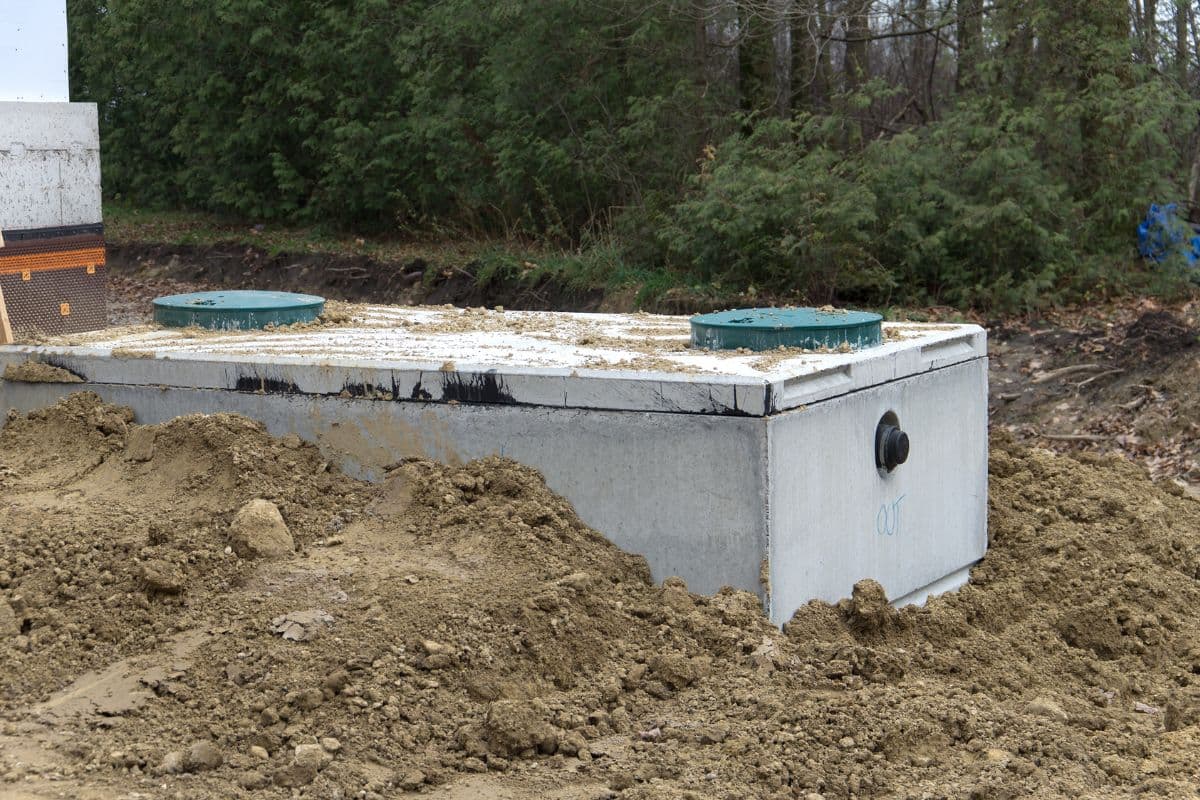
Every septic system is either aerobic (uses oxygen) or anaerobic (doesn't use oxygen). The difference determines how your waste is treated, what the system costs, how much maintenance it needs, and whether it will work on your property at all.
Anaerobic systems cost $3,000 to $8,000. Aerobic systems cost $10,000 to $20,000. But cost alone doesn't determine which system you need — your property's soil conditions and local regulations usually make the decision for you.
An anaerobic septic system is a passive, gravity-fed system with no mechanical components — wastewater flows from the home into a buried tank where solids settle and separate, and liquid effluent drains by gravity to a drainfield for final treatment in the soil. An aerobic treatment unit (ATU) is an active system that introduces oxygen into the treatment process using an electric air pump or compressor, accelerating bacterial breakdown of waste and producing a cleaner effluent that can be discharged in conditions where anaerobic systems cannot meet regulatory standards. The practical ownership difference is significant: an anaerobic system has no moving parts, requires pumping every 3 to 5 years, and has no electricity cost, while an aerobic system has a compressor, pump, and spray heads that require quarterly or annual maintenance by a licensed service provider, consume electricity continuously, and typically carry a mandatory service contract required by the health department. For most homeowners the choice is not a preference decision — it is determined by lot size, soil percolation rate, setback requirements, and local regulations.
How Each System Works
Anaerobic Septic Systems (Conventional)
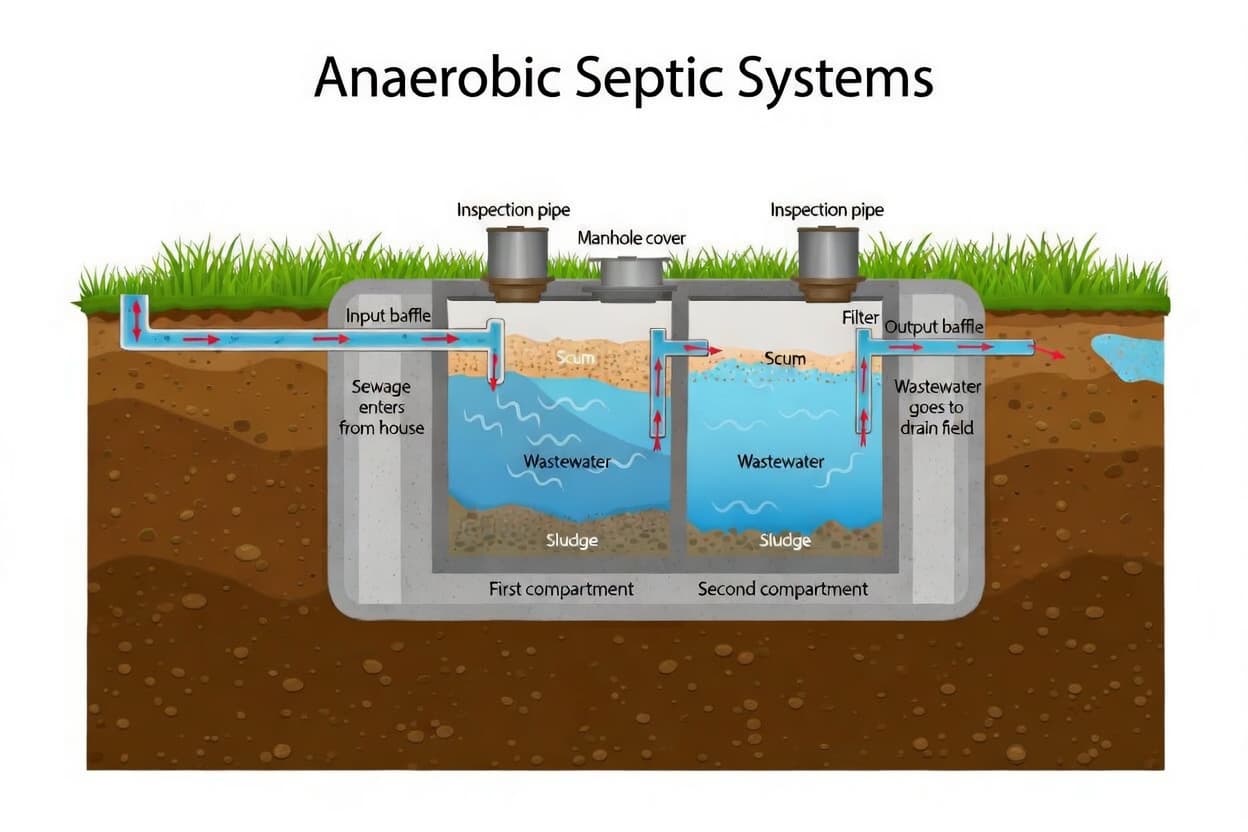
Anaerobic means "without oxygen." In an anaerobic septic system, wastewater flows from your house into a buried tank where bacteria that thrive without oxygen slowly break down organic matter. The process is passive — no mechanical parts, no electricity, no moving components.
Solids settle to the bottom of the tank as sludge. Grease and lightweight materials float to the top as scum. The partially clarified liquid in the middle (effluent) flows out to a drainfield, where it percolates through gravel and soil for final treatment. The soil itself does the remaining purification.
This is the most common septic system in the United States. When someone says "septic system" without any qualifier, they're almost always referring to a conventional anaerobic system.
Aerobic Septic Systems (ATUs)
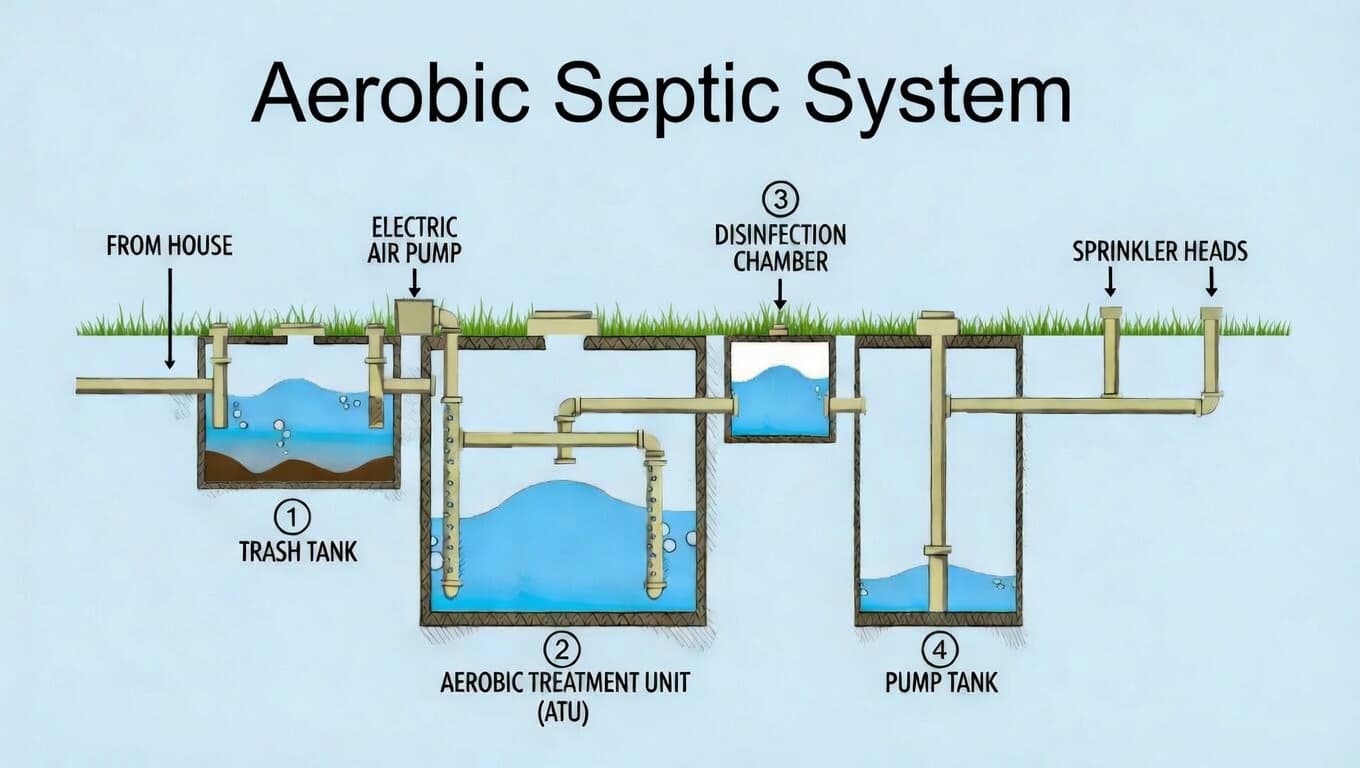
Aerobic means "with oxygen." An aerobic treatment unit (ATU) mechanically injects oxygen into the treatment chamber using an aerator (a device similar to a fish tank bubbler, but industrial-grade). This oxygen creates an environment where aerobic bacteria — which are far more efficient at breaking down waste — thrive.
The process typically uses three chambers: a pre-treatment/trash tank (where solids settle), an aeration chamber (where the aerator injects air and aerobic bacteria do the heavy work), and a clarification chamber (where remaining solids settle out before the treated effluent is discharged).
Because the treatment is more thorough, aerobic systems can use a smaller drainfield, discharge to surface spray systems, or work on properties where soil conditions can't support a conventional drainfield.
Key Differences at a Glance
| Feature | Anaerobic | Aerobic |
|---|---|---|
| How it works | Bacteria break down waste without oxygen | Aerator injects oxygen for faster bacterial breakdown |
| Treatment quality | Removes 60-80% of contaminants | Removes 85-98% of contaminants |
| Installation cost | $3,000 - $8,000 | $10,000 - $20,000 |
| Annual maintenance | Pumping only ($300-$600 every 3-5 years) | $200-$600/year + pumping |
| Electricity needed | No (gravity-fed) | Yes (aerator runs 24/7) |
| Moving parts | None | Aerator, pumps, control panel |
| Drainfield size | Standard (large) | Reduced or surface spray |
| Best for | Properties with good soil and space | Poor soil, small lots, sensitive areas |
| Lifespan | Tank: 40+ years, Drainfield: 15-30 years | Tank: 20-30 years, Components: 2-15 years |
Cost Comparison
The cost gap between these systems is significant, and it extends well beyond the initial installation.
Installation Costs
A conventional anaerobic system (tank + drainfield) costs $3,000 to $8,000 installed. An aerobic treatment unit costs $10,000 to $20,000 installed — two to three times more.
The price difference comes from the aerobic system's mechanical components (aerator, pumps, control panel), more complex tank design (multiple chambers), electrical work, and more involved installation.
Ongoing Costs
Anaerobic systems have minimal ongoing costs: tank pumping every 3 to 5 years ($300 to $600) and occasional inspections. Total annual cost averages $100 to $200.
Aerobic systems cost significantly more to maintain: quarterly inspections, annual maintenance contracts ($200 to $600 per year), electricity for the aerator ($60 to $180 per year), plus pumping. Total annual cost averages $500 to $1,000.
Component Replacement Costs
Anaerobic systems have no mechanical parts to replace. The main long-term cost is eventual drainfield replacement ($5,000 to $15,000) after 15 to 30 years.
Aerobic systems require periodic component replacement: aerator replacement ($500 to $1,000 every 2-10 years), pump replacement ($500 to $1,300 every 7-15 years), and control panel replacement ($300 to $500 every 10-15 years).
Aerobic and anaerobic systems have significantly different installed costs. Aerobic and engineered systems typically run $12,000 to $25,000, while conventional anaerobic systems run $5,000 to $10,000. For a personalized estimate factoring in your home size, soil conditions, and region, use our septic tank cost calculator.
Maintenance Comparison
Anaerobic Maintenance
- • Pumping: Every 3 to 5 years ($300-$600)
- • Inspections: Every 1-3 years (recommended)
- • Effluent filter: Clean at each pumping
- • Drainfield: No direct maintenance needed
- • Total annual cost: $100-$200 average
Aerobic Maintenance
- • Pumping: Every 3 to 5 years ($300-$600)
- • Inspections: Quarterly (often required by permit)
- • Maintenance contract: $200-$600/year (often mandatory)
- • Aerator check: Monthly visual/auditory check
- • Electricity: $60-$180/year for aerator
- • Total annual cost: $500-$1,000 average
The aerator runs continuously. Expect to hear a low hum similar to a refrigerator compressor. If the hum stops, check the aerator immediately — silence means the system isn't getting oxygen.
For a complete breakdown of what aerobic system ownership actually requires month to month, see our aerobic septic system maintenance guide.
Anaerobic System Pros and Cons
Anaerobic Pros
Lower cost
$3,000 to $8,000 installed vs $10,000 to $20,000 for aerobic. The savings extend to maintenance and repairs over the system's life.
No electricity required
Gravity does the work. No aerator, no pump (in most installations), no electrical components. The system functions during power outages.
Minimal maintenance
Pump the tank every 3 to 5 years. That's essentially the entire maintenance program. No quarterly inspections, no annual contracts, no component checks.
No moving parts
Nothing mechanical to break. No aerator to replace, no pump to fail, no control panel to malfunction. This dramatically reduces repair frequency and cost.
Longer component lifespan
Concrete tanks last 40+ years. Without mechanical components, there's simply less that can go wrong.
Most resilient bacteria
Anaerobic bacteria are hardy organisms. They're less affected by household chemicals, temperature changes, and usage fluctuations than aerobic bacteria.
Anaerobic Cons
Requires suitable soil
The drainfield depends on soil that passes a percolation test. Clay soil, rocky ground, or high water tables make conventional systems impossible.
Requires more space
A conventional drainfield is large. Most codes require a primary drainfield plus a designated reserve area for future replacement. Small lots may not qualify.
Lower treatment quality
Anaerobic systems remove only 40 to 60% of contaminants in the tank itself. The soil in the drainfield does the remaining treatment, which is why soil quality is so critical.
Slower processing
Anaerobic bacteria digest waste more slowly than aerobic bacteria. This is why the tank needs to be large enough to allow adequate retention time.
Aerobic System Pros and Cons
Aerobic Pros
Superior treatment quality
Aerobic systems remove 85% to 98% of contaminants, producing effluent clean enough for surface discharge in many jurisdictions. This is critical near sensitive water bodies.
Works on difficult properties
Properties that fail perc tests, have high water tables, shallow bedrock, or limited space can often use an aerobic system when conventional systems aren't possible.
Smaller drainfield
Because the effluent is already highly treated, the drainfield can be smaller or replaced with a surface spray system. This is the key advantage for small lots.
Faster waste processing
Aerobic bacteria break down waste 20 to 30 times faster than anaerobic bacteria. This means smaller tanks can handle the same volume of wastewater.
Aerobic Cons
Higher installation cost
$10,000 to $20,000, two to three times the cost of a conventional anaerobic system.
Ongoing electricity costs
The aerator runs continuously. Expect $5 to $15 per month in added electricity costs.
More frequent maintenance
Aerobic systems require quarterly inspections in many jurisdictions and an annual maintenance contract as a condition of the operating permit. Maintenance costs run $200 to $600 per year beyond pumping.
Mechanical failures
Aerators, pumps, and control panels are mechanical components that wear out. Aerator replacement costs $500 to $1,000. Pump replacement costs $500 to $1,300.
Vulnerable to power outages
Extended power loss shuts down the aerator, depriving the bacteria of oxygen. Prolonged outages can harm or kill the aerobic bacterial colony, temporarily reducing treatment quality.
Bacteria are less resilient
Aerobic bacteria are more sensitive to temperature extremes, chemical exposure (bleach, antibacterial products), and environmental changes than anaerobic bacteria.
Which System Do You Need?
In most cases, the decision is made for you by your property's site conditions and local regulations.
| Your Situation | System Required |
|---|---|
| Property passes perc test, adequate drainfield space | Anaerobic (conventional) |
| Property fails perc test | Aerobic, mound, or other alternative |
| Small lot with limited drainfield space | Aerobic |
| High water table or shallow bedrock | Aerobic or mound |
| Near a sensitive water body (lake, stream, wetland) | Aerobic (higher treatment quality required) |
| Local code mandates aerobic for your zone | Aerobic |
| Budget is the primary constraint, and the site allows conventional | Anaerobic |
The one question that determines everything: Does your property pass a perc test with enough space for a conventional drainfield? If yes, anaerobic is almost always the better choice (simpler, cheaper, less maintenance). If no, you need an alternative system, and aerobic is the most common solution.
Which System Do You Need?
| Your Situation | System Required | Reason |
|---|---|---|
| Soil passes perc test, lot large enough for standard drainfield | Anaerobic (conventional) | Standard gravity system is approvable — no reason to pay for aerobic |
| Soil fails perc test (too slow or too fast) | Aerobic or alternative system | Conventional drainfield cannot achieve adequate treatment in failing soil |
| Lot too small for required drainfield setbacks | Aerobic or mound system | Smaller footprint of aerobic discharge area may fit where conventional cannot |
| Property in environmentally sensitive area (lake shore, coastal zone, Chesapeake Bay watershed) | Aerobic required | Higher effluent standard required to protect groundwater and surface water |
| Texas or state with widespread ATU regulations | Aerobic likely required | Many Texas counties default to aerobic regardless of soil conditions |
| Shallow water table (less than 4 feet to seasonal high) | Aerobic or mound system | Conventional drainfield needs adequate soil depth for treatment before groundwater contact |
| Existing anaerobic system functioning, 10+ years of life remaining | Keep anaerobic system | No financial or regulatory justification to switch |
| Existing anaerobic system at end of life, soil still passes perc test | Replace with anaerobic | Simpler, cheaper, no ongoing service contract obligation |
| Existing anaerobic system failed, soil now failing perc test | Aerobic or alternative system | Failing soil from drainfield overload may no longer support conventional replacement |
| Buying a home with an aerobic system | Verify service contract is current and transferable | Lapsed service contract is a permit violation that transfers with the property |
| Buying a home with an anaerobic system | Confirm tank size, last pump date, and drainfield condition | No service contract required but inspection history matters |
| Adding bedrooms or ADU to existing system | Re-evaluate system capacity for new bedroom count | Both system types must be sized for maximum calculated occupancy |
Frequently Asked Questions
What is the difference between aerobic and anaerobic septic systems?
Which system costs more to install and maintain?
Can I choose which system I want?
What maintenance does each system require?
What happens if an aerobic system loses power or the compressor fails?
Can an aerobic system be converted back to anaerobic?
Are aerobic systems better for the environment?
Glossary
Related Guides
On theseptic.guide
Complete Septic System Guide
The foundational reference covering how both anaerobic and aerobic septic systems work, how each component functions, and what every homeowner needs to know before making any system decision.
Septic System Installation Cost 2026
Full price breakdown for new system installation by type, including conventional anaerobic systems, aerobic treatment units, mound systems, and alternative technologies.
Septic System Repair Cost 2026
Every repair type priced out for both anaerobic and aerobic systems, including compressor replacement, pump replacement, drainfield repair, and spray head servicing.
Septic System Maintenance Checklist
The full maintenance schedule for both system types, including what a licensed aerobic service visit covers, what anaerobic pumping visits should include, and how often each task needs to be done.
How Often Should You Pump Your Septic Tank?
Pumping intervals by tank size and household size for anaerobic systems, and how aerobic system service schedules differ from conventional pumping schedules.
Septic Tank Pumping Cost 2026
What anaerobic system pump-outs cost by tank size and region, and how aerobic system service contract costs compare to conventional pumping costs over time.
Signs Your Drainfield Is Failing
Warning signs that apply to both system types, and how drainfield failure in an aerobic system differs from failure in a conventional anaerobic system.
Drainfield Replacement Cost 2026
Replacement costs for conventional, mound, and alternative drainfield configurations used with both system types.
Best Septic System Alarms
Monitoring options for aerobic systems, including alarms that alert homeowners to compressor failure, high effluent levels, and pump malfunctions before they become permit violations.
Septic Tank Size Guide
How tank sizing works for both conventional anaerobic systems and aerobic treatment units, and when aerobic systems require additional pre-treatment or pump chambers.
How Long Does a Septic System Last?
Expected lifespan by system type, including how aerobic system component lifespans differ from the lifespan of passive anaerobic systems.
Buying a Home with a Septic System
What to verify before closing on a property with either system type, including how to confirm an aerobic system's service contract status and permit compliance.
Selling a Home with a Septic System
How aerobic system permit status, service contract history, and inspection records affect disclosure obligations and buyer negotiations differently than anaerobic systems.
Septic vs Sewer
How the higher ongoing cost of aerobic system ownership factors into the 20-year cost comparison between staying on septic and converting to municipal sewer.
Concrete vs Plastic vs Fiberglass Septic Tanks
How tank material choices apply to both conventional anaerobic tanks and the pre-treatment tanks used in aerobic treatment unit installations.
Septic Dos and Don'ts
What household practices protect both system types, including specific aerobic system rules around spray zone safety, disinfectant tablet maintenance, and what never to flush.
From Our Network
Does Homeowners Insurance Cover Basement Flooding?
For homes with aerobic systems that use surface spray irrigation, understanding how insurance treats water damage from system malfunctions is relevant alongside the septic permit and maintenance obligations covered in this guide.
Best Sump Pumps 2026
Aerobic system installations in high water table areas are often paired with basement or crawl space drainage improvements. This guide covers pump selection for below-grade water management alongside the above-grade aerobic system work.
External Resource
Need Help Choosing a Septic System?
Connect with licensed septic professionals in your area. Get free, no-obligation quotes and expert guidance on which system is right for your property.
Get Free QuotesGet Expert Septic Help
Connect with qualified septic professionals in your area. Free quotes, no obligation.