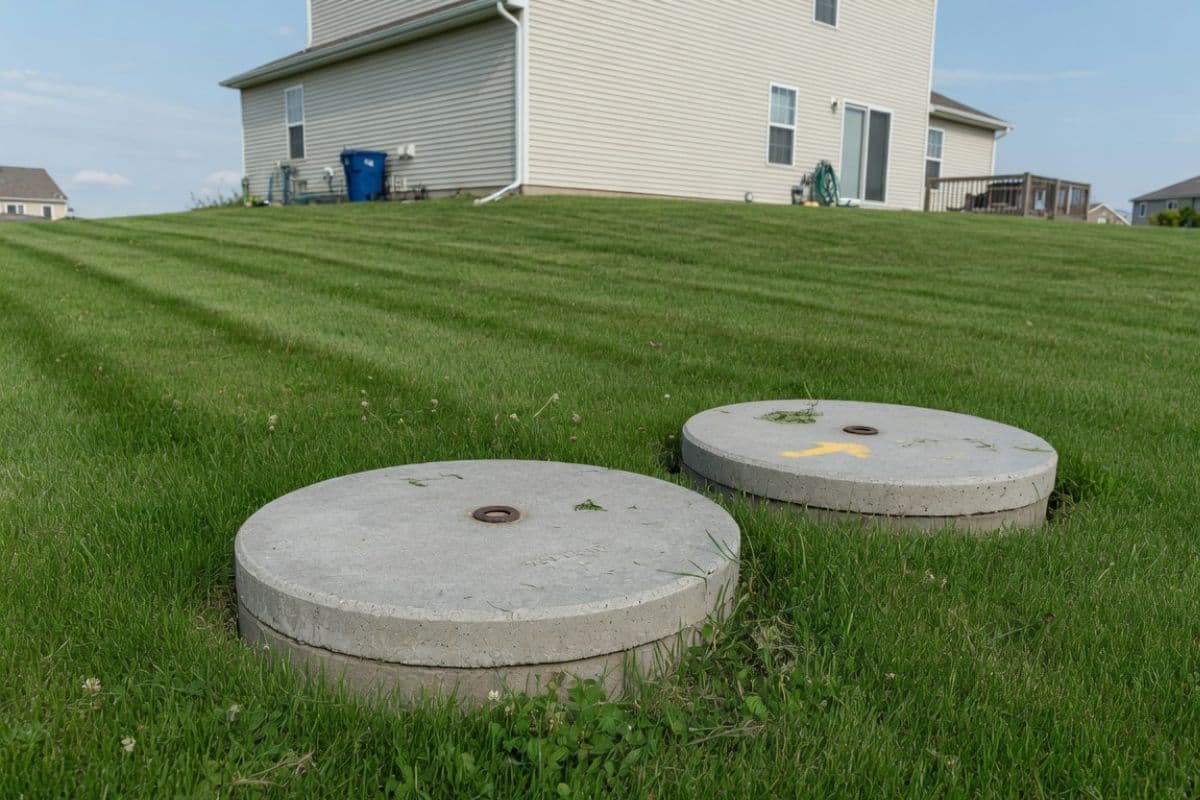
A holding tank stores wastewater. A septic system treats it. That single difference determines everything about cost, maintenance, and long-term viability for your property.
A holding tank is a sealed, watertight container buried in the yard that collects all household wastewater — toilets, sinks, showers, laundry. Nothing leaves the tank except through a pump truck. A septic system includes a tank where solids settle and bacteria break down waste, plus a drain field where clarified liquid is dispersed into the soil for final treatment. The septic system is a complete treatment cycle. The holding tank is just storage.
For full-time residential use, the cost difference over 10 years is enormous: $30,000 to $120,000 more for a holding tank versus a septic system. That number is not an error. It is the result of pumping a holding tank every 4 to 8 weeks versus pumping a septic tank every 3 to 5 years. Understanding when each system is appropriate — and when a holding tank is your only legal option — is the purpose of this guide.
The Permanent vs Temporary Rule
The simplest way to understand the holding tank vs septic tank decision: a septic system is a permanent wastewater solution. A holding tank is a temporary one.
A properly installed and maintained septic system handles a household's wastewater indefinitely. Solids are broken down by bacteria in the tank, liquid effluent is treated as it percolates through the drain field soil, and the system operates passively with no ongoing input other than periodic pumping every 3 to 5 years.
A holding tank provides no treatment. It fills up. When it fills, you pay $200 to $560 to have it pumped. For a family of four generating 200 to 300 gallons of wastewater per day, a 1,000-gallon holding tank fills in 3 to 5 days. Even a 2,000-gallon tank fills in 7 to 10 days. At that rate, you are scheduling pump-outs every 4 to 8 weeks at a minimum and often more frequently.
This operating cost is why holding tanks are typically installed as temporary solutions — during construction while a permanent system is being built, on seasonal properties with limited use, or on lots where soil conditions make a drain field impossible and no alternative treatment system is feasible.
Regulatory Warning
In many jurisdictions, holding tanks are not permitted for full-time residential use. Some counties allow them only as temporary installations with a defined timeline for conversion to a permanent system. Others require a bond or escrow deposit to guarantee the homeowner can cover pumping costs. Before installing a holding tank, confirm with your county health department that a holding tank is legally permitted for your intended use and duration.
How Each System Works
Holding Tank
A holding tank is a sealed container — concrete, fiberglass, or polyethylene — buried in the yard. Household wastewater flows by gravity from the home into the tank through a single inlet pipe. There is no outlet pipe. Nothing leaves the tank except through the pumping hatch on top.
An alarm system is required in most jurisdictions. The alarm activates when the tank reaches approximately 75 percent of capacity, giving the homeowner time to schedule a pump-out before the tank is completely full. If the tank fills beyond capacity and the homeowner continues using water, sewage will back up into the home through the lowest drain.
There is no bacterial treatment, no settling process designed to separate solids from liquids, and no dispersal into the soil. The holding tank is purely a storage vessel.
Septic System
A conventional septic system has two components: the septic tank and the drain field. Wastewater flows from the home into the septic tank, where it separates into three layers: a floating scum layer of fats and light solids on top, a middle layer of clarified liquid (effluent), and a bottom layer of settled solids (sludge). Anaerobic bacteria in the tank slowly break down the solids over time.
The clarified effluent in the middle layer flows out of the tank through an outlet pipe into the drain field — a network of perforated pipes buried in gravel trenches. The effluent percolates through the gravel and into the native soil, where naturally occurring soil bacteria complete the treatment process before the water reaches the groundwater table.
The system operates passively by gravity in most installations. No electricity, no moving parts. Pumping every 3 to 5 years removes accumulated sludge and scum that the bacteria cannot fully break down. See our septic tank pumping guide for pumping intervals by tank and household size.
For properties where soil conditions do not support a conventional drain field, alternative systems such as aerobic treatment units, mound systems, or pressure-dosed systems can provide treatment where conventional systems cannot.
Side-by-Side Comparison Table
| Feature | Holding Tank | Septic System |
|---|---|---|
| Function | Stores wastewater only | Treats and disperses wastewater |
| Treatment | None | Bacterial breakdown + soil filtration |
| Drain field | None | Required |
| Pumping frequency | Every 4 to 8 weeks (full-time) | Every 3 to 5 years |
| Annual pump cost (full-time) | $3,000 to $12,000 | $60 to $200 (amortized) |
| Installation cost | $3,000 to $8,000 | $5,000 to $15,000 |
| Soil requirements | None (no drain field) | Must pass percolation test |
| Moving parts | Alarm sensor only | None (conventional) |
| Alarm required | Yes (mandatory) | Recommended, not always required |
| Best for | Temporary use, seasonal properties | Full-time residential |
| Lifespan | Tank: 20 to 40 years | Tank: 40+ years, Drain field: 15 to 30 years |
Cost Comparison: Installation
A holding tank costs less to install because there is no drain field. But installation cost is a small fraction of the total cost of ownership for either system.
| Cost Item | Holding Tank | Conventional Septic System |
|---|---|---|
| Tank | $1,500 to $4,000 | $1,500 to $5,000 |
| Drain field | N/A | $2,000 to $6,000 |
| Excavation and labor | $1,000 to $2,500 | $1,500 to $4,000 |
| Alarm system | $150 to $500 (required) | $0 to $300 (recommended) |
| Permits | $200 to $500 | $300 to $1,000 |
| Total installed | $3,000 to $8,000 | $5,000 to $15,000 |
See our septic system installation cost guide for a full breakdown of conventional and alternative system installation costs.
Cost Comparison: 10-Year Operating Cost
This is where the difference becomes dramatic. A holding tank's operating cost for full-time use dwarfs the installation cost within the first two years.
| Scenario | Holding Tank (10-Year Total) | Septic System (10-Year Total) |
|---|---|---|
| Full-time family of 4 | $33,000 to $128,000 | $5,600 to $17,000 |
| Full-time couple | $18,000 to $68,000 | $5,400 to $16,200 |
| Vacation home (60 days/year) | $7,000 to $42,000 | $5,300 to $15,600 |
| Seasonal cabin (30 days/year) | $5,000 to $19,600 | $5,200 to $15,400 |
10-year totals include installation plus operating costs (pumping, inspections, and repairs). The holding tank column assumes $200 to $560 per pump-out at the frequency required for each usage level. The septic system column includes pumping every 3 to 5 years plus a $500 inspection reserve.
When a Holding Tank Is the Right Choice
An existing septic system with a frozen drainfield also operates temporarily as a holding tank, with wastewater removed by truck until the soil thaws.
Soil cannot support a drain field: If the soil fails a percolation test due to clay content, shallow bedrock, or a high water table, and no alternative septic system is feasible for the site, a holding tank may be the only legal option for on-site wastewater management.
Temporary installation during construction: New construction on properties where the permanent septic system permit is pending or the system is being installed can use a holding tank as a bridge. This is the most common use case for holding tanks in residential construction.
Seasonal or very low-use properties: A cabin used 20 to 30 days per year may need only 2 to 4 pump-outs annually, making the operating cost manageable. The lower installation cost of a holding tank versus a full septic system can make economic sense when annualized over low-use scenarios.
Lots too small for a drain field: Some waterfront properties, in-fill lots, or densely subdivided rural parcels simply do not have the space for drain field trenches at the setback distances required by the health department. A holding tank fits in a smaller footprint because no drain field is needed.
Properties awaiting sewer connection: If a municipal sewer line extension is planned but not yet completed, a holding tank can provide interim wastewater management until the connection is available.
When a Septic System Is the Right Choice
Any full-time residential use: If the property supports a drain field and will be occupied year-round, a septic system is the correct choice in virtually every scenario. The 10-year cost comparison is not close.
Properties with suitable soil: If the soil passes a percolation test and the lot has space for drain field trenches at required setbacks, a conventional septic system is the standard, lowest-cost permanent solution.
Properties with marginal soil: If the soil fails a conventional percolation test, alternative septic systems (aerobic treatment units, mound systems, pressure-dosed systems) can treat wastewater to a higher standard and disperse it in conditions where conventional systems cannot. These alternatives cost more than a conventional system ($10,000 to $25,000) but still cost dramatically less to operate over 10 years than a holding tank. See our aerobic vs anaerobic comparison for details.
Any property where the holding tank was installed as a temporary measure: If a holding tank was installed during construction or while waiting for a permit, converting to a permanent septic system as soon as the site and permits allow is almost always the right financial decision.
Maintenance Requirements Comparison
| Maintenance Task | Holding Tank | Septic System |
|---|---|---|
| Pumping | Every 4 to 8 weeks (full-time) | Every 3 to 5 years |
| Alarm check | Monthly (mandatory) | Annually (if equipped) |
| Tank inspection | At each pump-out | Every 1 to 3 years |
| Drain field care | N/A | Keep area clear, no vehicles or deep roots |
| Effluent filter | N/A | Clean every 1 to 2 years |
| Water conservation priority | Critical (every gallon adds cost) | Important but less urgent |
For the complete septic system maintenance schedule, see our septic system maintenance checklist. For aerobic system-specific maintenance, see our aerobic septic system maintenance guide.
How to Identify Which System You Have
If you bought a property and are not sure whether you have a holding tank or a septic system, here are the diagnostic indicators:
Check the property records: The county health department maintains permits for both holding tanks and septic systems. The permit will state which system type was installed and the tank capacity.
Look for a drain field: A septic system has a drain field — typically an area of the yard where the grass grows unusually well (fed by nutrient-rich effluent) and where you may see inspection ports (small capped pipes) at the ends of the trench lines. A holding tank has no drain field.
Check for an alarm: Holding tanks are required to have a level alarm. If you have an alarm panel in the house or garage that monitors tank level, you likely have a holding tank. Septic systems may have alarms but they are not universally required.
Ask the pumping company: If the system has been pumped regularly, the pumping company will know whether it is a holding tank or septic tank based on the pumping frequency and the presence or absence of an outlet.
For a thorough system evaluation, see our septic system inspection guide.
Frequently Asked Questions
What is the main difference between a holding tank and a septic tank?
A holding tank is a sealed container that stores all household wastewater with no treatment or dispersal. It must be pumped every 4 to 8 weeks for a full-time household. A septic tank is part of a treatment system that uses bacterial action to break down solids, then disperses clarified effluent into a drain field. A septic system requires pumping every 3 to 5 years. The holding tank stores everything; the septic system treats and disperses it.
How much does it cost to pump a holding tank vs a septic tank?
A single pump-out costs $200 to $560 for both systems depending on tank size and location. The cost difference comes from frequency. A full-time household pumps a holding tank every 4 to 8 weeks, spending $3,000 to $12,000 per year. The same household pumps a septic tank every 3 to 5 years, spending $60 to $200 per year amortized over the service interval. Over 10 years, a full-time family spends $30,000 to $120,000 more on a holding tank than on a septic system.
Can I convert a holding tank to a septic system?
In most cases yes. Converting requires passing a soil percolation test, obtaining permits, and installing a drain field. The drain field installation typically costs $1,500 to $5,000 for a conventional system in suitable soil. If the soil failed the original percolation test, alternative systems such as a mound system or aerobic treatment unit may be required at higher cost. The existing holding tank can sometimes be repurposed as the septic tank if it meets size and baffle requirements.
Is a holding tank bad for the environment?
A properly maintained holding tank pumped on schedule is environmentally safe. The risk comes from overflow — if not pumped in time, raw sewage can surface in the yard or run off toward water sources. Some jurisdictions require homeowners to post a bond when installing a holding tank for residential use specifically because of this overflow risk. A septic system, by contrast, provides continuous treatment and dispersal that does not depend on scheduled service visits to prevent overflow.
How often does a holding tank alarm go off?
A holding tank alarm activates when the tank reaches approximately 75 percent of capacity. For a full-time household filling a 1,000-gallon tank in 3 to 5 days, the alarm may sound every 2 to 4 days if pumping is not arranged promptly. When the alarm activates, schedule a pump-out immediately. Do not silence the alarm and continue normal water use — the tank will reach capacity and sewage will back up into the home through the lowest drain.
Can a vacation home use a holding tank long-term?
Yes, a holding tank can be a reasonable long-term solution for a vacation property used less than 60 days per year. At that usage level, 2 to 6 pump-outs per year at $200 to $560 each results in $400 to $3,400 in annual operating costs. This may be comparable to or less than the amortized cost of installing a full septic system. Confirm that a holding tank is legally permitted for the property and use case in your jurisdiction before committing to this approach.
What is the minimum holding tank size for a residential property?
Most jurisdictions require a minimum holding tank capacity of 1,000 gallons for residential use, though some states such as Nevada require a minimum of 2,000 gallons. A family of four generating 200 to 300 gallons per day fills a 1,000-gallon tank in 3 to 5 days. Upsizing to a 1,500 or 2,000-gallon tank extends the pump interval to 5 to 10 days and reduces the number of annual pump-outs required.
How do I know if my soil will pass a percolation test for a septic system?
A soil percolation test measures how quickly water drains through the ground. Clay-heavy soils drain slowly and often fail. Sandy or loamy soils drain well and typically pass. Shallow soils over bedrock or high water table soils also fail. A licensed soil scientist or septic engineer performs the test, which costs $250 to $1,000. If your soil fails, a conventional septic system cannot be permitted and alternative systems or a holding tank become the options.
Related Guides
Frozen Septic System
Find the freeze, compare thawing costs, and prevent a repeat next winter.
Septic System Installation Cost
Full breakdown of installation costs by system type, including conventional, aerobic, and mound systems.
Aerobic vs Anaerobic Septic Systems
How aerobic and anaerobic treatment systems compare on cost, maintenance, and performance.
Septic System Maintenance Checklist
Complete maintenance schedule by system type and season.
Aerobic Septic System Maintenance
Specific maintenance requirements for aerobic treatment units.
How Often to Pump Septic Tank
Pumping intervals by tank size and household size.
External Resource
Glossary
Holding tank
A sealed, watertight container that stores all household wastewater without treatment or dispersal. Must be pumped regularly by a licensed hauler. No outlet pipe, no drain field, no treatment process. Also called a holding vessel or cesspool in some jurisdictions (though cesspools technically allow some seepage, holding tanks do not).
Septic tank
The first component of a septic system. A buried tank (concrete, fiberglass, or polyethylene) where household wastewater separates into three layers: scum (floating solids), effluent (clarified liquid), and sludge (settled solids). Anaerobic bacteria partially break down organic matter. Clarified effluent flows to the drain field for final treatment.
Drain field (leach field)
The soil absorption component of a septic system. A network of perforated pipes buried in gravel-filled trenches that distributes clarified effluent from the septic tank into the native soil. Naturally occurring soil bacteria provide final treatment as effluent percolates through the soil layers before reaching the water table.
Percolation test (perc test)
A soil test that measures how quickly water drains through the ground at a specific site. Required before a septic system permit is issued. The test determines whether the soil can absorb effluent at the rate required for the proposed system size. Failing a perc test means a conventional drain field cannot be used and alternative systems or a holding tank become the options.
Effluent
The clarified liquid that flows from the septic tank to the drain field. Effluent has been partially treated by bacterial action in the tank but still contains dissolved contaminants that require further treatment in the soil. In a holding tank, effluent does not exist as a separate output because nothing leaves the tank.
Anaerobic bacteria
Bacteria that thrive in oxygen-free environments. In a septic tank, anaerobic bacteria break down organic solids in the sludge and scum layers. The process is slow compared to aerobic treatment but requires no mechanical input or electricity. The by-products include methane and hydrogen sulfide (which causes the characteristic septic smell).
Level alarm
A sensor and alarm system required in holding tanks that activates when the tank reaches approximately 75 percent of capacity. Provides advance warning to schedule a pump-out before the tank is full. Ignoring the alarm leads to sewage backup into the home through the lowest drain point.
Pump-out
The process of removing accumulated wastewater (holding tank) or sludge and scum (septic tank) using a vacuum pump truck. A licensed hauler transports the waste to an approved disposal facility. Cost per visit is $200 to $560 depending on tank size and access. The critical difference: a holding tank pump-out removes all contents; a septic tank pump-out removes accumulated solids while the system continues to function between visits.
Need Help Choosing a System?
Connect with licensed septic professionals in your area. Get free, no-obligation quotes and expert guidance on which system is right for your property.
Get Free QuotesGet Expert Septic Help
Connect with qualified septic professionals in your area. Free quotes, no obligation.