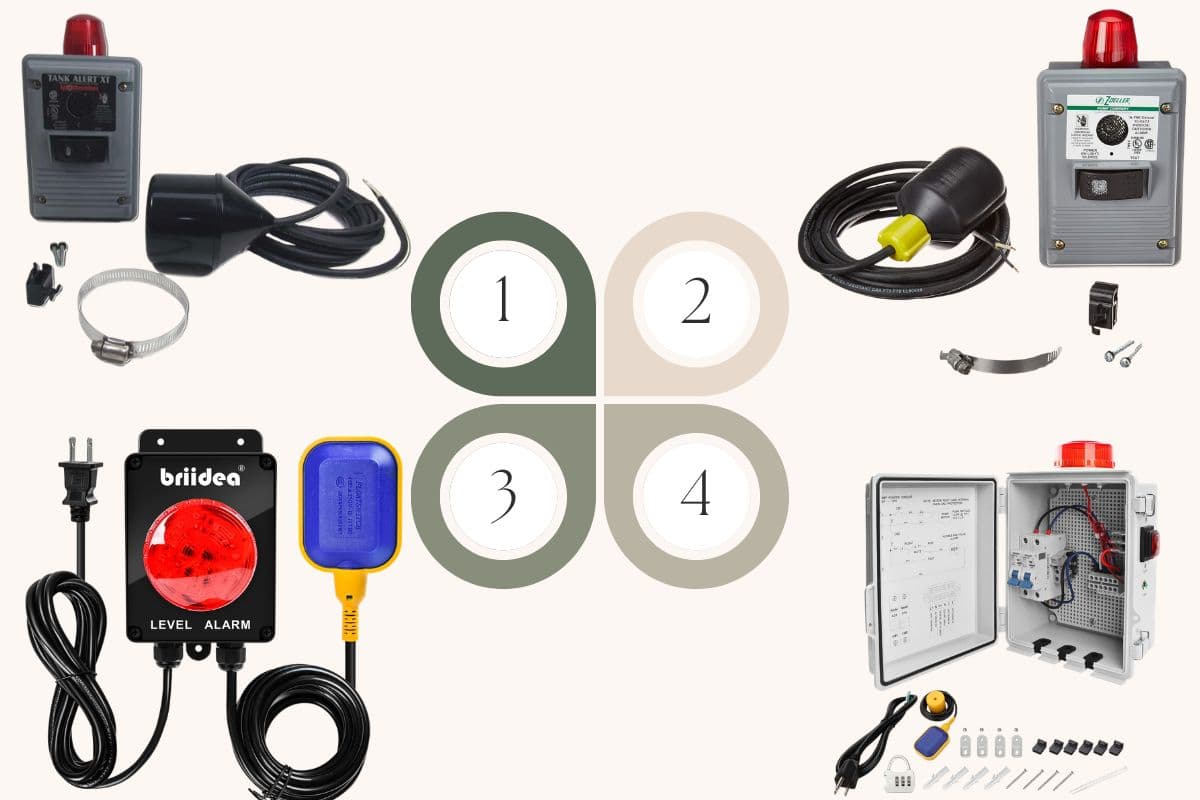
A septic system alarm is a monitoring device that uses a float switch inside a septic tank or pump chamber to detect dangerously high water levels and alert homeowners with an audible horn, warning light, or smartphone notification before sewage backs up into the home. The best septic system alarms in 2026 cost $30 to $200, feature weatherproof enclosures rated NEMA 4X or IP67, include float switches with 10 to 20 foot cords, and produce alarm volumes of 90 to 110 decibels. Septic alarms are required by code for systems with effluent pumps, aerobic treatment units, and mound systems, and are recommended as inexpensive insurance for any septic system. This guide reviews the 5 best septic alarms, explains how they work, covers DIY vs professional installation, and tells you exactly what to do when your alarm goes off.
Who Needs a Septic Alarm
Not every septic system requires an alarm, but many do and most would benefit from one.
Required by Code
If you have an aerobic treatment unit (ATU), a pump chamber, a dosing system, or a mound system with a lift pump, your local health department almost certainly requires a high-water alarm. These systems depend on mechanical pumps to move effluent. When the pump fails, the tank overflows. An alarm is your only warning. If your system has any kind of pump, you need an alarm. Full stop.
Not Required but Smart
Conventional gravity-fed septic systems do not typically require an alarm by code. But if your tank has ever backed up, if your drainfield is aging, or if you live in an area with heavy seasonal rain, an alarm is cheap insurance. It alerts you to rising water levels before they become an emergency. For $30 to $50 you get days of advance warning instead of a surprise sewage backup.
How Septic Alarms Work
Every septic alarm has the same basic components: a float switch inside the tank, a wire running to a control box outside the tank, and an alert system (horn, light, or both).
The float switch hangs inside the tank or pump chamber at a height you set. When the water level rises above that point, the float tips and closes an electrical circuit. That circuit triggers the alarm.
The control box is mounted on an exterior wall, a post near the tank, or inside the house depending on the model. When it receives the signal from the float, it activates a horn and a warning light. Most models let you silence the horn while the light stays on as a reminder.
💡 Setting the Trigger Height
The float should be positioned a few inches above the normal operating level but well below the inlet pipe. This gives you a warning window of several hours to a couple of days before the tank actually overflows. Your septic professional can set this during a routine pumping visit.
What Features Actually Matter
| Feature | Why It Matters | What to Look For |
|---|---|---|
| Weatherproof rating | Outdoor installations need water resistance | NEMA 4X or IP67 minimum |
| Float switch length | Must reach correct depth inside the tank | 10 ft minimum, 15–20 ft for deep tanks |
| Audible alarm volume | You need to hear it from inside the house | 90 dB minimum, 110 dB preferred |
| Visual indicator | See alarm status at a glance, day or night | Red LED or beacon that stays on |
| Battery backup | Power outages are when pumps fail most often | 9V or AA battery backup recommended |
| Auto-reset | Clears itself once water drops below float | Saves a trip outside to manually reset |
| WiFi or cellular alerts | Notifies you when you are away from home | Important for vacation homes or rentals |
What does not matter much: brand name alone, enclosure color, smart home integration beyond basic notifications, and multi-zone monitoring unless you have multiple pump chambers.
Quick Comparison
| Pick | Product | Type | Alert Method | Float Length | Price Range |
|---|---|---|---|---|---|
| Best Overall | SJE Rhombus Tank Alert XT | Indoor/outdoor hardwired | Horn + red beacon | 15 ft | $130–$180 |
| Best Indoor | Zoeller A-Pak Alarm | Indoor hardwired | Horn + LED | 15 ft | $80–$120 |
| Best Budget | Briidea High Water Alarm | Indoor/outdoor hardwired | 110 dB horn + LED | 10 ft | $30–$50 |
| Best WiFi | Sump Alarm WiFi Sensor | Indoor/outdoor WiFi | 90 dB horn + email/text | 20 ft | $130–$200 |
| Best All-in-One | CINVEI Control Panel | Indoor/outdoor hardwired | 110 dB horn + lights | 10 ft | $60–$90 |
Which Septic Alarm Is Right for Your Situation?
| Your Situation | Our Pick | Why |
|---|---|---|
| Most homeowners (primary residence with pump) | SJE Rhombus Tank Alert XT | Industry standard, trusted by installers, auto-reset, doubles as junction box |
| Budget is the priority | Briidea High Water Alarm | Under $50, loudest on list at 110 dB, plug-and-play, no electrician needed |
| Want indoor mounting in basement or utility room | Zoeller A-Pak | Battery backup for power outages, auto-reset, 3-year warranty |
| Vacation home or rental property | Sump Alarm WiFi Sensor | Free email alerts, server-side backup detects power and internet loss remotely |
| Travel frequently or away from home often | Sump Alarm WiFi Sensor | Remote notifications mean you know about problems even when you are not on-site |
| Installing a new pump chamber | CINVEI Control Panel | Combined alarm plus pump circuit breaker, complete solution in one box |
| Worried about power outages | Zoeller A-Pak | Only alarm on this list with battery backup that monitors during outages |
| Aerobic treatment unit (ATU) | SJE Rhombus Tank Alert XT | Professional-grade reliability for code-required alarm on mechanical systems |
| Want the simplest DIY install | Briidea High Water Alarm | Mount, drop float, plug in — done in 15 minutes |
Detailed Reviews
SJE Rhombus Tank Alert XT
Best Overall · $130–$180
SJE Rhombus is the brand that septic installers use. The Tank Alert line has been the industry standard for decades, and the XT model is the workhorse. The entire upper half of the enclosure illuminates red in an alarm condition, making it visible from a distance in any lighting. The horn sounds immediately and can be silenced while the beacon stays on until the water level drops and the alarm auto-resets.
The enclosure doubles as a junction box with pre-mounted terminal blocks, which means your electrician can splice pump power, pump switch, and alarm power in the same box. This reduces the number of boxes on your wall and keeps wiring clean.
Pros
- ✓ Industry standard trusted by septic installers
- ✓ NEMA 3R weatherproof enclosure
- ✓ Entire top half illuminates red as beacon
- ✓ Auto-reset when water level drops
- ✓ Doubles as junction box for clean wiring
Cons
- ✕ No WiFi or smartphone notifications
- ✕ Requires 120V circuit and electrician
- ✕ No battery backup
- ✕ Proprietary SJE float switch for replacements
Zoeller A-Pak Indoor Alarm
Best Indoor Alarm · $80–$120
Zoeller is one of the most recognized names in residential wastewater, and the A-Pak is their flagship alarm for homeowners. It mounts on a basement or utility room wall and connects to a float switch that runs into the tank or pump chamber. The alarm auto-resets when the condition clears.
The battery backup is the standout feature. When the power goes out, which is exactly when your septic pump stops working, the A-Pak continues monitoring on two AA batteries. A low-battery chirp tells you when the batteries need replacing.
Pros
- ✓ AA battery backup for power outages
- ✓ Auto-reset when condition clears
- ✓ 15 ft float cord
- ✓ 3-year warranty (5 years on Z-Control)
Cons
- ✕ Indoor only, not weatherproof
- ✕ Must route float wire into house
- ✕ WiFi only on pricier Z-Control models
Briidea High Water Septic Alarm
Best Budget Pick · $30–$50
The Briidea alarm delivers the two things that matter most, a loud horn and a reliable float switch, at a fraction of the price of the professional brands. The 110 dB alarm is louder than both the SJE Rhombus and the Zoeller. The IP67-rated enclosure handles rain, snow, and temperature extremes.
Installation is plug-and-play: mount the box, drop the float into the tank at the height you want, and plug it in. No electrician needed. The 2024 and newer models include a test button and a green power indicator light.
Pros
- ✓ 110 dB alarm — loudest on this list
- ✓ IP67 weatherproof enclosure
- ✓ Plug-and-play, no electrician needed
- ✓ Under $50 with test button included
Cons
- ✕ 10 ft float cable (shorter than others)
- ✕ No battery backup
- ✕ No WiFi or remote notifications
Sump Alarm WiFi Septic Sensor
Best WiFi Alarm · $130–$200
Sump Alarm is a St. Louis-based company that makes every unit in the USA. Their WiFi-enabled septic alarm is the first outdoor-rated WiFi high-water alarm on the market. The alarm pairs with your home WiFi and sends free, unlimited email alerts when the float triggers. For $1.99 per month you can add text and voice call alerts.
The server-side backup is what separates this from cheaper WiFi alarms. If your power goes out or your internet drops, the Sump Alarm server detects the disconnect and notifies you. The 20-foot heavy-duty float is the longest standard float on this list.
Pros
- ✓ Free unlimited email alerts
- ✓ Server-side backup detects power/internet loss
- ✓ 20 ft heavy-duty float (longest on list)
- ✓ Made in USA, IP67 weatherproof
Cons
- ✕ Requires 2.4 GHz WiFi at mounting location
- ✕ 90 dB horn (quieter than Briidea/CINVEI)
- ✕ Text/voice alerts require $1.99/month subscription
CINVEI Septic Control Panel
Best All-in-One · $60–$90
The CINVEI is not just an alarm. It is a control panel that combines a high-water alarm, a pump circuit breaker, and a float switch in a single weatherproof enclosure. For homeowners installing a new pump chamber or replacing an old alarm panel, this is a complete solution out of the box.
The built-in pump circuit breaker is the differentiator. If your pump draws too much current, a sign of a failing motor or a jammed impeller, the breaker trips before the pump burns out. This protects a $500 to $1,500 pump from damage.
Pros
- ✓ Combined alarm + pump circuit breaker
- ✓ 110 dB alarm with flashing lights
- ✓ IP67 weatherproof, float switch included
- ✓ Protects pump from overcurrent damage
Cons
- ✕ Requires electrician for installation
- ✕ 10 ft float cable may be short
- ✕ No WiFi or remote notifications
- ✕ Basic included float switch
When Your Alarm Goes Off: What to Do
Silence the Horn
Press the silence or mute button on the control box. The light should remain on. This does not fix the problem. It stops the noise so you can think.
Reduce Water Use Immediately
Stop all laundry, dishwashing, and showers. Every gallon of water you send down the drain makes the situation worse. This is the single most important thing you can do in the first 10 minutes.
Check the Circuit Breaker
If you have a pump-based system, check whether the pump's circuit breaker has tripped. If it has, reset it and listen for the pump to kick on. If the breaker trips again immediately, do not keep resetting it. The pump may have a short or jammed impeller. Call a professional.
Check for Recent Heavy Rain
If it has rained heavily in the past 24 to 48 hours, your drainfield may be temporarily saturated. Reduce water use and wait. If it happens repeatedly after rain, you have a groundwater infiltration problem that needs professional attention.
Check When You Last Pumped
If it has been more than 3 years since your last septic tank pumping, an overdue pump-out may be the cause. Schedule an emergency pumping. The typical cost is $300 to $600.
Call a Septic Professional
If the breaker is not tripped, the pump sounds normal or will not turn on, and you have not had recent heavy rain, something more serious is going on. Expect to pay $150 to $300 for a service call.
Installation: DIY or Hire a Pro
| Situation | DIY? | Why |
|---|---|---|
| Standalone alarm with power cord (Briidea) | Yes | Plug-and-play. Mount the box, drop the float, plug it in. |
| WiFi alarm (Sump Alarm WiFi) | Yes | Same as above plus WiFi pairing. Follow the app instructions. |
| Hardwired alarm (SJE Rhombus, Zoeller) | Maybe | Requires 120V circuit. Hire an electrician ($75–$150) if not comfortable. |
| Control panel with pump breaker (CINVEI) | Hire a pro | Involves wiring pump power. Incorrect wiring can damage pump or create fire hazard ($100–$200). |
💡 Float Switch Placement
Set the float so it triggers when the water level is 2 to 4 inches above the normal operating level but at least 6 inches below the tank's inlet pipe. This gives you a comfortable warning window without triggering false alarms.
Alarm Maintenance: The 5-Minute Annual Checklist
Test the alarm
Press the test button and confirm you hear the horn and see the warning light.
Replace backup batteries
If your alarm has battery backup (Zoeller A-Pak), replace batteries annually. Batteries degrade faster in humid environments near septic tanks.
Inspect the float switch
Manually raise the float and confirm the alarm triggers. Check for debris, grease buildup, or damage. Clean with warm water if needed.
Check the wire
Follow the wire from the tank to the control box. Look for damage from lawn mowers, rodents, UV degradation, or frost heave. A severed wire is the most common reason an alarm fails to trigger.
Verify WiFi connection (if applicable)
Trigger the float and confirm you receive an email alert. Verify the server-side backup is active by checking the Sump Alarm dashboard.
Do this every fall before winter sets in. Power outages and frozen ground are most common in winter, which is exactly when you need your alarm working.
Frequently Asked Questions
Why is my septic alarm going off?+
Can I install a septic alarm myself?+
How loud should a septic alarm be?+
Do I need a WiFi septic alarm?+
Is a septic alarm the same as a sump pump alarm?+
How often should I test my septic alarm?+
My alarm keeps going off after heavy rain. Is that normal?+
Glossary
Float Switch
A buoyant device that rises with water level and closes an electrical circuit at a preset height, triggering the alarm.
NEMA 4X
A rating for enclosures that are watertight, dustproof, and corrosion-resistant. The standard for outdoor septic alarm enclosures.
IP67
An Ingress Protection rating meaning the enclosure is dustproof and can withstand temporary submersion in water up to 1 meter deep.
Effluent Pump
The pump inside a septic pump chamber that moves treated wastewater from the tank to the drainfield. When this pump fails, the alarm triggers.
Auto-Reset
An alarm feature that automatically clears the alert when the water level drops below the float switch trigger point.
Control Panel
An enclosure that combines alarm functions with pump power management, including circuit breakers and pump switch connections.
Server-Side Backup
A cloud-based monitoring feature (Sump Alarm WiFi) that detects when the alarm loses power or internet and sends you a notification.
Auxiliary Contacts
Dry contact terminals on the alarm panel that allow connection to secondary devices like auto-dialers or home security systems.
Related Articles
Septic Tank Backing Up: Causes and Fixes
Septic Overflow After Rain
Signs Your Drainfield Is Failing
Septic Smell Inside the House
Slow Drains with Septic
Septic System Repair Cost
Septic Tank Pumping Cost
How Often to Pump Your Septic Tank
Septic System Maintenance Checklist
Best Septic Tank Treatments
Best Septic Tank Risers
Aerobic vs Anaerobic Septic Systems
Complete Guide to Septic Systems
Septic System Winter Care
Our Network
Smart Sump Pumps — The Basement Guide
Similar float switch and WiFi alert technology to monitor water levels and send smartphone notifications before flooding causes damage.
Best Water Leak Detectors — The Basement Guide
WiFi alert technology to monitor water levels and send smartphone notifications before flooding causes damage.
Water Leaking Into Garage — The Garage Guide
Water intrusion problems where high-water alarms and float switches can provide early warning.
Get Expert Septic Help
Connect with qualified septic professionals in your area. Free quotes, no obligation.