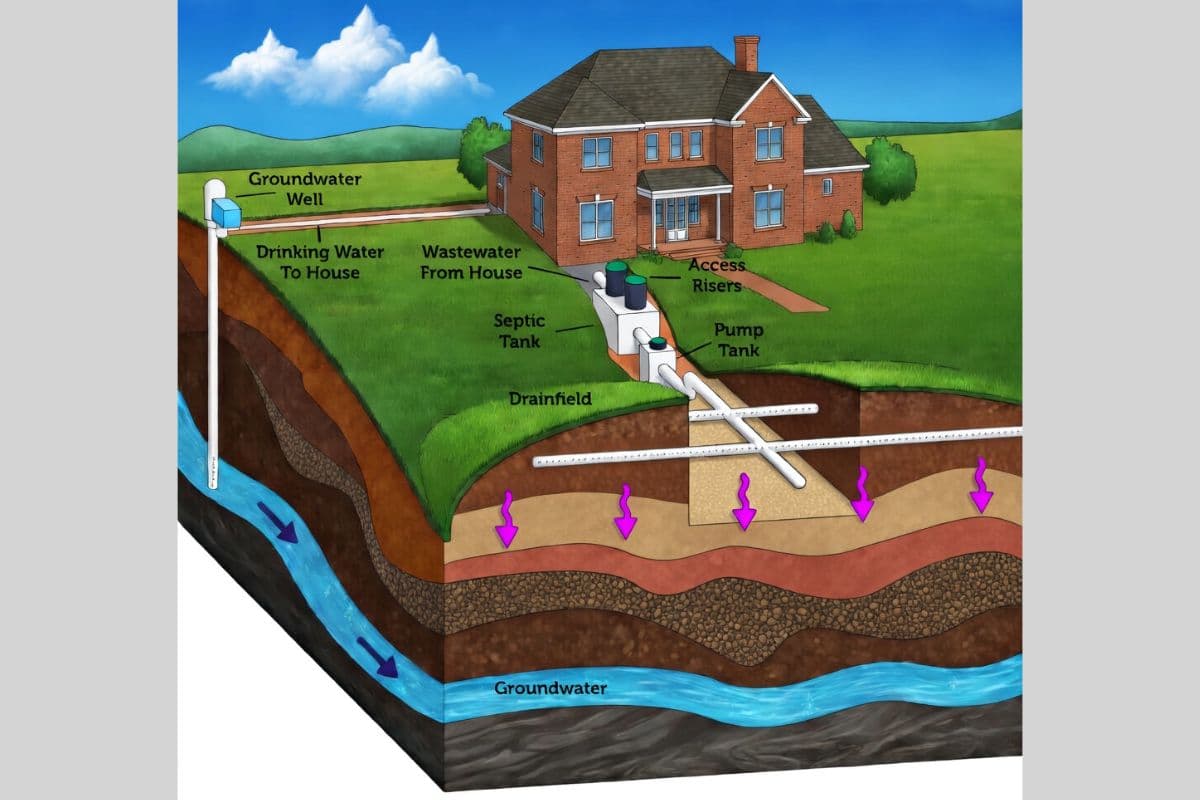
A mound septic system is an engineered on-site wastewater treatment system in which the drainfield is constructed above the natural ground surface in a raised bed of imported sand rather than being buried in native soil. It is required when the native soil is too shallow, too close to a seasonal high water table, or too close to bedrock to safely treat septic effluent before it reaches groundwater. The mound replaces the underground trench drainfield of a conventional system with an elevated bed that provides the soil depth the property’s natural conditions cannot.
Mound systems are more expensive to install than conventional systems, require a pump to deliver effluent to the elevated bed, and need more ongoing attention than a gravity-fed system. But on properties where the soil fails a percolation test or where the water table is too high for a conventional drainfield, a mound system is often the only permitted option outside of an aerobic treatment unit.
For full installation pricing by system type, see our septic system installation cost guide.
When Is a Mound System Required?
A mound system is required when at least one of three site conditions prevents a conventional gravity-fed drainfield from functioning safely.
Shallow soil depth above a restrictive layer
Conventional drainfields require a minimum depth of usable soil between the bottom of the distribution pipes and any restrictive layer below, typically 24 to 36 inches depending on state regulations. A restrictive layer is any material that prevents or significantly slows the downward movement of effluent: hardpan clay, fractured bedrock, dense gravel that drains too fast, or solid bedrock. Properties in rocky terrain, glaciated regions, or areas with heavy clay subsoil commonly encounter this condition.
High seasonal water table
The soil between the drainfield trenches and the water table is what treats effluent before it reaches groundwater. Most regulations require a minimum separation distance of 12 to 36 inches between the bottom of the drainfield and the seasonal high water table. On properties near rivers, lakes, wetlands, or in low-lying areas where the water table rises significantly in wet seasons, this separation cannot be achieved at grade. The mound raises the drainfield above grade so the required separation distance exists within the imported sand bed rather than in native soil that does not provide it.
Failed percolation test
A soil that percolates too slowly (water moves through it at more than 60 minutes per inch in most jurisdictions) does not treat effluent adequately. Native clay-heavy soils, compacted subsoils, and certain glacial till types commonly fail the perc test. A mound system uses carefully graded imported sand with a known percolation rate to provide the treatment that the native soil cannot.
Not every property that needs a mound system has all three conditions. One is enough for a mound to be required.
How a Mound System Works
The process is the same as a conventional septic system through the tank stage. All household wastewater flows to the septic tank, where solids settle to the bottom, grease floats to the top, and the liquid effluent in the middle is discharged for treatment. The difference begins at the point where a conventional system sends effluent by gravity to underground trenches.
The pump tank
Effluent from the septic tank flows into a second buried chamber called the pump tank or dosing chamber. A submersible pump in the pump tank delivers effluent to the mound in measured doses controlled by a timer or float switches. The pump is necessary because the mound is elevated above grade and effluent cannot reach it by gravity.
The mound bed
The mound itself is a rectangular raised structure built on the ground surface. It consists of several distinct layers, from the bottom up:
- A base of native soil or a thin sand interface layer that transitions from the natural ground surface into the imported fill
- A main body of clean, coarse sand imported to the site, typically 18 to 36 inches deep, which provides the treatment zone where biological and physical filtration of the effluent occurs
- A layer of gravel in the upper portion of the sand bed, surrounding the perforated distribution pipes
- The distribution pipes themselves, which receive pressurized effluent from the pump and distribute it evenly across the entire bed
- A layer of topsoil over the gravel and pipes to support vegetation and protect the bed from erosion and temperature extremes
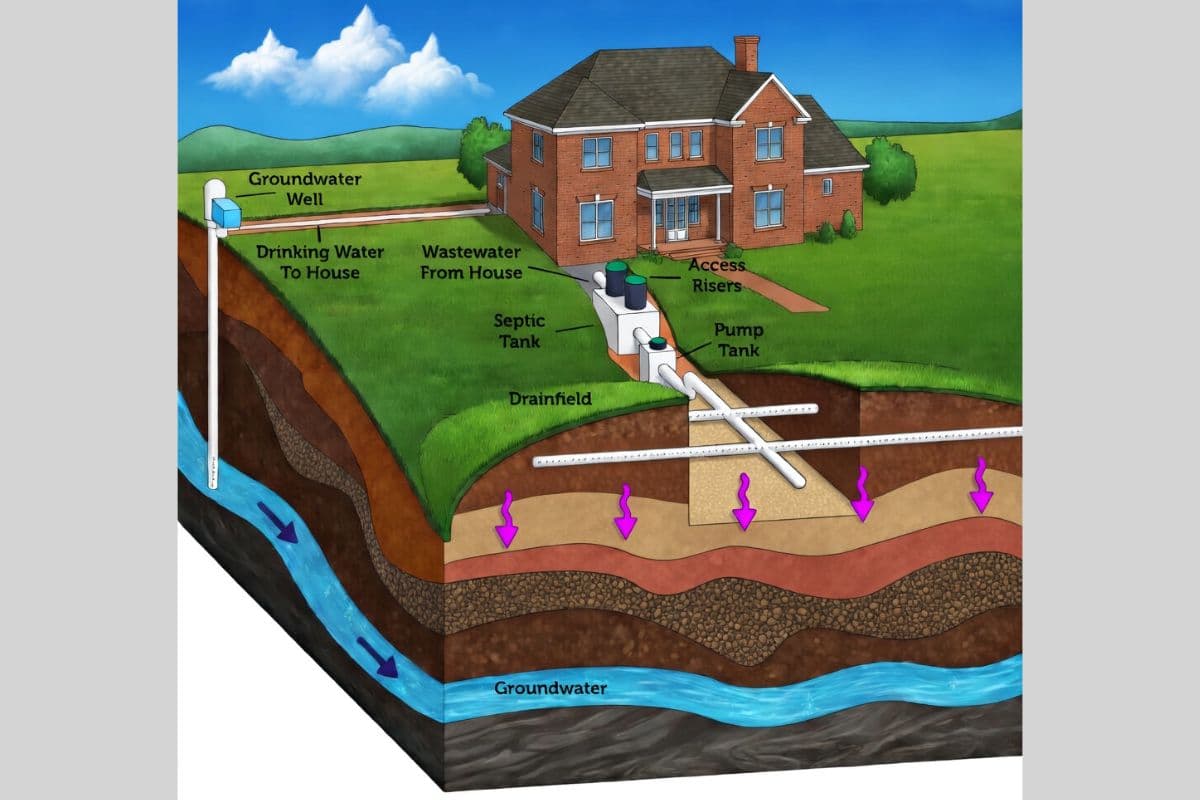
A mound septic system uses a raised sand bed to treat effluent when native soil conditions are inadequate for a conventional drainfield.
Treatment process
As effluent percolates down through the gravel and sand, aerobic bacteria in the upper soil layers break down pathogens and organic material. By the time effluent reaches the native soil beneath the mound, it has been treated to a level safe for final dispersal. The treatment is more reliable than a conventional drainfield in marginal soil because the imported sand is specified to a known particle size and percolation rate, rather than relying on whatever native soil happens to be present.
Dosing
Unlike a conventional system where effluent flows continuously by gravity, a mound system receives effluent in timed doses. The pump runs for a set period (typically 15 to 30 minutes) several times per day, distributing a controlled volume of effluent across the entire bed with each dose. This dosing pattern prevents any single area of the bed from being overloaded while allowing the rest of the bed to drain and rest between doses. The rest periods are critical to maintaining treatment capacity and preventing biomat accumulation.
Mound System Components
| Component | Function | Typical Lifespan |
|---|---|---|
| Septic tank | Primary treatment, solids separation | 30 to 50 years |
| Pump tank / dosing chamber | Stores effluent between doses, houses the pump | 20 to 40 years |
| Effluent pump | Delivers effluent to the mound under pressure | 7 to 15 years |
| Float switches / timer controls | Control pump operation and dosing cycle | 5 to 15 years |
| Distribution pipes | Disperse effluent across the mound bed | 20 to 30 years |
| Imported sand bed | Primary treatment zone | Indefinite if maintained |
| Alarm system | Alerts homeowner to pump failure or high water | 10 to 20 years |
Mound System vs. Conventional System: Key Differences
| Factor | Conventional System | Mound System |
|---|---|---|
| Required soil conditions | Adequate depth and percolation | Soil that fails depth or perc requirements |
| Drainfield location | Below ground surface | Above ground surface |
| Effluent delivery | Gravity flow | Pressurized pump dosing |
| Moving parts | None | Pump, float switches, controls |
| Electricity required | No | Yes, for the pump |
| Maintenance requirements | Pump every 3 to 5 years, inspect filter | All of the above plus pump inspection and alarm testing |
| Installed cost | $3,000 to $8,000 | $10,000 to $20,000 |
| Visibility on property | Invisible at grade | Raised mound visible above grade |
| Lifespan | 25 to 40 years | 25 to 40 years with proper maintenance |
How to Maintain a Mound Septic System
A mound system requires everything a conventional system requires, plus additional attention to the pump and electrical components that a gravity system does not have.
Pump the septic tank on schedule
The septic tank upstream of a mound system must be pumped on the same schedule as any other septic tank: every 3 to 5 years for a typical household. The pump tank (dosing chamber) should be inspected at the same visit. If solids from the septic tank escape into the pump tank because the septic tank was not pumped on schedule, those solids can clog the pump, clog the distribution pipes in the mound bed, or accelerate biomat formation in the sand. Any of those outcomes is expensive to repair. See our how often to pump guide for the schedule by tank size and household.
Inspect and test the pump annually
The effluent pump is the only mechanical component the system cannot function without. A pump failure means the pump tank fills, the alarm activates, and effluent has nowhere to go until the pump is repaired or replaced. Annual inspection includes:
- Confirming the pump activates when the float rises
- Checking the pump discharge pressure
- Inspecting the power cord and float switch for wear or damage
- Testing the high-water alarm by manually raising the float
Pump replacement costs $300 to $800 for the unit plus $200 to $500 for installation. Pumps in mound systems typically last 7 to 15 years depending on usage frequency and effluent quality.
Test the alarm system
Every mound system has a high-water alarm that sounds when the pump tank water level rises above the normal operating range, indicating the pump has failed or the system is being hydraulically overloaded. Test the alarm at least once a year by manually raising the float above the alarm threshold and confirming the alarm activates. An alarm that does not work gives no warning before the pump tank overflows.
Protect the mound surface
The vegetated surface of the mound is the barrier that protects the sand bed from erosion, UV exposure, and temperature extremes. Mow the grass on the mound regularly but do not scalp it. Never drive vehicles over the mound. Keep heavy equipment away from the entire mound footprint. Never plant trees, shrubs, or deep-rooted plants on or immediately adjacent to the mound. Roots penetrate the distribution pipes and the sand bed. Shallow-rooted grasses are the only appropriate vegetation.
Manage water use
Mound systems are sized for a specific daily effluent volume based on the property’s bedroom count. Exceeding that volume on a sustained basis can overwhelm the bed’s treatment capacity. The dosing schedule is calibrated to the design volume, and sending significantly more water than that volume to the pump tank causes the pump to run longer and more frequently than the bed can handle. Spread laundry loads across the week, run dishwashers only when full, and be aware of peak water use events like house guests or extended visits.
Do not use the system as a dump for non-household waste
Everything that applies to conventional systems applies here: no grease, no flushable wipes, no chemical drain cleaners, no antibacterial products in large quantities. Mound systems are if anything less tolerant of chemical disruption than conventional systems because the pump tank concentrates whatever enters it before delivering it to the sand bed.
How Long Does a Mound System Last?
A well-maintained mound system lasts 25 to 40 years, which is comparable to a conventional drainfield. The sand bed itself, if properly specified and protected, does not have a fixed lifespan in the way that mechanical components do. The factors that shorten mound system life are the same ones that shorten any drainfield’s life: hydraulic overloading from too much water entering the system, solids escaping from an unpumped septic tank and clogging the bed, and biomat accumulation from infrequent dosing cycles.
The pump and electrical components have shorter service lives and should be treated as maintenance items rather than components that last the life of the system. Budget for pump replacement every 10 to 12 years as a routine cost of ownership.
What Are the Warning Signs of a Failing Mound System?
The high-water alarm is sounding. This is the system telling you the pump has failed or the pump tank is filling faster than the pump can empty it. Reduce water use immediately and call a septic professional. Do not ignore a sounding alarm.
The pump is running constantly. If the pump runs more frequently or for longer periods than its normal dosing cycle, the pump tank may be receiving more water than the system was designed for, or the distribution pipes in the mound may be partially blocked.
Wet or soggy soil at the base of the mound. Effluent seeping out from the base or sides of the mound indicates the sand bed is saturated and no longer treating effluent before it exits the bed. This is a serious finding requiring professional assessment.
Odors at the mound surface. A functioning mound system should not produce noticeable odors at the surface. Sewage smell at the mound indicates effluent is reaching the surface rather than percolating through the sand.
Slow drains throughout the house. Same as with any septic system: whole-house slow drains point to the pump tank being full, the effluent pump failing, or the mound bed losing absorption capacity.
See our signs your drainfield is failing guide for the full progression of symptoms and how to interpret them.
Mound System Pros and Cons
Pros
It makes development possible on sites where no other system would be approved. For a property owner whose land fails a perc test, a mound system is often the difference between being able to build and not being able to build at all.
The imported sand bed provides more consistent treatment than native soil because its percolation characteristics are known and specified. In that sense, a mound system treats effluent more reliably than a conventional system in marginal soil.
The pressurized dosing system distributes effluent more evenly across the bed than gravity flow distributes effluent across conventional trenches, which reduces the risk of any single section being overloaded.
Cons
The installed cost is two to three times higher than a conventional system. The pump and electrical components add ongoing maintenance costs and failure risk that a gravity system does not have. The mound is visible above grade, which some property owners find objectionable aesthetically. The system requires electricity to operate, which matters on off-grid properties.
The mound occupies significant surface area on the property. A mound for a three-bedroom home typically covers 2,000 to 4,000 square feet of land surface and rises 2 to 4 feet above grade. That footprint must be kept clear of vehicles, structures, and deep-rooted vegetation permanently.
Frequently Asked Questions
What is a mound septic system?
Why would I need a mound system instead of a conventional septic system?
How much does a mound septic system cost to install?
How often does a mound system need to be pumped?
How long does a mound septic system last?
Can I build a mound system myself?
What are the maintenance costs for a mound system?
What happens if the pump fails in a mound system?
Glossary of Mound System Terms
Dosing chamber (pump tank)
A second buried chamber downstream from the septic tank that receives effluent and stores it between pump cycles, housing the effluent pump and the float switches or timer controls that regulate dosing. The dosing chamber allows the mound system to deliver effluent in controlled timed doses rather than continuously, which prevents the sand bed from being hydraulically overloaded and allows the bed to drain and rest between doses. Its size is engineered to hold at least one full day’s effluent volume to provide a buffer in the event of a pump failure.
Effluent pump
A submersible pump installed in the dosing chamber that delivers effluent to the mound distribution pipes under pressure on a timed dosing schedule. Effluent pumps in mound systems are not the same as sump pumps and must be specified for sewage service with resistance to the corrosive conditions inside a dosing chamber. They typically last 7 to 15 years depending on how frequently the pump cycles, which is determined by household water use volume and the size of the dosing chamber.
Restrictive layer
Any subsurface material that prevents or significantly slows the downward percolation of effluent, including hardpan clay, solid bedrock, fractured rock with insufficient depth, dense gravel that drains too quickly for treatment, and seasonally saturated soil. The depth from the ground surface to the restrictive layer is the primary factor that determines whether a conventional drainfield can be installed and what minimum drainfield depth is required. When that depth is insufficient under state regulations, a mound system or other alternative is required.
Pressurized distribution
A method of delivering effluent to drainfield pipes under pump pressure through small orifices that distribute the effluent in a fine spray across the entire pipe length, ensuring even distribution throughout the bed with each dose. Pressurized distribution is more uniform than gravity-fed distribution because it actively pushes effluent to all parts of the bed rather than relying on gradient flow, which tends to favor the sections of the bed nearest the inlet. Even distribution is essential in a mound system because uneven loading can overload sections of the sand bed while others are underused.
Biomat
A layer of microbial growth and organic material that forms at the soil interface within the mound sand bed as effluent percolates through it. In controlled amounts, biomat is a normal and beneficial part of the treatment process, slowing percolation slightly and increasing biological treatment. Excess biomat from chronic hydraulic overloading or solids escaping an unpumped tank can reduce the bed’s absorption capacity to the point where effluent cannot percolate through the sand and begins to surface at the mound base. Unlike drainfield biomat in native soil, mound biomat can sometimes be partially recovered through rest periods and reduced loading, but severe cases require bed renovation or replacement.
Related Guides
On theseptic.guide
Septic System Installation Cost 2026
Full cost breakdown for every system type including mound systems, with component-by-component pricing and the site conditions that determine which type is required.
Aerobic vs Anaerobic Septic Systems
How aerobic treatment units compare to conventional anaerobic systems as an alternative when soil conditions prevent a conventional drainfield, with cost and maintenance differences.
How Often Should You Pump Your Septic Tank?
The pumping schedule by tank size and household size that applies to the septic tank upstream of any mound system.
Signs Your Drainfield Is Failing
The warning sign progression that applies to mound systems as well as conventional drainfields, including how to distinguish temporary saturation from permanent failure.
Drainfield Replacement Cost 2026
What it costs to replace a failed mound bed or conventional drainfield by system type and site condition.
Septic System Repair Cost 2026
Pricing for every common repair including pump replacement, float switch replacement, distribution pipe repair, and alarm system service for mound systems.
How Long Does a Septic System Last?
Expected lifespan by system type and maintenance history, including mound systems and the mechanical components that require periodic replacement.
Septic System Maintenance Checklist
The full maintenance schedule adapted for both conventional and alternative systems including mound systems, with pump inspection and alarm testing intervals.
Septic Tank Size Guide
How tank sizing requirements apply to mound systems, including why the tank upstream of a mound system must be correctly sized for the bedroom count.
Buying a Home with a Septic System
What to verify when buying a property with a mound system, including pump maintenance history, alarm functionality, and whether the mound footprint has been protected.
Best Septic System Alarms
Monitoring options for the high-water alarm that is a required component of every mound system, including WiFi-connected alarms that send alerts to your phone.
From Our Network
Basement Flooding Insurance · thebasement.guide
For homes in the high water table conditions that typically require mound systems, basement flooding risk from the same saturated soil is a related concern.
Crawl Space Encapsulation Guide · thebasement.guide
Properties in shallow soil or high water table conditions that require mound septic systems often have the same moisture challenges in crawl spaces.
External Resource
Need Professional Septic Service?
Connect with licensed septic professionals in your area for mound system installation, inspection, or repair.
Get Free QuotesGet Expert Septic Help
Connect with qualified septic professionals in your area. Free quotes, no obligation.