There is a $50 device that most septic system owners have never heard of. It sits at the outlet pipe inside your tank, invisible and underwater, and its entire job is to catch the suspended solids that escape your tank's natural settling process before they reach your drainfield. When it works, your drainfield lasts decades. When it is missing or neglected, those solids reach the drainfield soil and feed the biomat overgrowth that is responsible for over 95 percent of drainfield failures.
That device is the effluent filter. This guide reviews the four best options available on Amazon, explains exactly how they work, and helps you choose the right one for your system.
Why Effluent Filters Exist
Your septic tank is designed to separate wastewater into three layers: sludge at the bottom, a scum layer of fats and grease at the top, and relatively clarified liquid effluent in the middle. The effluent is what exits through the outlet pipe and flows to the drainfield.
The problem is that “relatively clarified” does not mean solids-free. According to EPA document 625/R-00/008, a typical residential septic tank receives influent with 155 to 330 milligrams of suspended solids per liter and reduces that concentration to 50 to 100 milligrams per liter after settling. That remaining concentration of fine suspended particles travels out of the tank with every gallon of effluent. Over time, those particles accumulate in the drainfield soil and accelerate biomat formation.
An effluent filter installs at the outlet tee and acts as a final barrier. Slot openings of 1/16 inch catch the particles that survive the settling process and hold them in the tank until the next pump-out, rather than letting them continue downstream. Independent research cited by Polylok and Zabel has shown that their residential filters reduce total suspended solids reaching the drainfield by 40 percent or more. The University of Minnesota Extension's septic system guidance identifies effluent filters as one of the most cost-effective protective devices available for conventional gravity systems.
The cost of a good effluent filter is $30 to $100. The cost of drainfield replacement is $5,000 to $20,000. That math is not complicated.
What to Look For
Slot Size
The standard residential slot size is 1/16 inch (1.6mm). This is the industry baseline that most state regulations reference. Some filters offer finer filtration at 1/32 inch for systems with high solids loading or grease trap applications.
Flow Rate (GPD)
Filters are rated in gallons per day. A typical three-bedroom home generates approximately 300 to 450 gallons per day. Most residential filters are rated for 800 to 3,000 GPD, which gives ample headroom for normal use and surge loads.
Outlet Pipe Compatibility
Most residential tanks have 4-inch outlet pipes. Verify your outlet pipe diameter before ordering. A filter with the wrong housing will not install correctly.
Housing Included or Cartridge Only
Some filters include their own housing that replaces the existing outlet tee. Others are cartridge-only, designed to drop into an existing tee. If your tank has no filter housing currently, you need either a complete assembly or a cartridge plus a compatible tee.
Ball Check or Shut-Off Mechanism
The best filters have a ball or gate that closes off the outlet when the filter is removed for cleaning. Without this, pulling the filter out risks allowing the scum layer to escape into the drainfield during the maintenance window.
Alarm Compatibility
Some filters include a port for a float switch that triggers an audible or visual alarm when the filter begins backing up the tank. This is useful for busy households or second homes where the system may not be checked regularly.
Quick Reference
| Filter | Type | Flow Rate | Housing Included | Shut-Off Ball | Price Range | Best For |
|---|---|---|---|---|---|---|
| Polylok PL-122 | Slotted | 3,000 GPD | Yes | Yes | $65 to $95 | Best overall, high-use households |
| Zabel A1800 | Slotted, slough design | 800 GPD | No (cartridge only) | No | $40 to $75 | Best retrofit, most contractor-recommended |
| SimTech STF-110 | Bristle | 1,200 GPD | No (cartridge only) | No | $45 to $65 | Best for hair, lint, fibrous solids |
| Tuf-Tite EF-4 | Slotted | 800 GPD | Combo available | No | $25 to $45 | Best budget option |
Detailed Reviews
#1 Polylok PL-122 — Best Overall
Best for: High-use households, anyone who wants the most filtration surface area and the best shut-off protection during cleaning.
The PL-122 is Polylok's flagship residential filter and the one most frequently specified by engineers on new system designs. It offers 122 linear feet of 1/16-inch filtration slots, which is significantly more filtration surface area than most competing residential filters. More surface area means the filter takes longer to clog between cleanings, which matters in households with heavier-than-average water use or garbage disposal use.
The defining feature of the PL-122 is its patented automatic shut-off ball. When you pull the filter out of the housing for cleaning, a red ball floats up and seals the outlet, preventing any scum or floating solids from escaping while the filter is out. Polylok was the first manufacturer to include this feature on a residential filter, and it remains one of the most practically important design differences between premium and budget options. Without a shut-off, removing the filter for cleaning is a brief window where untreated material can reach the drainfield.
The PL-122 comes with its own complete housing, so it does not require a separate tee or any additional components. It installs in any new or existing 4-inch outlet pipe, and Polylok's modular design allows two units to be snapped together if higher flow capacity is needed. An optional alarm port accepts a float switch for system monitoring. The housing is made of high-density polyethylene and is corrosion resistant.
The PL-122 is rated to handle flows up to 3,000 GPD, making it suitable for larger households and light commercial applications as well as standard residential use.
Pros
- 122 linear feet of 1/16-inch filtration slots, more than most residential competitors
- Patented automatic shut-off ball seals outlet during filter removal
- Complete housing included, no separate tee required
- Modular design allows linking two units for higher capacity
- Alarm port for optional float switch monitoring
- Rated to 3,000 GPD, handles heavy-use households
- Corrosion-resistant high-density polyethylene construction
Cons
- Higher price than budget options
- Complete housing means replacing your existing outlet tee during installation
- Larger size may require confirming sufficient depth in your tank
#2 Zabel A1800 — Best Retrofit and Most Contractor-Recommended
Best for: Retrofitting into an existing tank that already has a 4-inch outlet tee, and for homeowners whose septic contractor stocks Zabel products.
The Zabel A1800 is the most widely recommended residential effluent filter among septic contractors, largely because Zabel pioneered the residential effluent filter category. Bob Zabel, a Louisville, Kentucky, septic tank pumper, received the original patent for a residential effluent filter in 1959. The A1800 is the current production descendant of that original design, now manufactured by Polylok since the two companies merged in 2006.
What distinguishes the A1800 from slotted filters with mesh-style filtration is Zabel's patented flow design. Rather than a cylindrical mesh screen that catches and holds solids on its surface, the A1800 uses slots designed to allow solids to slough off and fall back into the tank rather than packing into the filter material. This sloughing action reduces the trapping of solids in the filter body itself, extending the intervals between cleanings and reducing the likelihood of the filter clogging rapidly after a high-water-use event. Independent research cited by the manufacturer has shown the A1800 reduces total suspended solids in residential applications by 40 percent.
The A1800 is a cartridge-only filter, meaning it installs into an existing 4-inch outlet tee. It is compatible with any 4-inch tee, including the Polylok PL-68 housing and Zabel's own Versa-Tees. If your tank has no tee currently, you will need to add one. The A1800 is available in 18-inch and 22-inch lengths. The 22-inch version includes a built-in gas deflector that prevents gas bubbles from carrying solids through the outlet. All A1800 series filters feature a locking tab that secures the cartridge in the tee. The A1800 is compatible with the Polylok SmartFilter alarm and switch, which provide visual and audible notification when the filter or tank needs service.
The current A1800 is made of one-piece polypropylene rather than the older snap-together design, which was prone to breaking during servicing. This is a meaningful improvement if you are buying a replacement for an older Zabel cartridge.
Pros
- Most widely recommended by septic contractors for retrofit installations
- Patented slough design reduces solid trapping and extends cleaning intervals
- Fits any existing 4-inch outlet tee, no housing replacement needed
- Independent research shows 40 percent TSS reduction
- Compatible with SmartFilter alarm system
- One-piece polypropylene construction eliminates breakage during servicing
- Available in 18-inch and 22-inch versions
Cons
- Cartridge only, requires a compatible existing tee or purchase of separate housing
- Flow rate limited to 800 GPD, may need upgrading for large or high-use households
- No built-in shut-off mechanism when filter is removed
#3 SimTech STF-110 — Best for Hair, Lint, and Fibrous Solids
Best for: Households that generate significant quantities of fibrous solids such as hair, lint, polyester threads, and wipes, and for existing concrete baffle systems where a rigid cartridge does not fit.
The SimTech STF-110 takes a fundamentally different approach from slot-style filters. Rather than a rigid plastic cylinder with machined slots, the STF-110 is constructed from non-directional polypropylene bristles wound around a stainless steel core. This bristle design provides over 2,200 square inches of 1/16-inch filter area in a 4-inch diameter cartridge and has a distinctly different solids capture profile than slot-style filters.
Where slotted filters excel at blocking semi-solid particles and grease, the STF-110's bristle matrix is particularly effective at catching fibrous materials: hair, lint from laundry, polyester threads, and similar long thin solids that can pass through or wrap around the exterior of a rigid slot cartridge without being captured. For households with high hair and lint loading, the bristle design often outperforms slot filters on these specific material types while performing comparably on typical organic solids.
The STF-110's flexibility is also a practical advantage in retrofit situations. The bristle matrix compresses enough to fit into existing 4-inch concrete baffles that often have irregular interior dimensions due to age and wear, where a rigid cartridge may not seat properly. Self-locking bristles hold the filter in position and prevent it from floating up in the tee during tank operation. The filter is rated at 1,200 GPD.
Cleaning the STF-110 differs from slot-style filters. Rather than rinsing the exterior of a rigid cylinder, you pull the bristle cartridge out and hose off the bristle matrix over the open tank so captured solids fall back in. Polylok and SimTech both supply disposal bags with the filter so it can also be discarded rather than cleaned, which some homeowners prefer given the nature of what it captures.
The STF-110 is a filter-only product. Like the Zabel A1800, it requires a compatible 4-inch tee or baffle.
Pros
- Bristle design exceptionally effective at capturing hair, lint, and fibrous solids
- Flexible construction fits irregular concrete baffles where rigid filters may not
- Over 2,200 square inches of 1/16-inch filter area
- Rated to 1,200 GPD
- Self-locking bristles prevent filter float-up
- Can be rinsed and reused or disposed of in supplied bags
- Stainless steel core provides corrosion resistance and structural stability
Cons
- Bristle matrix can be more difficult to clean thoroughly than smooth-surface slot filters
- Cartridge only, requires existing or separately purchased 4-inch tee
- Not ideal as a primary filter if solids loading is predominantly semi-solid or grease-heavy
- Less widely stocked by contractors than Polylok and Zabel products
#4 Tuf-Tite EF-4 — Best Budget Option
Best for: Homeowners adding a filter to a tank that has no filter at all and wants a straightforward, proven, low-cost option to provide basic drainfield protection.
Tuf-Tite is best known in the septic industry for its risers and access covers, but the EF-4 effluent filter is a solid, no-frills performer that delivers basic 1/16-inch filtration at a lower price point than the PL-122 or Zabel A1800. With 86 linear feet of 1/16-inch filtration slots and an 800 GPD flow rating, the EF-4 is appropriately sized for standard residential use in households of two to four people with conservative to average water use.
The EF-4 is available as a filter-only cartridge or as a combo pack that includes the filter and its own housing, which is the better value if your tank does not already have a filter housing in place. Tuf-Tite's housing uses the same standard 4-inch connection used by the other filters on this list, so it is easy to install or swap. The filter is yellow for easy visual identification when the tank is open.
Where the EF-4 falls short relative to the PL-122 is primarily in filtration surface area and the absence of an automatic shut-off ball. When you pull the EF-4 for cleaning, the outlet remains open until you reinstall the filter. In practice this is a manageable limitation if you work quickly and avoid disturbing the scum layer, but it is a genuine design gap compared to the PL-122's shut-off ball. For homeowners on a tight budget who currently have no filter at all, the EF-4's protection is vastly better than nothing, and the lower price makes it easier to add one during a routine pump-out.
Pros
- Lowest price of the four reviewed filters
- Available as combo pack with housing included
- Proven 1/16-inch slot filtration at the industry standard
- Simple installation in any existing or new 4-inch outlet connection
- Bright yellow color for easy visual identification
- Widely available, including on Amazon with fast shipping
Cons
- 86 linear feet of filtration surface area, less than the PL-122's 122 feet
- No automatic shut-off ball when filter is removed for cleaning
- 800 GPD flow rating, lower than the PL-122, undersized for large or high-use households
- Less robust construction than higher-priced options
Does Your Tank Already Have a Filter?
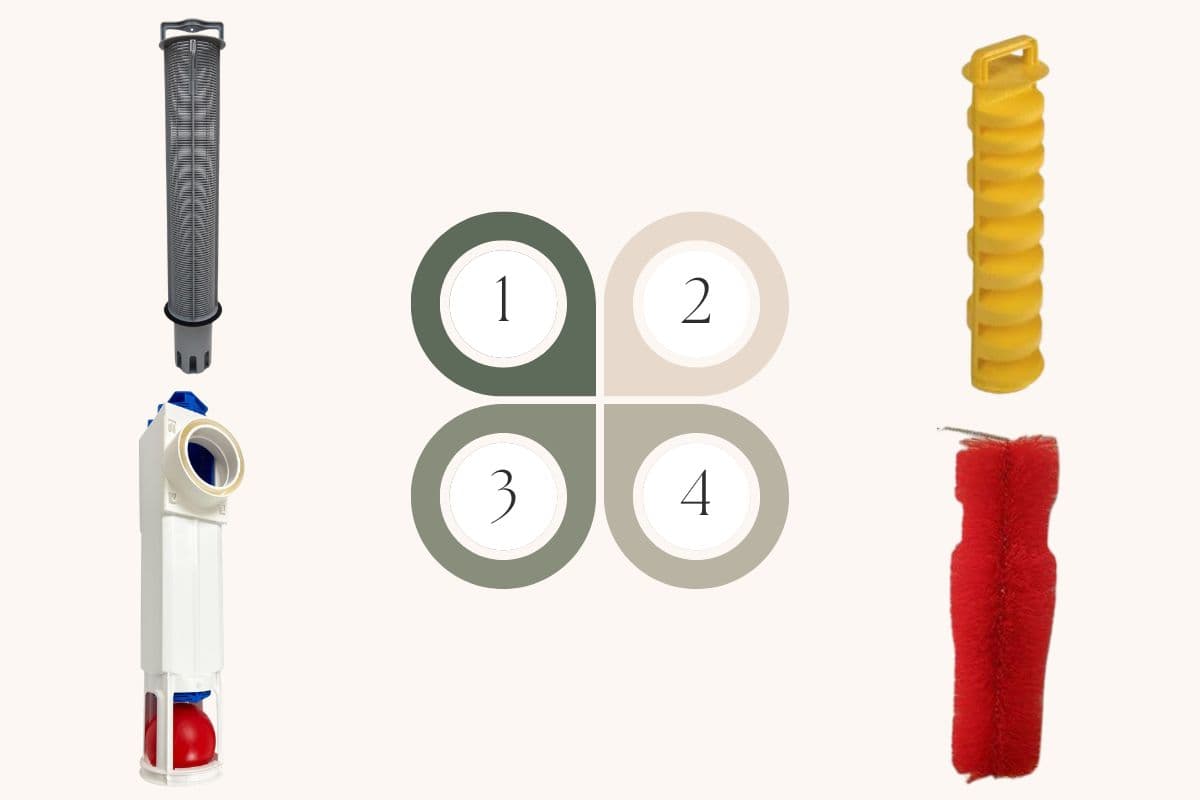
Many homeowners do not know whether their tank has an effluent filter installed. Here is how to find out, and what you are actually looking at when you open the tank.
Which States Require Them
Many states now require effluent filters on new septic system installations as part of their code. California, Florida, and most northeastern states with aggressive groundwater protection programs have moved toward mandatory filter installation. If your system was permitted and installed in the last 15 to 20 years in one of these states, a filter is likely present. If your system is older, predates your state's current code, or was installed in a state with historically loose enforcement, verify physically rather than assuming.
What to Look for When You Open the Tank
Open the outlet-side access port of your tank, which is the lid or riser on the side of the tank closest to the drainfield. Look down into the outlet tee. A filter will be visible as a cylindrical device extending downward into the tank liquid from the tee opening, typically white, yellow, or black plastic. It may have a handle or riser rod extending upward toward the lid for removal. If you see a plain pipe fitting or a concrete tee with nothing inserted, your tank has no filter.
The outlet side is distinguishable from the inlet side because it sits slightly lower in the tank. On most two-compartment tanks there are two access lids: the inlet lid is on the house side, the outlet lid is on the drainfield side. Open the drainfield-side lid.
What a Plain Outlet Tee Looks Like
If your tank has a working outlet tee but no filter, you will see a downward-pointing pipe inside the tee that extends about 12 inches below the waterline. There is no cartridge, no visible filter material, and nothing to grab and pull out. This is a normal tee that is perfectly functional but unprotected.
What a Filter Housing Looks Like
A filter housing replaces the plain tee entirely. It is a larger plastic assembly with a filter cartridge inside that can be seen and grabbed. The cartridge often has a handle, tab, or extended PVC rod at the top to assist with removal for cleaning.
If You Are Not Sure
Ask your septic contractor to check during the next pump-out. This takes about 30 seconds and costs nothing.
What to Order: Retrofit vs. No Existing Tee Decision Guide
Before ordering any filter, work through this decision tree to confirm what you actually need.
Step 1: Does Your Tank Have a 4-Inch Outlet Tee?
Most tanks installed since the 1980s have a PVC outlet tee. Older tanks, particularly those with concrete construction, may have a cast concrete baffle instead of a separate tee, or the original PVC tee may have deteriorated and been removed. If you are not sure, open the outlet side access port and look.
If yes, you have a 4-inch PVC tee with no filter installed: Order a cartridge-only filter. The Zabel A1800 is the default recommendation here because it fits any 4-inch tee. The SimTech STF-110 also works well in this scenario and is the better choice if you have hair or lint concerns.
If yes, you have a 4-inch PVC tee but want a shut-off ball: Order the Polylok PL-122, which includes its own complete housing. You will remove the existing tee and replace it with the PL-122 housing during installation. This is a 10-minute job with basic hand tools.
If no, your tank has no tee or a deteriorated tee: Order a complete filter assembly that includes the housing. The Polylok PL-122 comes with its own housing. The Tuf-Tite EF-4 Combo also includes a housing. Either can be installed as a complete replacement for a missing or failed outlet tee.
If your tank has a concrete baffle rather than a PVC tee: The SimTech STF-110 is the best fit because its flexible bristle construction compresses to fit irregular concrete opening dimensions. Rigid cartridge filters may not seat properly in concrete baffles that have worn or shifted over decades.
Step 2: Confirm Your Outlet Pipe Is 4 Inches
The vast majority of residential tanks use 4-inch outlet pipes. The filter models reviewed here are all designed for 4-inch connections. If your tank has a 6-inch outlet, you need to specify 6-inch versions of these filters. SimTech makes a 7-inch version of the STF-110 (the STF-110/7R) for larger outlet pipes.
How to Clean an Effluent Filter
Effluent filter cleaning is included in every professional pump-out as a standard step. If you are maintaining your system yourself between pump-outs, or if your system generates heavy solids loading and needs more frequent cleaning, here is the process.
Important Warning
If your tank level appears abnormally high when you open the lid, meaning the liquid is near the top of the tank, flowing over the baffles, or at a level that suggests the drainfield is not accepting flow normally, do not pull the filter for cleaning first. In this scenario, pulling the filter removes the only barrier preventing scum from flowing into the drainfield. Have the tank pumped before cleaning the filter. A normal tank at its working level is fine to service. An overfull tank is not.
Step 1: Locate the outlet-side access port. This is the riser or buried lid on the side of the tank closest to the drainfield.
Step 2: Open the access port and check the tank level. Confirm the level looks normal before proceeding. If the liquid is unusually high, stop and schedule a pump-out first.
Step 3: Pull the filter straight up and out. Use the handle or riser rod. Slow, steady upward pressure. Do not bang it against the tank walls.
Step 4: Rinse the filter over the open tank with a garden hose. This is the most important step to get right: rinse the filter directly over the open access port so everything you wash off falls back into the tank rather than onto the ground, into your yard, or near a well. Use plain water only. No bleach, no antibacterial cleaners, no chemical agents. These will kill the bacterial colony in your tank.
Step 5: Inspect the filter while it is out. Check for cracks, broken slots, or deteriorating bristles. A filter with physical damage should be replaced rather than reinstalled.
Step 6: Reinstall the filter and close the access port securely.
If the filter clogs again quickly after cleaning, the problem is usually not the filter itself. It indicates a tank that is overdue for pumping, a household habit issue such as garbage disposal use or wipes being flushed, or a hydraulic overload from excessive water use. See our complete septic maintenance guide for a full household audit checklist.
The SmartFilter Alarm: Should You Add One?
The Polylok SmartFilter alarm is a float switch accessory compatible with both the PL-122 and the Zabel A1800 that sits inside the filter housing and triggers a visual and audible alert when effluent backs up above the normal operating level in the tank. This happens when the filter is restricting flow because it needs cleaning, or when the tank is approaching capacity.
Most homeowners living in their primary residence will notice slow drains before a filter becomes critically clogged, and the alarm is optional for them. The households where the alarm delivers real value are vacation homes and seasonal properties that go unoccupied for weeks or months at a time, rental properties where tenants are unlikely to report early warning signs, and households with elderly or disabled residents who may not notice gradual drain slowdowns.
The alarm installs into the port built into the PL-122 housing or attaches to the A1800 tee assembly and runs a wire up through the access riser to a surface-mounted indicator. The surface unit is typically a small box that mounts near the tank lid or on a post, visible during yard inspections. Cost is approximately $40 to $80 for the alarm assembly. If you are a candidate for the alarm, ask your contractor about adding it during installation.
How Often to Clean
The standard recommendation from most manufacturers is to clean the effluent filter every time the tank is pumped, at minimum once every three to five years. For typical household use and a well-maintained system, this interval is sufficient.
Households that should clean more frequently include those with garbage disposal use, high occupancy (five or more people), frequent heavy laundry loads, any history of flushing wipes or non-biodegradable items, and households where the system has been neglected for several years. For these situations, annual inspection and cleaning is a more conservative and appropriate interval.
A filter that becomes clogged between its normal cleaning schedule is giving you useful information. A clogged filter is not a failure, as Peter Gavin, president of Polylok, has noted: it means the filter is doing its job. But rapid reclogging usually points to an underlying issue that deserves attention.
Frequently Asked Questions
Does every septic tank need an effluent filter?
How much does it cost to have a filter installed by a professional?
Will an effluent filter make my drains run slower?
Can I install an effluent filter myself?
How do I know when the filter needs cleaning?
What happens if you never clean the effluent filter?
Does an effluent filter eliminate the need for regular pumping?
Which filter is right for my system?
Glossary
Effluent Filter
An effluent filter is a cylindrical device installed at the outlet tee of a septic tank that intercepts suspended solid particles before the clarified liquid leaves the tank and flows to the drainfield. It is typically made of PVC or polypropylene and uses slots of 1/16 inch or smaller to physically block particles that survive the natural settling process inside the tank. The filter does not treat wastewater. Its sole function is mechanical filtration of particles that would otherwise reach the drainfield and accelerate biomat formation. Effluent filters are designed to be periodically removed, rinsed clean over the open tank, and reinstalled, typically at each pump-out. They do not reduce the need for regular tank pumping.
Total Suspended Solids (TSS)
Total suspended solids is a measurement of the concentration of solid particles that remain suspended in liquid rather than settling to the bottom, expressed in milligrams per liter. In the context of septic systems, TSS refers to the fine particles that remain in effluent after the settling process in the tank separates the heaviest solids as sludge. A typical residential septic tank reduces influent TSS from 155 to 330 mg/L down to 50 to 100 mg/L according to EPA data. These remaining particles travel with the effluent to the drainfield, where they accumulate in the soil and accelerate biomat formation. Effluent filters reduce TSS reaching the drainfield by catching a portion of these particles before the effluent leaves the tank.
Biomat
Biomat is the naturally occurring layer of anaerobic bacteria that forms at the soil surface in drainfield trenches where effluent is discharged. A normal biomat is a healthy and necessary part of the septic treatment process, filtering pathogens and fine biological solids from effluent as it passes through and into the surrounding soil. The problem occurs when the biomat receives excess organic material, including the suspended solids that an effluent filter is designed to catch. Under excessive organic loading, the biomat grows thicker than the soil can compensate for, eventually clogging the soil surface and preventing effluent from percolating. Once the biomat seals the drainfield soil, effluent backs up toward the tank and eventually into the house. Drainfield failure caused by excessive biomat formation is the most common septic system failure mode and the primary reason effluent filters exist. For a detailed explanation, see our article on what happens if you never pump your septic tank.
Outlet Tee (Outlet Baffle)
The outlet tee, also called the outlet baffle, is the T-shaped pipe fitting at the outlet side of the septic tank that controls how effluent exits. Its downward-pointing inlet extends below the surface of the liquid and prevents the floating scum layer from traveling out of the tank with the effluent. The outlet tee is the component that holds an effluent filter cartridge in position. In older tanks, the outlet tee may be a concrete baffle rather than a plastic tee, and the physical dimensions of the internal opening vary, which is why flexible filters like the SimTech STF-110 are sometimes preferred for retrofit installations in older concrete tanks.
Sloughing Action
Sloughing action refers to the design principle in Zabel's A1800 filter that allows solids caught by the filter to detach and fall back into the tank rather than remaining packed in the filter material. Where conventional mesh-style filters provide a surface for solids to attach and accumulate, Zabel's slot geometry creates less attachment surface area, encouraging solids to break free under flow pressure and settle back as sludge. This design reduces the rate at which the filter becomes clogged and extends cleaning intervals. The term is borrowed from the biological process by which organisms shed cells from their outer layers.
Gallons Per Day (GPD)
Gallons per day is the flow rate measurement used to size effluent filters for a given system. A properly sized filter must have a GPD rating that equals or exceeds the daily wastewater volume the household generates. The EPA estimates average indoor water use at approximately 70 gallons per person per day. A household of four generates roughly 280 gallons per day under typical conditions, with surge loads during heavy laundry days or guest occupancy potentially doubling that rate. Choosing a filter rated for at least twice the expected daily flow provides headroom for surge conditions and reduces the frequency with which the filter restricts flow between cleanings.