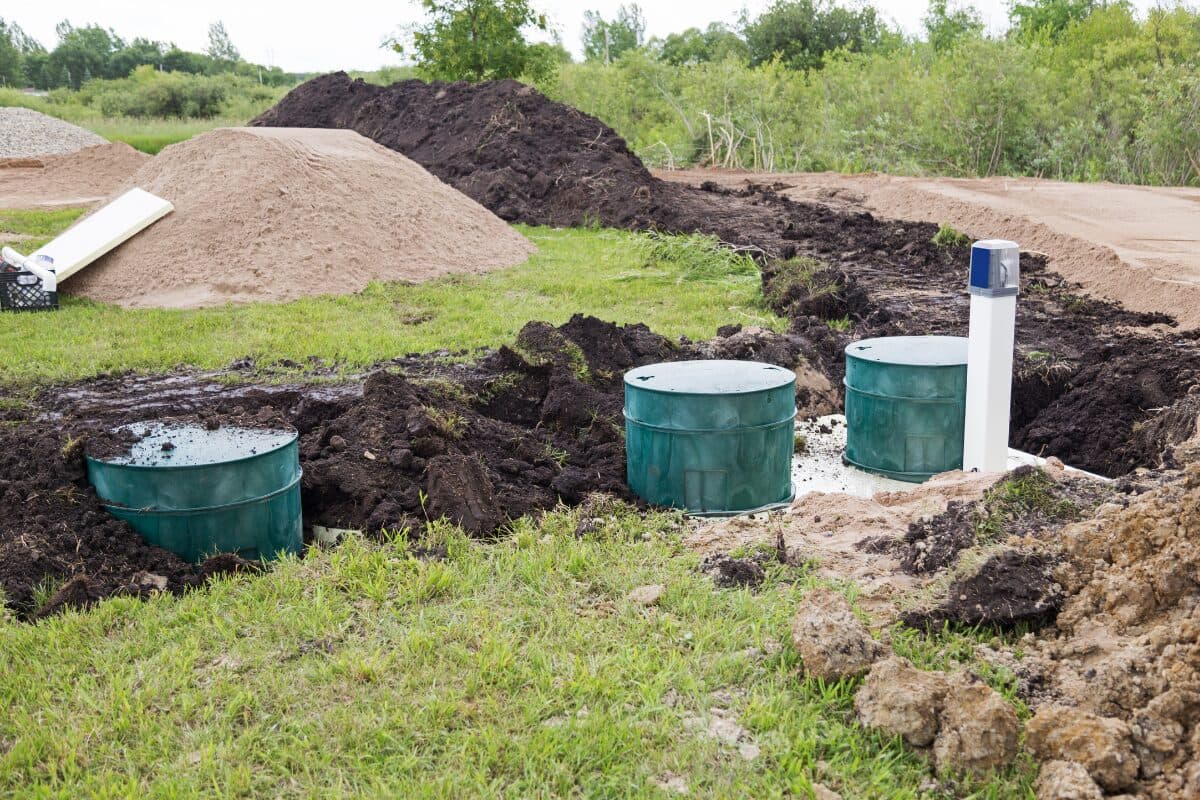
TL;DR
- Filling an old tank in place (also called abandonment or decommissioning) typically costs $500 to $2,000. Full removal typically costs $1,500 to $6,000.
- Most homeowners don't need full removal. Filling in place is allowed in most areas and is the standard approach when nothing will be built on top.
- You need full removal when you're building, adding on, or putting a pool or driveway over the tank.
- Never leave an old tank empty and buried. Lids rot, tanks collapse, and an open tank is a serious fall hazard.
- Most counties require a permit, a licensed pumper, and an inspection. Permit fees are often around $50 to a few hundred dollars.
Old septic tanks turn up in a few common ways: the house switched to city sewer years ago, a new system was installed and the old tank was never dealt with, or a new owner finds a buried tank while landscaping or planning an addition. Whatever the reason, an unused tank has to be handled properly, both for safety and because it can come up in an inspection when you sell.
The Build-Over Rule
Whether you fill or remove comes down to one question: will anything go on top of the tank?
| Your situation | What you need |
|---|---|
| Nothing will be built over it (lawn or garden stays) | Fill in place. Cheapest, and accepted in most areas. |
| Building an addition, garage, deck footings, or pool over it | Full removal. Fill material in a crushed tank isn't a stable base for a foundation. |
| Driveway or heavy equipment will cross it | Usually full removal, or an engineer's sign-off on compacted fill |
| Steel tank or cesspool of unknown condition | Act soon. Steel tanks rust through and cesspools collapse. Ask about removal. |
| Switching to sewer | Decommissioning is part of the conversion. See our septic to sewer conversion cost guide. |
| Replacing your septic system | The old tank is usually decommissioned as part of the job. See our septic installation cost guide. |
If you're unsure what will go there later, ask about removal now. Removing a tank you've already filled costs more than doing it once.
Just Found an Old Tank on Your Property?
New owners often discover an old tank while landscaping, building a fence, or planning an addition. Here's what to do.
Right away, if the lid is cracked, missing, or the ground is sinking:
- Keep people and pets away. Rotted lids give way without warning.
- Cover the area with a sheet of plywood weighted at the edges, and put up a barrier or caution tape.
- Don't step on the lid, and never climb into a tank. Septic tanks can hold toxic gases that cause collapse in seconds.
- Call a septic contractor. A failing lid over an open tank is an emergency job.
If the tank seems stable:
- Ask your county health department for records. They may show when the tank was installed and whether it was ever decommissioned.
- Find out whether the house is still connected to it. If you're on city sewer, the tank should be disconnected.
- Check your purchase documents and inspection report. If the tank wasn't mentioned, talk to your real estate agent or attorney about what the seller should have disclosed. Our guide to buying a home with a septic system covers what inspections should catch.
- Get quotes to decommission it. The rest of this guide covers the options and costs.
5-Minute Diagnostic: What Are You Dealing With?
Before you call anyone, gather what a contractor will ask about.
- Find the tank. Check your property records, county health department, or old inspection reports. Our guide on how to find your septic tank walks through the methods.
- Figure out the material. Concrete is the most common. Steel tanks are found on older homes and are the most likely to have rusted through. Fiberglass and plastic are lighter and easier to remove. See concrete vs. plastic vs. fiberglass tanks.
- Check whether it's still connected. If the house is on sewer, the old inlet pipe should be capped. If you're not sure, a plumber or septic contractor can confirm it.
- Look at the lid and the ground around it. Cracked lids, sagging ground, or a soft spot over the tank all mean the tank should be dealt with soon. Keep kids and pets away.
- Call your county health department. Ask whether they require a permit, whether filling in place is allowed, and what fill material they accept. This one call answers most of the cost questions.
Note every at-risk pipe and what it's made of. That's your project list.
What Each Option Involves
Filling in Place (Abandonment)
This is the standard approach. Requirements vary by county, but the steps are usually:
- Get an abandonment permit from the county health department.
- Have a licensed septage hauler pump the tank completely and keep the receipt.
- Remove or crush the lid.
- Crush the bottom or punch holes in it so the tank can't hold water.
- Fill the tank with clean sand, gravel, or other approved fill.
- Cap the old inlet pipe from the house.
- Schedule the county inspection.
Some counties allow homeowners to do the crushing and filling themselves. Pumping almost always has to be done by a licensed hauler.
Full Removal
The tank is pumped, then excavated, broken up or lifted out, and hauled away. The hole is backfilled and compacted so the area can support a structure. Removal costs more because of the excavation equipment, hauling, disposal fees, and compaction.
What About the Drainfield?
In most areas the old drainfield or leach lines can stay in place once the tank is decommissioned. You only need to remove them if you're building over that area. Excavation typically runs about $1 to $5 per square foot, so clearing a drainfield usually adds roughly $1,000 to $5,000, more for large fields or where trees and roots are involved. Check with your county, since a few areas have their own rules.
Rules Vary by County: Four Real Examples
Every county sets its own abandonment rules. These four show how much they differ:
| County | Who can do the work | What's required | How it's verified |
|---|---|---|---|
| Licking County, OH | Pumping by a county-registered pumper | $50 permit. Remove or crush the top, crush at least one side, fill with clean fill. | On-site inspection plus a submitted form |
| Hillsborough County, FL | Licensed septic contractor, licensed plumber, or the owner of an owner-occupied home | $50 permit. Pump, crush or puncture the bottom, fill, flag the location. | On-site inspection. Skipping it can mean a fine. |
| Sacramento County, CA | Pumping by a county-registered firm | Destruction permit. Pump, puncture the bottom, fill with sand, gravel, or concrete. | Before-and-after photos plus the pumping receipt, emailed in |
| Austin, TX | Licensed hauler pumps. The plumber doing a sewer hookup can abandon the tank. | Fee paid before work. Fill with material under 3 inches, no clay or debris. | On-site inspection |
Your county health department sets the rules where you live. For more on the permit process in general, see our septic system permits guide.
Cost Breakdown
Typical ranges. Your price depends on tank size and material, access, local disposal fees, and county requirements.
| Cost item | Typical range | Notes |
|---|---|---|
| Permit | Often $50 to a few hundred dollars | Several counties charge $50 |
| Pumping | About $300 to $700 | Required for both options. National averages run around $400. See our pumping cost guide. |
| Fill in place, total | $500 to $2,000 | Includes pumping, crushing, fill, and capping |
| Full removal, total | $1,500 to $6,000 | Includes pumping, excavation, hauling, backfill, and compaction |
| Drainfield removal (if needed) | Roughly $1,000 to $5,000 | Excavation at about $1 to $5 per square foot. Only needed if you're building over it. |
| Locating a buried tank | Usually a few hundred dollars | Only if records don't show where it is |
How Tank Material Affects the Price
| Tank material | Fill in place | Full removal |
|---|---|---|
| Concrete | Standard cost | Highest. Heavy, so it has to be broken up and hauled in pieces. |
| Steel | Standard cost, but often urgent because steel rusts through | Mid-range. Easier to cut and crush, but a corroded tank can collapse during excavation. |
| Fiberglass or plastic | Standard cost | Lowest. Light enough to lift out mostly intact. |
| Cesspool (block or stone-lined pit) | Often required to be filled. Ask your county. | Varies. Depends on depth and how much lining must come out. |
Filling in place costs about the same regardless of material. Material mostly matters when the tank has to come out.
What pushes the price up:
- Large or multi-compartment tanks
- Tight access where equipment can't reach easily
- Steel tanks that have partially collapsed
- Rock, high water tables, or deep burial
- Counties that require an engineer or extra inspections
What brings it down:
- Doing it at the same time as a sewer hookup or new system install, when the equipment is already on site
- Counties that let homeowners do the crushing and filling
10-Year Total Cost of Ownership
Leaving an old tank alone looks free. Over a decade, it often isn't.
| Option | Upfront cost | Ongoing risk | 10-year outlook |
|---|---|---|---|
| Leave it as is | $0 | Collapse, sinkhole, fall hazard, possible fines, problems at sale | Often ends up costing more: emergency decommissioning plus whatever damage the collapse causes |
| Fill in place | $500 to $2,000 | Minimal if done to code and inspected | One-time cost. Paperwork protects you at sale. |
| Full removal | $1,500 to $6,000 | None | One-time cost. Area is usable for anything. |
If you plan to build over the area within 10 years, removal now is cheaper than filling now and digging it out later.
Compare prices on decommissioning or removal before the ground freezes.
Get free quotes from local septic contractorsCommon Mistakes
- Leaving an empty tank buried. An empty tank is more dangerous than a full one. The lid can rot and collapse with no warning.
- Filling without pumping first. Sewage left in the tank contaminates the ground and almost always fails inspection.
- Skipping the permit. Unpermitted work can lead to fines and can hold up a home sale when the buyer's inspector asks for records.
- Filling with the wrong material. Use the clean fill your county approves. Trash, debris, and organic material settle and create sinkholes.
- Building over a filled tank. A crushed, filled tank isn't a foundation. If anything goes on top, remove it.
- Forgetting to cap the inlet pipe. An open line from the house can let sewer gas or water travel where it shouldn't.
- Not keeping records. Save the permit, pumping receipt, and inspection sign-off. Buyers and their lenders may ask for them.
When to Call a Pro
Almost always. Pumping requires a licensed hauler in nearly every area, and full removal requires excavation equipment. Call a septic contractor when:
- You need the tank pumped (required for either option)
- You're doing full removal
- The tank is steel, collapsing, or in poor condition
- You can't find the tank or don't know its size
- Your county requires a licensed contractor for abandonment
The one part some homeowners handle themselves is crushing and filling a pumped tank, and only where the county allows it.
Quote Checklist
Ask every contractor these questions. The answers are where quotes differ most:
- Does the price include the permit, or will I pull it myself?
- Is pumping included, and is your hauler licensed in this county?
- Are you filling in place or removing the tank? Why?
- What fill material are you using, and does the county approve it?
- Does the price include capping the inlet pipe?
- Are disposal and hauling fees included?
- Will you schedule the inspection and give me the sign-off paperwork?
- What happens to the price if the tank is larger than expected or partially collapsed?
Get at least three quotes. A quote that's much lower than the rest usually leaves out the permit, the inspection, or the fill.
Get Expert Septic Help
Connect with qualified septic professionals in your area. Free quotes, no obligation.
The Home Guide Network Editorial Team
Our guides are researched and written by the editorial team at The Home Guide Network, an independent publisher covering home systems for homeowners. We cover garages, basements, septic systems, and wells across four dedicated guide sites. Learn more at thehome.guide.
Frequently Asked Questions
How much does it cost to remove an old septic tank?
Do I have to remove an old septic tank?
Can I leave an old septic tank in the ground?
Do I need a permit to abandon a septic tank?
Can I abandon a septic tank myself?
What do you fill an old septic tank with?
Can you build over an old septic tank?
Does an old septic tank affect selling a house?
Glossary
Related Guides
On theseptic.guide
Septic to Sewer Conversion Cost
Full cost breakdown for converting from septic to municipal sewer, where tank decommissioning is one line item in a larger project.
Septic System Installation Cost
What a new system costs, including decommissioning the old tank as part of a replacement job.
How to Find Your Septic Tank
Methods for locating a buried tank before you can get a decommissioning quote.
Septic Tank Pumping Cost
What pumping costs on its own, since it is required for both filling and removal.
Septic System Permits
How the permit process works for septic work, including abandonment permits.
Buying a Home with a Septic System
What inspections should catch, including an old tank that was never decommissioned.
Selling a Home with a Septic System
How documentation of proper decommissioning protects you during a sale.