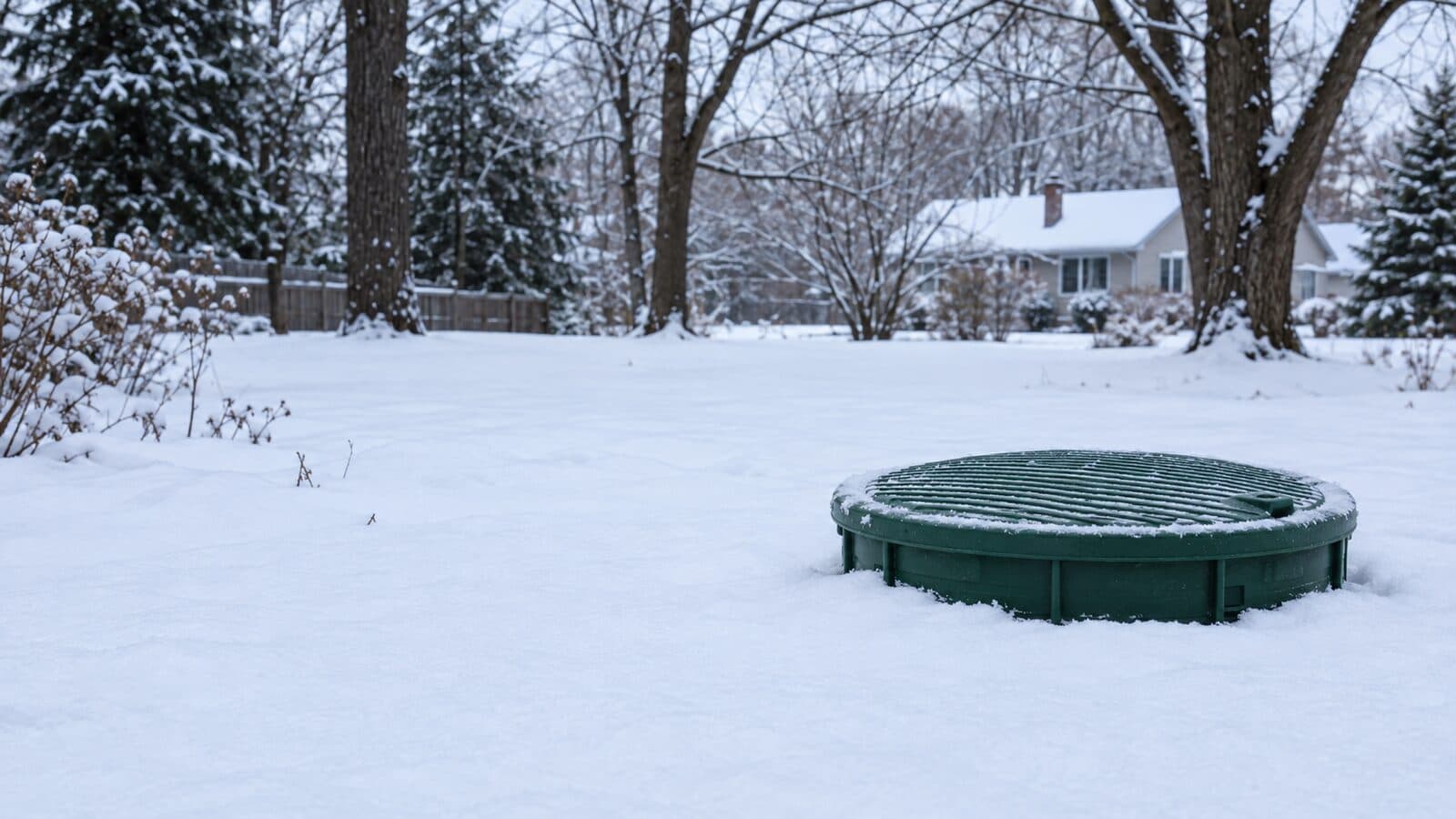
A frozen septic system is a septic system where ice has blocked the flow of wastewater somewhere between your house and the soil, most often in the sewer line that runs from the house to the tank, in a pump line that didn't drain, or in a drainfield that went into winter wet. Freezing is a cold-climate problem that shows up during long cold snaps with little snow cover, in homes that sit empty or use very little water, and in systems with a design or installation flaw that lets water sit still in a shallow pipe. The fix depends entirely on where the ice is: frozen pipes can usually be thawed the same day with steam or hot water jetting, while a frozen drainfield cannot be thawed at all and has to be managed as a holding tank until spring.
TL;DR
- Stop using water now. Every flush adds to what's already backed up behind the ice.
- If you have a pump and the alarm is on or the pump is running nonstop, shut the pump off at the breaker or control panel. A pump pushing against ice burns out.
- Find where it froze. The five usual spots are the roof vent, the house-to-tank line, the tank, the pump line, and the drainfield. The 5-minute diagnostic below walks you through it.
- Frozen pipe? Thaw it. A septic pro with a steamer or hot water jetter typically clears a frozen line for $200 to $600.
- Frozen drainfield? Hold it. It won't accept water until spring. Your tank becomes a holding tank and gets pumped every 4 to 25 days depending on household size, at $300 to $600 per pump-out.
- Never pour in antifreeze, salt, or additives, and never build a fire over the system.
- Fix the cause in spring, or it will freeze again next winter.
Is It Actually Frozen?
A frozen system and a full tank or clogged line can look identical from inside the house. Three things point to ice:
- The timing. Problems that start during or right after several days of temperatures well below freezing, especially with thin or no snow cover, are the classic freeze pattern.
- Every drain is affected, or the lowest ones are. A single slow sink is usually a local clog. When the toilet, tub, and washer all slow down or back up together, the blockage is in the main line or beyond. Our slow drains guide covers the non-freeze causes.
- It was working fine before the cold. A system that drained normally in November and quits in a January cold snap is far more likely frozen than failed.
One common look-alike: a clogged effluent filter at the tank outlet slows every drain in the house, cold or not. If your tank has one and it hasn't been cleaned in a couple of years, it's worth ruling out. Our best septic tank effluent filters guide covers cleaning and replacement.
If the tank is overdue for pumping or the drainfield was soggy last fall, the cold may simply be exposing a problem that was already there. Keep that in mind when you get to the root-cause section.
The 5 Places a Septic System Freezes
Most homeowners picture the tank freezing solid. In an occupied home, that's the least likely spot. Here's where ice actually forms, roughly from most to least common for a typical gravity system:
| Where it froze | How common | Telltale sign | What fixes it |
|---|---|---|---|
| House-to-tank sewer line | Most common | Whole house backs up; tank level is normal or low when you check it | Steam or hot water jetting through a cleanout |
| Pump line (mound, pressure, and uphill systems) | Very common on pump systems | Pump alarm, or pump running constantly | Shut off pump; pro thaws the line and checks drainback |
| Drainfield or mound | Common in wet or low-snow winters | Tank level high; ice or surfacing effluent over the field | Cannot be thawed; pump the tank until spring |
| Roof vent stack | Common in extreme cold | Gurgling and sewer smell, drains slow but still move | Clear the frost at the vent opening |
| The tank itself | Rare unless the home sits empty | Ice visible at the riser; vacant or barely used home | Steam, tank heater, or wait and pump |
1. The house-to-tank sewer line
The pipe between your foundation and the tank (sometimes called the building sewer) is the single most common freeze point. It's often buried only a few feet deep, it runs under the yard where people walk and snow gets packed down, and any low spot (a "belly" where the pipe sagged after installation) holds water that sits still and freezes. A slow drip from a leaky toilet or a high-efficiency furnace's condensate line makes it worse. A thin trickle of cold water creeps along the bottom of the pipe and freezes in layers until the pipe is closed.
2. The pump line
If your system has a pump (mound systems, pressure distribution, any drainfield uphill from the tank), the pipe from the pump to the field must drain completely after every cycle. The University of Minnesota's Onsite Sewage Treatment Program points to two common culprits: a check valve that holds effluent in the line, and a missing or plugged weep hole, the small (typically 1/4-inch) hole in the pump piping that lets the line drain back into the tank. Water left standing in a shallow pump line freezes, the pump keeps trying to push against it, and the alarm goes off. Our septic alarm reviews cover the alarm hardware itself.
3. The drainfield or mound
A drainfield that went into winter saturated (effluent at the surface, soggy soil, seepage out the side of a mound) is a prime candidate to freeze, according to the University of Minnesota. The water in the soil turns to ice and the field stops accepting effluent. Compacted snow from foot traffic, vehicles, and snowmobiles drives frost deeper and makes it worse. A frozen field is the most expensive version of this problem because there's no practical way to thaw it. See our mound septic system guide if you have a mound.
4. The roof vent stack
This one isn't technically in the septic system, but it mimics a septic freeze and it's the cheapest to fix. Warm, moist air rises out of your plumbing vent, hits subzero air, and builds a ring of frost inside the pipe until it closes off. NDSU Extension notes that a blocked vent lets traps siphon dry and can push sewer gas into the house, which can cause headaches, nausea, and dizziness. Signs: gurgling from drains, a sewer smell indoors, and drains that are slow but still moving. Our septic smell inside the house guide covers the odor side.
5. The tank
A tank that gets a steady supply of warm household wastewater rarely freezes. The tanks that do freeze belong to cabins and seasonal homes that sit empty, homes with one or two people using a fraction of the system's design flow, and tanks installed very shallow. The University of Minnesota recommends insulation during construction if the top of the tank sits within 2 feet of the surface.
The Line-or-Field Rule
Every decision about a frozen system comes down to one question: is the ice in a pipe, or is it in the field?
If the ice is in a line, thaw it. If the ice is in the field, hold it until spring.
A frozen pipe is a short, specific blockage. A pro can find it with a camera and melt it in an hour or two. A frozen drainfield is thousands of square feet of saturated soil turned to ice. No steamer touches that. The University of Minnesota is blunt about it: if the soil treatment area is full of ice, there's no point thawing the lines leading to it, because the field can't take liquid until it thaws on its own.
This rule keeps you from paying for the wrong fix. Homeowners with a frozen field sometimes pay for two or three line thaws before anyone checks the field. Each one buys a few days at most, because the effluent has nowhere to go once it reaches the frozen soil.
The 5-Minute Diagnostic
Work through these in order. You don't need tools beyond a flashlight, boots, and access to your tank riser if you have one.
Minute 1: Count the drains. Run a little water in one sink. Is the problem one fixture, or the whole house? One fixture points to a local clog. The whole house, or the lowest fixtures (basement shower, floor drain) backing up first, points to the main line, tank, or field.
Minute 2: Smell and listen. Gurgling plus a sewer smell, with drains still moving slowly, points to a frosted-over roof vent. From the ground, look at the vent pipe on your roof. A visible frost cap or a pipe buried in drifted snow is your answer.
Minute 3: Check the pump. If you have a pump system, look at the control panel. Is the alarm light on? Can you hear the pump running continuously? Either one, with backed-up drains, points to a frozen pump line or a frozen field. Turn the pump off now. The University of Minnesota's guidance is to shut off a pump you hear running constantly and call a professional.
Minute 4: Look at the tank level (only if you have risers). If your tank has risers to the surface, open the inlet-side lid and shine a light in. Do not lean over the opening or put your head in. Tank gases can overcome you in seconds, and an open riser is a fall hazard for kids and pets.
- Liquid at its normal level, just below the inlet pipe, and the inlet pipe is dry: the blockage is between the house and the tank. That's a frozen building sewer.
- Liquid above the outlet and up into the inlet pipe: water isn't leaving the tank. That's a frozen outlet, pump line, or drainfield.
- Ice on the surface: the tank itself is freezing.
No risers? Skip this step. Without them the lids are buried in frozen ground and opening them is a job for the pumper. Our guide to finding your septic tank will help you mark the spot for them.
Minute 5: Walk the drainfield. Stay on the edges and don't pack the snow. Look for ice sheets, yellow or gray ice, wet patches, or effluent surfacing at the edges of a mound. Any of those means the field is frozen or was already failing. Surfacing sewage is a health hazard, so keep kids and pets away from it. If the field looks normal under undisturbed snow, the problem is most likely upstream.
What your answers mean:
| You found | Most likely frozen | Line or field? | Next step |
|---|---|---|---|
| One fixture slow | Nothing; local clog | Neither | Treat as a normal clog with a septic-safe drain cleaner |
| Gurgling, smell, slow drains, frosted vent | Roof vent | Neither | Clear the vent |
| Whole house backed up, tank level normal | Building sewer | Line | Call for steam or jetting |
| Pump alarm or pump running nonstop | Pump line or field | Line until proven otherwise | Pump off; call a pro |
| Tank level high, field looks normal | Outlet or pump line | Line | Call a pro |
| Tank level high, ice or wet spots on field | Drainfield | Field | Holding tank mode until spring |
| Ice in the tank | Tank | Line (treat like one) | Call a pro |
What to Do in the First Hour
When your septic system freezes, stop using water, shut off any pump that's running nonstop or alarming, stay off the system, and call a septic pumper or installer. Here's the full sequence:
- Stop all water use. No flushing, no showers, no laundry. Water you send down now will back up through your lowest drain.
- Shut off the pump if you have one and the alarm is on or the pump is running nonstop. Leave it off until a pro looks at it.
- Stay off the system. Don't drive, plow, shovel, or walk over the tank, the line, or the field. Packed snow lets frost go deeper.
- Clear a path for the pumper. If a truck has to reach the tank, plow or shovel the driveway route, but leave the snow over the system itself alone.
- Call a septic pumper or installer, not a general plumber. Septic companies in cold regions own steamers and jetters for exactly this. When you call, tell them what you found in the diagnostic. It saves them time and saves you money.
- Ventilate if you smell sewer gas. Open a window, and if anyone feels dizzy, headachy, or nauseated, get everyone outside.
If sewage is already in the house, our septic tank backing up guide covers cleanup and safety.
How to Thaw a Frozen Septic System
A frozen septic line is thawed with steam or high-pressure hot water fed through a cleanout directly to the ice, which a septic pro can usually do in an hour or two. A frozen drainfield can't be thawed and has to wait for spring. Here's how each part is handled:
Building sewer and pump lines: steam or hot water jetting. The pro feeds a hose through a cleanout and works it up to the ice, melting it from the inside. In a hard, low-snow Minnesota winter, one pumping company reported in Pumper magazine that its crew did seven or eight line-thawing jobs a day, seven days a week, for six straight weeks, while other crews pumped tanks with frozen drainfields. After the line opens, you'll usually be told to run warm water for a while to finish clearing it.
Camera inspection. If the freeze keeps coming back or the pro can't find it, a camera run down the line locates the ice and usually shows why it formed: a sag, a crack, a shallow section.
Heat cable and tank heaters. For lines that freeze repeatedly, a self-regulating heat cable rated for drain and sewage lines can be run inside the pipe through a cleanout. Tank heaters that blow warm air down a vent or access pipe exist too. The University of Minnesota lists both as legitimate fixes for chronic freezing.
Drainfield: no thawing method works. Pump the tank on a schedule until the ground thaws in spring.
Roof vent: The frost usually forms at the very top of the pipe. A roofer or plumber can clear it, and in many cases warm weather or a few hot showers will open it on its own. Don't climb an icy roof yourself, and don't whack a frozen PVC vent, which gets brittle in the cold.
Holding Tank Mode: What It Really Costs
When the drainfield is frozen, your septic tank becomes a holding tank. Nothing leaves it except by truck. This is where frozen septic systems get expensive, and most guides skip the math. Here it is.
The University of Minnesota puts normal household water use at 50 to 75 gallons per person per day. With serious conservation (short showers, flushing less, laundry at a laundromat, full dishwasher loads only with a septic-safe dishwasher detergent), most households can get down to roughly 40 gallons per person per day. A 1,000-gallon tank pumped empty gives you about 1,000 gallons before it's full again.
| Household | Days between pump-outs (normal use, ~60 gal/person/day) | Days between pump-outs (conserving, ~40 gal/person/day) | Est. monthly cost while conserving (at $400 per pump-out) |
|---|---|---|---|
| 1 person | ~17 days | ~25 days | ~$480 |
| 2 people | ~8 days | ~12 days | ~$960 |
| 3 people | ~5 to 6 days | ~8 days | ~$1,440 |
| 4 people | ~4 days | ~6 days | ~$1,920 |
| 5 people | ~3 days | ~5 days | ~$2,400 |
Estimates for a 1,000-gallon tank. A 1,500-gallon tank stretches each interval by about half. Per-pump-out cost uses the midpoint of our septic pumping cost guide; winter access and digging fees can push it higher.
That lines up with what regulators see in the field. A Minnesota Pollution Control Agency official once noted that a family of four with a frozen drainfield may need the tank pumped every week. Over a three-month freeze, a family of four can spend $5,000 to $6,000 just keeping the toilets working.
Three ways to keep that number down:
- Conserve hard. Every gallon you don't send down the drain is a gallon you don't pay to haul.
- Install risers now if you don't have them. Every winter pump-out without risers means digging through frozen ground to reach the lid, and the pumper charges for it. See our best septic tank risers.
- Set a pump-out schedule from the table above. A regular septic tank has no high-level alarm the way a true holding tank does, so the first warning you'll get is the lowest drain in the house backing up. Book ahead instead of waiting for that. Our holding tank vs septic tank comparison explains the difference.
Why It Froze (and the Fix So It Doesn't Happen Again)
The University of Minnesota's guidance is clear: unless the cause is corrected, the system will freeze again next winter. A thaw treats the symptom. This table covers the cause.
| Cause | How it causes freezing | Permanent fix | Typical cost |
|---|---|---|---|
| Little or no snow cover | Snow is insulation. Fresh snow insulates at roughly R-1 per inch, so a foot of it rivals the fiberglass in a 2x4 wall. Without it, frost drives deeper. | Leave snow over the system; add 8 to 12 inches of straw or leaves over the line, tank, and field next fall | $0 to $50 per year |
| Compacted snow or soil | Packed snow and soil lose their insulating air pockets | Keep vehicles, snowmobiles, livestock, and foot traffic off the system; mark it with stakes | $0 to $100 |
| Leaky fixture or furnace condensate drip | A thin, slow trickle freezes in layers inside the pipe | Fix the leak; for a high-efficiency furnace, add a condensate pump that discharges in larger batches (the University of Minnesota suggests about 2 gallons per cycle) | $0 to $300 |
| Low or irregular water use | Not enough warm water to keep the line and tank above freezing | Normal, regular use with one warm load a day using a septic-safe laundry detergent; a caretaker who runs water during vacancies | $0 |
| Sagging pipe ("belly") | Water pools in the low spot and freezes | Excavate and re-bed the section with proper slope, and insulate it while it's open | $50 to $250 per linear foot |
| Pump line can't drain back | Check valve holds water in a shallow line | Pro adds or clears a weep hole or reconfigures the check valve | $150 to $400 service call |
| Open or uninsulated risers and inspection pipes | Cold air pours straight into the tank and lines | Tight caps; insulated riser covers | $30 to $80 per riser |
| Shallow tank or line | Above your local frost depth | Rigid foam board over the tank and pipe, added soil cover, or insulated pipe | $100 to $3,000 depending on scope |
| Wet or failing drainfield going into winter | Saturated soil freezes solid | Diagnose the failure; rejuvenation or replacement | $1,000 to $15,000 |
| Late-season install, no grass yet | Bare soil has no insulation and holds no snow | Heavy mulch the first winter; let grass grow tall over the system in fall | $0 to $50 |
For a step-by-step fall checklist, see our septic system winter care guide.
Cost Breakdown
What you'll pay this winter
| Item | Typical cost |
|---|---|
| Clearing a frosted roof vent (roofer or plumber) | $150 to $350 |
| Steam or hot water thaw of a frozen line | $200 to $600 |
| After-hours or weekend surcharge | $150 to $300 extra |
| Camera inspection to locate ice or damage | $125 to $500 |
| Holding tank pump-out (per visit) | $300 to $600 |
| Digging to reach buried lids in frozen ground | $50 to $200 per visit |
| Effluent pump replacement (if it burned out running against ice) | $500 to $1,300 |
| Control panel replacement | $300 to $500 |
| Line repair if ice or frost heave cracked the pipe | $50 to $250 per linear foot |
10-year cost of ownership: thaw-and-hope vs. fixing it
Assumptions: a house-to-tank line that froze once, in a cold region where low-snow winters come around every few years. Thaw costs use the $200 to $600 range above. Electricity estimates assume a 50-foot self-regulating cable running about half the time for four months at typical residential rates.
| Approach | Upfront | Ongoing | 10-year total (incl. first thaw) | Refreeze risk |
|---|---|---|---|---|
| Thaw only, change nothing | $200 to $600 | 5 to 8 more thaws in hard winters | $1,200 to $5,400 | High |
| Insulate: foam board, riser covers, fall mulch | $100 to $500 | $0 to $50 per year | $300 to $1,600 | Medium (doesn't fix a sag) |
| Self-regulating heat cable in the line | $100 to $650 (cable plus optional install) | ~$40 to $80 per winter in power | $700 to $2,050 | Low (power outages are the weak spot) |
| Fix the cause: re-bed and insulate the bad section | $1,000 to $3,000 | $0 | $1,200 to $3,600 | Low |
| Dedicated septic heater unit | ~$1,400 to $2,500 | Power varies by model and climate | $1,600 to $3,100 plus power | Low |
| One winter in holding tank mode (family of 4) | n/a | ~$1,900 per month | $5,000 to $6,000 for one 3-month freeze | n/a |
The takeaway: doing nothing is the most expensive option over ten years, and a single winter of holding tank mode costs more than any permanent fix on the list. For a line that froze because of a sag or shallow burial, fix it in spring. For a shallow line you can't easily dig up, a heat cable is the cheapest insurance. Dedicated heater units make the most sense for cabins and seasonal homes that sit empty through the coldest months.
Common Mistakes
- Pouring antifreeze, salt, or a septic additive down the drain. The University of Minnesota and the Minnesota Pollution Control Agency both say don't. None of it reliably clears ice in a buried line, and it can harm the tank's bacteria or the soil. RV antifreeze in the traps of a winterized vacant home is a different, legitimate use. Bacterial septic tank treatments have a place in routine care, but none of them thaws ice.
- Building a fire or using a torch over the system. It won't reach the ice, and an open flame near PVC or septic gas is a real hazard.
- Running water continuously "to keep it moving." A steady trickle is how many lines freeze in the first place, and a full stream overloads a system that can't drain.
- Letting the pump keep running. A pump pushing against ice can burn out its motor, turning a thaw into a $500 to $1,300 replacement.
- Pumping sewage onto the ground. It's a health hazard, and it's illegal in most places.
- Paying to thaw lines that lead to a frozen field. Remember the Line-or-Field Rule.
- Piling straw or mulch on a system that's already frozen. Mulch is a fall prevention step. On frozen ground it insulates the ice and delays the spring thaw.
- Shoveling or plowing snow off the system. That snow is the best insulation you have.
- Treating the thaw as the fix. Without correcting the cause, expect a repeat next winter.
When to Call a Pro
Call a licensed septic pumper or installer right away if:
- Sewage is backing up into the house
- The pump alarm is on or the pump runs nonstop
- More than one fixture is affected and you've ruled out the roof vent
- You see effluent surfacing on the drainfield, or ice in the tank
- The system froze last winter too
- You smell sewer gas indoors and anyone feels sick
The vent is the only freeze point most homeowners can reasonably deal with themselves, and only from the ground. Everything else takes a steamer, a jetter, a camera, or a pump truck. If you need someone fast, you can get free quotes from local septic pros here.
After It Thaws
Once the system is running again, or once spring arrives for a frozen field, have each component checked. The University of Minnesota recommends:
- Baffles: confirm they're still in place and undamaged after a tank freeze.
- Pump: confirm it pumps effluent and cycles on and off normally, and that the pump line drains back. If your pump system has no alarm, add one now. See our best septic system alarms.
- Effluent filter: have it cleaned while the tank is open. Replace it if it's cracked or clogged beyond cleaning. See our best effluent filters.
- The line: a camera run if it froze, to check for cracks or a sag.
- The field: if it was soggy before winter, it needs a full evaluation. See our signs your drainfield is failing and septic system repair cost guides.
Then schedule the permanent fix for spring or summer, when the ground is workable and contractors aren't buried in emergency calls. Homeowners insurance rarely covers freeze repairs. Our insurance guide explains what is and isn't covered.
For the full list of seasonal checks from the source most of this guidance comes from, see the University of Minnesota Onsite Sewage Treatment Program's seasonal care page.
Frequently Asked Questions
Can a septic tank freeze?
How do I know if my septic system is frozen?
Will a frozen septic system thaw on its own?
How much does it cost to thaw a frozen septic line?
Can I use the toilet if my septic system is frozen?
Should I pour hot water or antifreeze down the drain to thaw it?
How long does a frozen drainfield take to thaw?
How do I keep my septic system from freezing next winter?
Glossary
- Building sewer
- The building sewer is the pipe that carries wastewater from your house's foundation to the septic tank. It's the most common place for a septic system to freeze, because it's often shallow, it runs under areas where snow gets packed down, and any sag in it holds standing water.
- Frost closure
- Frost closure is the gradual blocking of a roof plumbing vent by frost. Warm, moist air from the drain system condenses and freezes at the top of the vent in extreme cold. It causes gurgling, slow drains, and sewer gas indoors, and is often mistaken for a frozen septic system.
- Weep hole
- A weep hole is a small hole, typically 1/4 inch, drilled at the lowest point of the pump piping inside the pump tank so the pump line drains back into the tank after each cycle. A missing or plugged weep hole leaves water standing in the line, where it can freeze.
- Check valve
- A check valve is a one-way valve in a pump line that stops effluent from flowing backward. In cold climates, a check valve that holds water in a shallow line is a common cause of freezing unless the system is designed to drain back.
- Steam thawing
- Steam thawing is a method of clearing a frozen pipe by feeding a hose from a portable steamer into the line through a cleanout and melting the ice from the inside. It works on PVC and other non-metal pipes and is the standard tool septic pros use for frozen lines.
- Holding tank mode
- Holding tank mode is how a septic system operates when the drainfield is frozen. The tank can't discharge, so it fills with wastewater and must be pumped by truck on a schedule until the field thaws in spring.
- Frost depth
- Frost depth is how deep the ground freezes in your area during a typical winter. Septic lines and tanks above the frost depth are at risk of freezing, especially when snow cover is thin.
- Pump tank (dosing chamber)
- A pump tank is a separate tank or compartment that holds settled effluent and pumps it to a mound or pressure-distribution drainfield in measured doses. Its pump, float switches, alarm, and discharge line all need to work in winter, and the discharge line needs to drain.
- Soil treatment area
- The soil treatment area is the part of the system where effluent soaks into the soil: trenches, a drainfield bed, or a mound. Once it freezes, it can't accept effluent until spring.
- Belly
- A belly is a low spot or sag in a buried pipe, usually caused by soil settling after installation. Water collects in it instead of draining, which makes a belly a common freeze point and a frequent cause of repeat freezing.
Related Guides
- Septic System Winter Care: the full fall prevention checklist
- Septic Tank Backing Up Into the House: emergency steps if sewage is already inside
- Slow Drains on a Septic System: non-freeze causes of slow drains
- Septic Tank Pumping Cost: what each holding tank pump-out will run
- Septic System Repair Cost: line, pump, and panel repair pricing
- Signs Your Drainfield Is Failing: what to check once the ground thaws
- Best Septic Tank Risers: easier winter access and cheaper pump-outs
- Best Septic System Alarms: early warning on pump systems
- Best Septic Tank Effluent Filters: the cheapest drainfield protection there is
- Best Septic Tank Treatments: routine bacterial support for the rest of the year
- Aerobic Septic System Maintenance: extra winter concerns for ATUs
Get Expert Septic Help
Connect with qualified septic professionals in your area. Free quotes, no obligation.