Septic tank additives are products marketed to homeowners with on-site wastewater systems that claim to enhance bacterial activity, break down sludge and scum, reduce pumping frequency, eliminate odors, and restore failing drainfields. They are sold in liquid, powder, and tablet form and are available in three categories: biological additives containing bacteria, enzymes, or both; chemical additives containing inorganic acids, alkalis, or organic solvents; and enzyme-only products targeting specific types of waste.
The honest answer to whether they work is that for a healthy, properly maintained septic system, the scientific evidence and the EPA both say no. Biological additives provide no measurable benefit to a functioning tank, and chemical additives can actively harm the system, the drainfield, and groundwater. The narrow exception is biological additives used as recovery tools after a specific disruption event that has significantly reduced the tank's bacterial population, such as antibiotic exposure, chemical contamination, or an extended period of home vacancy.
Americans spend more than $400 million per year on septic tank additives. That figure represents a massive transfer of money from homeowners to an industry whose products the EPA, state regulators, and independent university researchers consistently find unnecessary for properly maintained systems.
This guide covers what each additive type does, what the research actually shows, the specific scenarios where a biological additive might help, the products that should never be used, and what actually maintains a healthy septic system. For an overview of how the system works and why bacteria are central to tank function, see our complete septic system guide.
How a Healthy Septic Tank Already Works
Understanding why additives are generally unnecessary starts with understanding what already happens inside a healthy tank without any intervention.
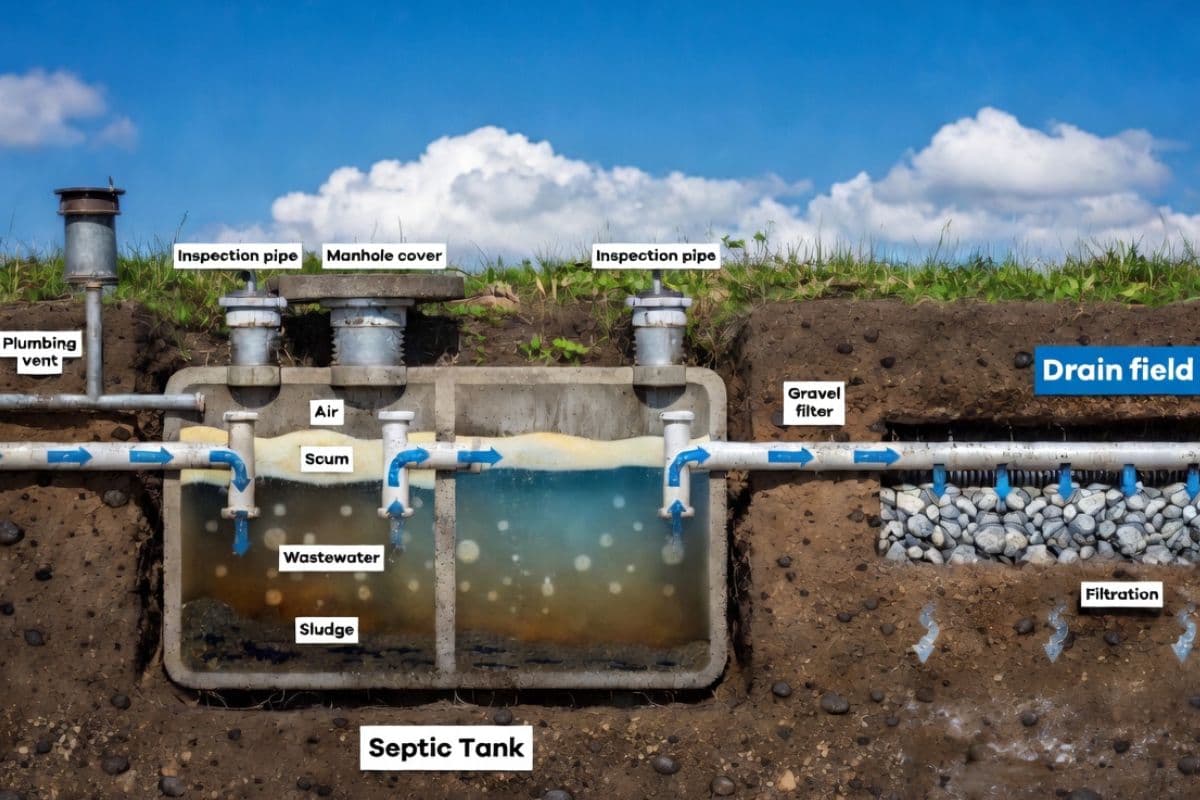
When wastewater enters the tank, it separates into three layers. Heavy solids sink to the bottom and form the sludge layer. Oils and grease float to the surface and form the scum layer. The clarified liquid effluent in the middle exits through the outlet pipe to the drainfield.
The tank is not a passive container. It is a biologically active environment populated by billions of anaerobic bacteria that arrived with the first flush of household waste. These bacteria continuously digest organic solids, reduce sludge volume, and break down waste into gases and simpler compounds. They reproduce and sustain their population through the steady supply of organic material entering the tank from normal household use.
This is the key point that additive marketing glosses over
A functioning septic tank is already full of bacteria. A single tablespoon of healthy septic sludge contains more bacteria than most additive doses introduce in an entire bottle. Research comparing treated and untreated tanks has repeatedly found no difference in bacterial activity or sludge accumulation levels.
The tank's bacterial population is self-sustaining as long as the conditions that support it are maintained, which means keeping harsh chemicals, antibiotics, and antimicrobial products out of the system in normal quantities.
The Three Types of Additives and What Each Does
Biological Additives (Bacteria and Enzymes)
Biological additives are the most commonly sold category and include products containing live bacteria strains, enzymes, or a combination of both.
Bacteria-based additives claim to supplement or restore the tank's bacterial population. The practical reality is that the volume of bacteria introduced by an additive dose is negligible compared to the population already established in a functioning tank. A study of 48 septic tanks found no measurable difference in sludge levels between tanks using bacterial additives and those that did not. The EPA confirmed in its updated 2024 Septic Tank Additives Fact Sheet that these products are unnecessary for domestic wastewater systems that are already functioning correctly.
Enzyme-based additives claim to speed up the breakdown of specific waste components. Enzymes are specific: cellulase breaks down only fibrous material like toilet paper, protease breaks down only protein-based waste, lipase breaks down only fats. They do not address the full range of materials entering the tank. Unlike bacteria, enzymes cannot reproduce, which means they must be continuously repurchased and reintroduced to maintain any intended effect.
Some enzyme products work by liquefying the scum layer to allow fats and oils to flow downstream into the drainfield, where they cause clogging and damage rather than solving a problem.
The verdict on biological additives:
Unlikely to harm a healthy system in normal use. Unlikely to provide any measurable benefit to a healthy system. May help in specific recovery scenarios covered later in this guide.
Chemical Additives (Inorganic Acids, Alkalis, and Organic Solvents)
Chemical additives are the most dangerous category and should never be used in a residential septic system.
Inorganic acid and alkali additives include products containing sulfuric acid, sodium hydroxide, and similar harsh compounds. They are marketed as drain uncloggers and pipe cleaners. They kill anaerobic bacteria, disrupting the biological process the entire system depends on. They corrode concrete tanks and distribution boxes, causing structural damage that leads to leaks and eventual system failure. They damage soil structure in the drainfield, reducing its ability to absorb and treat effluent.
Research found that hydrogen peroxide, sometimes included in these products, degrades soil structure in drainfields. Washington State has banned chemical additives outright. Montana prohibits products that claim to eliminate the need for pumping.
Organic solvent additives include products containing chlorinated hydrocarbons such as trichloroethylene and methylene chloride. They are marketed to dissolve fats, oils, and grease. They are highly toxic to the bacterial ecosystem in the tank, pose a serious risk of groundwater contamination, and are classified as hazardous materials.
The verdict on chemical additives:
Do not use them under any circumstances. The EPA, state regulators, and independent researchers are unanimous on this point.
Enzyme-Only Products
Enzyme-only products without bacteria are the weakest category and the most straightforwardly unnecessary. Enzymes work in tandem with bacteria. Without bacteria to continue the breakdown process, enzyme activity provides only a brief and limited effect before the enzyme is consumed or degraded. They cannot reproduce, requiring continuous repurchase. For most tank conditions, the existing bacterial population already produces the enzymes needed for normal waste digestion.
What the Research Actually Shows
The scientific consensus on septic additives is unusually consistent across multiple independent studies spanning decades.
- A study of 48 septic tanks comparing tanks using bacterial additives to untreated control tanks found no difference in sludge accumulation levels between the two groups.
- Kansas State University research found no benefit to septic tank function from any type of additive tested.
- A peer-reviewed study published in the Journal of Environmental Health examining biological additive efficacy found that additives did not improve septic tank effluent quality in measurable ways.
- Washington State University Extension concluded that the amount of bacteria or enzyme in an additive dose is small compared to the bacteria already present in the tank and provides little if any benefit.
- The EPA's 2024 updated Septic Tank Additives Fact Sheet states directly that the use of additives is not recommended for domestic wastewater treatment because a significant presence of bacteria, enzymes, yeasts, fungi, and other microorganisms already exists in functioning onsite wastewater treatment systems.
No peer-reviewed study has concluded that any commercially available septic additive meaningfully improves the performance of a healthy, properly maintained residential septic system.
Does RID-X Actually Work?
RID-X is the most widely recognized septic additive brand in the United States and the product most homeowners have in mind when they search this topic. It contains a blend of bacteria strains and enzymes including cellulase, protease, lipase, and amylase, and is marketed for monthly use to maintain septic system health and reduce pumping frequency.
The honest assessment: RID-X is unlikely to harm a healthy system in normal monthly doses. It is also unlikely to provide any measurable benefit. The bacteria and enzyme concentrations in a RID-X dose are small relative to the established bacterial population in a functioning tank. The NC State landmark research on septic additives, which studied 48 tanks over time, found no difference in sludge levels between tanks using bacterial additives including RID-X-type products and untreated control tanks. The Ohio Department of Health and the EPA both state that additives including RID-X are not recommended.
The more pointed concern is that RID-X contains stronger enzyme concentrations than the natural bacterial environment normally produces, and these enzymes can break down solids further than they would naturally decompose, potentially suspending material that would otherwise settle as sludge and allowing it to flow downstream into the drainfield.
The verdict
RID-X is not a replacement for pumping, does not meaningfully extend pumping intervals, and at $10 to $15 per month adds $120 to $180 per year in cost for no documented benefit. That same money over three years funds a pump-out that actually removes sludge. If you want to use a biological additive as a recovery measure after a disruption event, a single dose of any bacteria-based product including RID-X is appropriate. Ongoing monthly use is not supported by evidence.
The Yeast Myth
Flushing baker's yeast into the septic tank is one of the most persistent home remedy myths in septic maintenance, passed down through generations of homeowners who mean well but are operating on a fundamental misunderstanding of biology.
Yeast is a fungus, not a bacterium. The waste decomposition process in a septic tank is performed by anaerobic bacteria, a completely different class of microorganism that operates through a completely different biological mechanism. Yeast ferments sugars into alcohol and carbon dioxide. It does not digest sewage, does not support the anaerobic digestion process, and is not what the tank's bacterial ecosystem needs.
Beyond being ineffective, yeast can cause problems. The carbon dioxide produced during fermentation creates frothing and agitation inside the tank that disrupts the settling process. Solids that would normally sink to form the sludge layer are instead kept in suspension, increasing the risk that they exit through the outlet pipe into the drainfield.
Bottom line
Yeast is unlikely to cause the serious harm that chemical additives cause. It is essentially a harmless placebo in small quantities. But it is a placebo, not a maintenance strategy.
Drainfield Rejuvenation Products: A Different Category
A subset of the additive market targets homeowners with failing or failed drainfields rather than healthy systems. Products in this category, including hydrogen peroxide treatments, proprietary bacterial blends marketed as biomat removers, and surfactant-based soil treatments, claim to restore drainfield absorption capacity by breaking up or dissolving the biomat layer that clogs trench surfaces.
Hydrogen peroxide treatments have been studied and the evidence is not favorable. Research found that hydrogen peroxide in concentrations sufficient to oxidize biomat also degrades soil structure, reducing the long-term absorption capacity of the drainfield even if short-term flow improves. Washington State banned these products partly on this basis.
Certain specialized bacterial blends and soil aeration treatments have shown limited effectiveness in field trials under specific conditions. Products designed to introduce oxygen and aerobic bacterial strains into saturated drainfield soil have shown some ability to degrade biomat in cases where the failure is caused by biological clogging rather than physical damage, crushed pipes, root intrusion, or fundamental design flaws. Results vary widely by soil type, saturation level, and the underlying cause of failure.
Drainfield rejuvenation products are not a replacement for professional drainfield rehabilitation or replacement when failure has progressed significantly. They may provide limited benefit in early-stage biomat clogging as a supplement to professional aeration and jetting. They will not fix a drainfield that has failed from physical damage, root intrusion, soil compaction, or design problems. Before spending money on any drainfield treatment product, have a professional assess the actual cause of the failure. See our drainfield failing guide for the full assessment process.
Water Softeners: The Hidden Additive Problem
Water softeners are not marketed as septic additives but function as one of the most impactful inputs into the septic system in many homes. The backwash cycle of a water softener regenerates the resin bed by flushing it with a concentrated brine solution, then discharges 50 to 100 gallons of sodium-rich water into the household drain system per regeneration cycle.
This creates two problems for the septic system. First, the volume of water entering the tank during a regeneration cycle can temporarily hydraulically overload the system, reducing retention time and sending more suspended solids toward the drainfield. Second, research suggests that high sodium concentrations in the tank can affect the soil structure in the drainfield, reducing the soil's ability to absorb water over time, particularly in clay-heavy soils.
Practical recommendation
If your water softener currently drains into the septic system, consider having a plumber reroute the discharge to a separate dry well or to a designated outdoor area away from the drainfield. This is a modest plumbing change that eliminates a continuous source of hydraulic and chemical stress on both the tank and the drainfield.
Which States Have Banned Chemical Additives?
Most articles on this topic say that “some states” have banned chemical additives without being specific. Here is what is documented:
| State | Restriction |
|---|---|
| Washington | Bans chemical additives including organic solvents and inorganic acid/alkali products |
| Montana | Prohibits products that claim to eliminate the need for pumping |
| Delaware | Restricts sale of chemical septic additives |
| Rhode Island | Restricts chemical additives based on environmental protection grounds |
| Connecticut | Requires additives to meet state approval standards before sale |
Many additional states regulate additive labeling or claims without outright banning products. Your local health department can direct you to the approved products list for your jurisdiction.
Does Septic Tank Monthly Treatment Work?
Dozens of products are marketed as monthly septic treatments — tablets, pods, liquid concentrates, and powdered bacterial blends designed to be flushed or poured down a drain on a regular schedule. The pitch is simple: add a dose every 30 days and your tank will break down solids faster, reduce sludge buildup, and extend the time between pumpings. Some labels go further, claiming their formula restores bacterial balance, eliminates odors, and prevents costly drainfield failures.
The evidence does not support those claims for a normally functioning system. A healthy septic tank already contains billions of anaerobic bacteria that colonize naturally from everyday waste. Peer-reviewed research and the EPA's own guidance confirm that introducing additional bacteria into a system that is already biologically active does not measurably improve decomposition rates, reduce sludge accumulation, or delay the need for pumping. In controlled studies, tanks receiving monthly biological additives performed no differently from untreated tanks over multi-year observation periods.
The one scenario where a monthly biological treatment may provide short-term value is when the tank's bacterial population has been genuinely disrupted — for example, after a round of chemotherapy drugs entering the system, a significant antibacterial chemical spill, or extended vacancy where the tank partially dried out. In those narrow cases, a biological additive can help re-seed the colony while normal waste flow gradually restores equilibrium. Once the system stabilizes, continuing the monthly dose offers no additional benefit.
For the vast majority of homeowners, the money spent on monthly treatments is better redirected toward routine pumping every three to five years and mindful water use. If you are evaluating products for a recovery situation, our best septic tank treatments guide ranks the most effective biological options, and our best septic tank sludge dissolver guide covers targeted formulas designed for heavy buildup.
The Narrow Exception: When a Biological Additive Might Help
The research is clear that additives do not benefit healthy systems. The one exception is biological additives used as recovery tools in specific situations where the tank's bacterial population has been significantly disrupted.
| Disruption Scenario | Why Bacteria Are Affected | Role of a Biological Additive |
|---|---|---|
| Strong antibiotics or chemotherapy | Drugs pass through the body and can reduce bacterial population | A single dose after the course ends may speed recovery |
| Large accidental chemical dump | A gallon of bleach or drain cleaner can crash the bacterial population | A single dose after the incident may help re-establish the colony |
| Home vacant for 6+ months | Without incoming organic material, bacterial populations decline sharply | A single dose when reoccupying can help jumpstart the system |
| Immediately after a complete pump-out | Pump-out removes most established bacteria along with the sludge | A single dose may shorten the recolonization window |
In all of these scenarios, the system will recover on its own through normal household use without any additive. The additive may speed up recovery modestly. These are recovery scenarios, not routine maintenance situations. A single dose is appropriate in each case, not ongoing monthly treatment.
Products to Avoid Entirely
This is the most important section of this guide. These product types should never be introduced into a septic system.
Inorganic acid and alkali additives
Products containing sulfuric acid, sodium hydroxide, potassium hydroxide, or similar compounds. Found in many drain cleaners and pipe uncloggers marketed for septic use.
Organic solvent additives
Products containing trichloroethylene, methylene chloride, or other chlorinated hydrocarbons. Marketed to dissolve grease and oils.
Formaldehyde-based products
Still sold in some markets despite being banned in many states. Highly effective at killing bacteria, which is precisely why they should never be introduced into a system that depends on bacteria to function.
Hydrogen peroxide treatments
Specifically documented to damage drainfield soil structure.
Products claiming to eliminate pumping
No additive can remove the inorganic solids that require physical pump-out. Any product making this claim is misrepresenting what it can do.
If you are unsure whether a product is safe, check whether your state's health or environmental department has approved or restricted it.
What Actually Maintains a Healthy Septic System
The actions that protect a septic system are well established, inexpensive, and consistently supported by research. None of them involve purchasing additives.
Pump on schedule
This is the single most important maintenance action. Pumping removes the accumulated solids that bacteria cannot fully digest, including inorganic materials, minerals, and synthetic fibers. No additive can substitute for this. See our pumping frequency guide for the exact schedule based on your tank size and household size.
Keep harmful products out of the system
Avoid pouring bleach, drain cleaners, paint, solvents, or large quantities of antibacterial products directly down drains. Normal diluted household cleaning does not significantly harm the bacterial population. It is concentrated doses that cause problems.
Flush only appropriate materials
Human waste and toilet paper are what the system is designed to process. Everything else slows digestion, increases sludge accumulation, and clogs the drainfield. See our complete flushing guide.
Conserve water
High water use reduces the retention time effluent spends in the tank. Fixing leaky toilets and faucets and spreading laundry loads throughout the week both reduce hydraulic load on the system.
Protect the drainfield
No vehicles, no structures, no deep-rooted plants within 30 feet of drainfield components. Direct surface water and roof runoff away from the drainfield area.
Get regular inspections
A professional inspection every one to three years catches developing problems before they become expensive failures. See our septic inspection cost guide for what to expect.
Glossary
Frequently Asked Questions
Do septic tank additives actually work?
Are septic tank additives safe?
When should I use a septic tank additive?
Can septic additives replace pumping?
Are there septic additives I should never use?
Does RID-X work and should I use it?
Is bakers yeast good for a septic tank?
Do I need to add bacteria to a new septic tank?
What actually kills septic tank bacteria?
Can septic additives fix a failing drainfield?
Related Guides
Continue learning about septic system care with these in-depth guides.
Best Septic Tank Treatments 2026
Our reviewed and ranked list of biological treatments that are safe for septic systems, with honest assessments of what each product can and cannot do.
How Often Should You Pump Your Septic Tank?
The only maintenance action that actually removes accumulated solids from the tank, with the exact schedule by tank size and household size.
Septic Tank Pumping Cost 2026
Real pricing for the maintenance that protects your drainfield, compared to the cost of additives that do not.
Septic Tank Cleaning vs Pumping
The difference between the two services, what a thorough pump-out includes, and why physical removal of solids is the only reliable way to maintain tank capacity.
What You Can and Cannot Flush
The complete list of what kills tank bacteria, accelerates sludge accumulation, and clogs the drainfield.
Septic System Maintenance Checklist
The proven maintenance actions that actually protect a septic system, none of which involve purchasing additives.
Septic Dos and Don'ts
Practical household habits that support tank health and protect the bacterial ecosystem without spending money on products that do not work.
Signs Your Drainfield Is Failing
What happens to the drainfield when maintenance is deferred and when enzyme additives liquefy the scum layer and allow fats to flow downstream.
Septic Tank Backing Up Into House
What chemical additives that kill tank bacteria eventually lead to, with emergency steps and causes.
Complete Septic System Guide
How the tank's bacterial ecosystem works and why it is self-sustaining under normal conditions without any supplementation.
Septic Smell in Your Yard
Additives that claim to eliminate odor often mask symptoms rather than address the cause. Eight real causes of outdoor septic odor and the specific fix for each.
External Resource
EPA Septic Tank Additives Fact Sheet (2024) — The EPA's most current official position on septic additives, covering all additive types and their documented effects.
Ready to Schedule a Pump-Out?
Connect with licensed septic professionals in your area. Get free, no-obligation quotes and compare prices before you commit.
Get Free QuotesGet Expert Septic Help
Connect with qualified septic professionals in your area. Free quotes, no obligation.