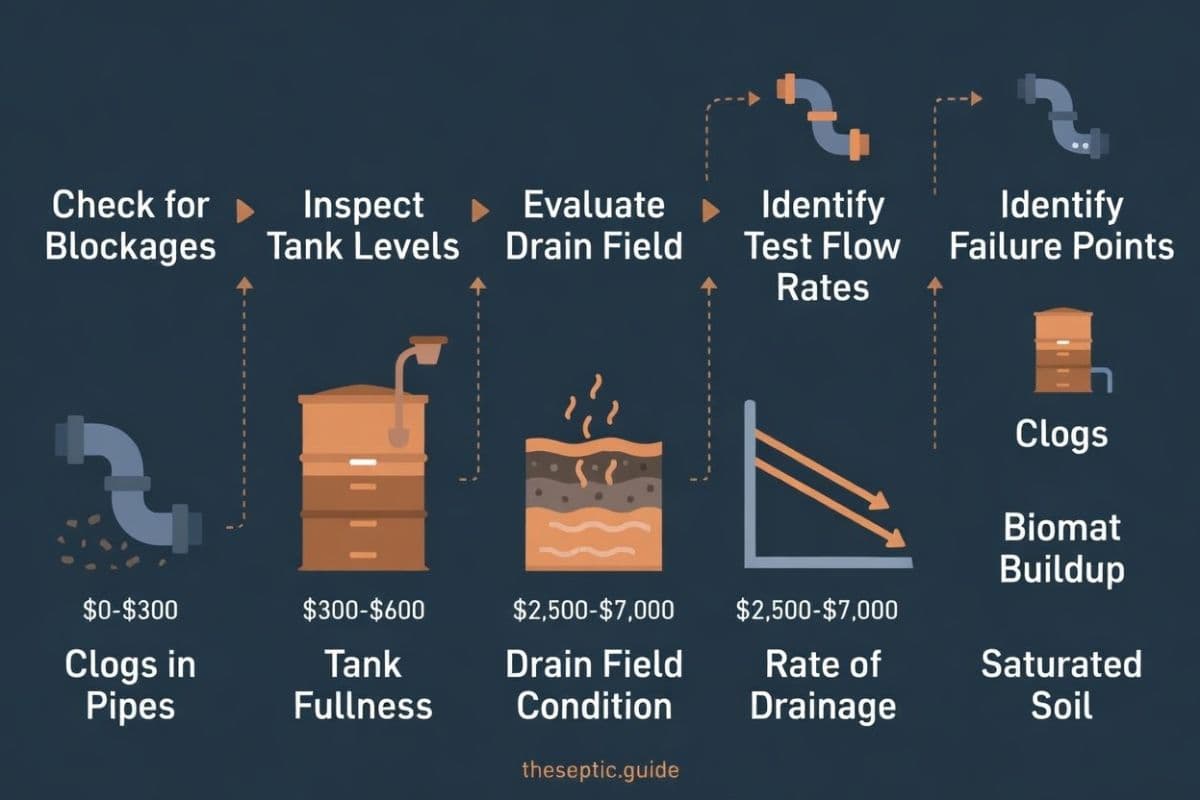
Slow drains in a home with a septic system are a plumbing condition in which one or more fixtures drain more slowly than normal due to a restriction somewhere between the fixture and the point where wastewater is fully processed, ranging from a simple localized pipe clog to a full septic tank to a drainfield that can no longer absorb effluent. Unlike a municipal sewer home where slow drains almost always indicate a pipe clog, a septic home has three distinct failure points that produce similar symptoms but require completely different fixes at costs ranging from zero dollars to 15,000 or more. The most important diagnostic step is determining whether the slowness affects a single fixture, a group of fixtures on one level, or every fixture in the house simultaneously, because each pattern points to a different location and cause. The majority of slow drain cases in septic homes are resolved by pumping the tank or clearing a localized clog, and only a small percentage turn out to be drainfield or system-level failures.
Slow drains in a home with a septic system mean one of three things: a localized pipe clog ($0 to $300 fix), a full septic tank that needs pumping ($300 to $600 fix), or a drainfield or system-level problem ($1,000 to $15,000 fix). The critical skill is telling them apart before you spend money on the wrong solution.
A plumber who snakes a drain when the real problem is a saturated drainfield wastes your time and money. A homeowner who panics about system failure when the issue is a hair clog in the bathroom sink wastes worry. This guide gives you a step-by-step diagnostic process that starts with the simplest, cheapest possibilities and works toward the more serious causes only if the simple fixes do not resolve the problem.
The Diagnostic Flowchart
Start at the top. Each question narrows down the cause.
| Question | If Yes | If No |
|---|---|---|
| Is only ONE fixture slow? | Localized clog in that fixture's drain line. Fix it yourself or call a plumber. | Continue to next question. |
| Are MULTIPLE fixtures slow, but only on one level? | Partial clog in a branch drain line serving that level. Plumber can snake it. | Continue to next question. |
| Are ALL fixtures in the house slow? | Problem is downstream — full tank, clogged effluent filter, or drainfield issue. | If drains are totally stopped, see tank backing up. |
| When was the tank last pumped? (>3 years ago?) | Pump the tank first. This solves the problem in most cases. | If pumped recently, continue. |
| After pumping, did the slow drains resolve? | Full tank was the cause. Resume normal pumping schedule. | Continue to next question. |
| Standing water, soggy soil, or sewage odor near drainfield? | Drainfield problem. Needs professional inspection. | Continue. |
| Has it been raining heavily? | Drainfield is temporarily saturated. Wait for it to dry. See overflow after rain. | Continue. |
| Do you hear gurgling from multiple drains? | Venting issue or main line obstruction. Plumber should inspect. | Call a septic professional for full system evaluation. |
This flowchart eliminates the most common and cheapest causes first. Most slow drain problems in septic homes are resolved at steps 1, 2, or 4 — localized clog or full tank. Only a minority are true drainfield or system failures.
What Is Causing My Slow Drains?
Match what you are observing to the most likely cause and recommended first action.
| What You Are Observing | Most Likely Cause | Estimated Fix Cost | Recommended First Action |
|---|---|---|---|
| One fixture slow, all others normal | Localized clog in that fixture's drain pipe | $0 – $300 | Plunger, clean P-trap, or manual snake |
| One fixture slow, returns after clearing | Recurring clog deeper in branch line | $100 – $600 | Call a plumber to snake or hydro-jet the line |
| All fixtures slow, tank not pumped in 3+ years | Full septic tank | $300 – $600 | Schedule pump-out immediately |
| All fixtures slow, tank recently pumped | Clogged effluent filter or main line blockage | $0 – $400 | Check effluent filter, camera-inspect sewer line |
| Slow drains plus gurgling from multiple fixtures | Blocked vent stack or main line restriction | $0 – $600 | Check roof vent for obstructions, call plumber if clear |
| Slow drains only on one floor or one section | Branch drain line clog | $100 – $600 | Plumber to snake or camera-inspect branch line |
| Slow drains worsen during or after heavy rain | Drainfield temporarily saturated | $0 – $600 | Reduce water use, pump tank, allow drainfield to dry |
| Slow drains plus soggy soil over drainfield | Drainfield saturated or failing | $1,000 – $15,000 | Stop heavy water use, professional drainfield inspection |
| Slow drains plus sewage odor in yard | Drainfield absorption failing or broken pipe | $500 – $15,000 | Professional inspection, camera-inspect sewer line |
| Slow drains gradually worsening over months | Progressive biomat buildup in drainfield | $1,000 – $15,000 | Professional drainfield assessment |
| Slow drains after guests or high water use day | Hydraulic overload, system temporarily overwhelmed | $0 – $600 | Reduce water use 24 to 48 hours, monitor, pump if needed |
| Flushing toilet backs water into shower or tub | Main sewer line blockage | $150 – $4,000 | Stop water use, call plumber or septic professional |
Localized Pipe Clog (Single Fixture)
If only one sink, shower, tub, or toilet is draining slowly while every other fixture in the house works fine, the problem is in that fixture's drain pipe. This is a plumbing issue, not a septic issue.
Common Clog Culprits by Fixture
| Fixture | Most Common Clog Material | DIY Fix | When to Call a Plumber |
|---|---|---|---|
| Bathroom sink | Hair and soap scum in the P-trap or pop-up stopper | Remove stopper, clean hair, flush with hot water | If clog returns repeatedly or is deeper than the P-trap |
| Kitchen sink | Grease, food particles, soap residue | Pour boiling water, use a drain snake (not chemical cleaners) | If snake cannot clear it or grease has hardened in the line |
| Shower/tub | Hair wrapped around the drain crossbar | Remove drain cover, pull hair with needle-nose pliers or drain snake | If clog is beyond the trap or recurs monthly |
| Toilet | Excess toilet paper, “flushable” wipes, foreign objects | Plunger (cup or flange style) | If plunging does not clear it or toilet gurgles after flushing |
| Washing machine | Lint, fabric softener buildup in the standpipe | Clean the lint trap, flush the standpipe with hot water | If water backs out of the standpipe during drain cycles |
What NOT to use: Never use chemical drain cleaners (Drano, Liquid-Plumr, etc.) in a home with a septic system. These products contain sodium hydroxide or sulfuric acid that kill the bacteria in your septic tank. A $5 bottle of drain cleaner can disrupt the biological process that your entire system depends on. Use a manual snake, a plunger, or call a plumber instead. For a complete list of what harms your system, see our flushing guide.
Cost to Fix a Localized Clog
| Method | Cost | Effectiveness |
|---|---|---|
| DIY (plunger, manual snake, clean P-trap) | $0 – $30 | Solves 70% to 80% of single-fixture clogs |
| Plumber snake/auger | $100 – $300 | Solves deeper clogs that DIY cannot reach |
| Plumber hydro-jetting | $300 – $600 | Clears grease buildup and root intrusion in longer pipe runs |
Full Septic Tank
If multiple fixtures throughout the house are draining slowly, the most common cause is a septic tank that needs pumping. This is the diagnosis in the majority of whole-house slow drain cases and is the first thing to check before assuming anything more expensive.
How a Full Tank Causes Slow Drains
Your septic tank is designed to hold wastewater while solids settle as sludge and grease floats as scum. The liquid layer in the middle (effluent) exits through the outlet pipe to the drainfield. Over time, sludge and scum accumulate. When they take up too much of the tank's volume:
1. The effluent layer has less room, so the tank's effective capacity drops
2. Solids can reach the level of the outlet pipe or effluent filter, partially blocking flow
3. Wastewater entering the tank from the house has nowhere to go quickly, creating a bottleneck
4. Drains throughout the house slow down as the system backs up from the tank
How to Confirm This Is the Cause
If you have a septic tank riser with an accessible lid, open it and check the water level. In a properly functioning tank, the water level should be at or just below the outlet pipe (typically 8 to 12 inches from the top of the tank). If the water level is above the outlet pipe, the tank is backing up, either because it is full of solids or because something downstream is restricting flow.
If you do not have a riser, check when the tank was last pumped. If it has been 3 or more years, schedule a pumping ($300 to $600). The pumper will measure sludge and scum levels and tell you whether the tank was overdue.
The Effluent Filter Factor
Many septic tanks have an effluent filter installed on the outlet pipe. This filter catches solids before they reach the drainfield. Over time, the filter clogs with captured material. A clogged effluent filter restricts outflow from the tank and causes the same symptoms as a full tank — whole-house slow drains.
A clogged effluent filter is one of the most overlooked causes of slow drains in septic homes — and one of the cheapest to fix ($0 if you clean it yourself, $50 to $200 if a professional does it during a service call).
Branch Line or Main Sewer Line Clog
If multiple fixtures are slow but only on one floor or one section of the house, the clog may be in a branch drain line or in the main sewer line itself between the house and the septic tank.
Signs of a Main Line Problem
Multiple fixtures on the lowest level of the house are affected first (gravity)
Flushing a toilet causes water to back up in a nearby shower or tub
Floor drains in the basement are slow or backing up
Gurgling sounds from multiple drains when water is running elsewhere
Common Main Line Clog Causes
| Cause | How It Happens | Fix | Cost |
|---|---|---|---|
| Tree root intrusion | Roots grow into pipe joints seeking moisture | Professional root cutting or hydro-jetting | $200 – $600 |
| Pipe belly or sag | Section of pipe settles below grade, creating a low spot | Excavate and replace the affected section | $500 – $2,000 |
| Grease accumulation | Years of cooking grease coating the pipe interior | Hydro-jetting to scour the pipe | $300 – $600 |
| Crushed or collapsed pipe | Vehicle traffic, heavy equipment, or soil movement | Excavate and replace | $1,000 – $4,000 |
| Non-flushable items | Wipes, feminine products, or other items lodged in pipe | Snake or hydro-jet | $150 – $400 |
A plumber with a sewer camera ($200 to $400 for the inspection) can identify the exact location and nature of the clog without any digging. This is almost always worth the cost because it prevents guesswork and unnecessary excavation.
Drainfield Problem
If the tank has been pumped, the effluent filter is clean, and the main line is clear, the problem is downstream in the drainfield. This is the most expensive diagnosis but also the least common for slow drains that developed gradually.
Signs That the Drainfield Is the Problem
| Sign | What It Means |
|---|---|
| Standing water or soggy soil over the drainfield | Soil cannot absorb effluent — drainfield is saturated or failed |
| Unusually green or lush grass over the drainfield | Effluent is surfacing and fertilizing the grass |
| Sewage odor in the yard | Untreated or partially treated effluent is reaching the surface |
| Tank fills back up rapidly after pumping | Effluent cannot exit because the drainfield is not accepting it |
| Slow drains worsen during or after rain | Saturated soil reduces drainfield absorption. See overflow after rain. |
| Slow drains progressively worse over months or years | Biomat buildup is gradually clogging the drainfield soil |
Drainfield Fix Options and Costs
| Fix | When It Works | Cost |
|---|---|---|
| Wait for soil to dry | Temporary saturation from heavy rain | $0 (reduce water use and wait) |
| Drainfield aeration/rejuvenation | Moderate biomat clogging, system is 10 to 20 years old | $1,000 – $5,000 |
| Repair distribution box or replace a section | D-box failure or single crushed line | $500 – $2,500 |
| Full drainfield replacement | Complete failure, excessive biomat, or end of life | $5,000 – $15,000 |
A professional drainfield inspection ($200 to $500) is essential before committing to any drainfield repair. The inspection determines whether the problem is fixable with rejuvenation or requires a full replacement. See our drainfield failure guide for details.
Plumbing Vent Blockage
This is the cause that most homeowners and many professionals overlook entirely. Your home's plumbing vent stack — the pipe that runs from your drain lines up through the roof — allows air into the drain system. Without that air, drains cannot flow freely because a vacuum forms behind the water as it drains. The result is slow drains and gurgling sounds, which look and sound exactly like a septic problem but have nothing to do with the septic system.
Signs of a Blocked Vent
Gurgling sounds from drains when water runs in another fixture
Slow drains throughout the house but no sewage odor outside
A “glug-glug” sound when a toilet flushes
Sewer gas smell inside the house (gas escaping through drain traps because the vacuum pulls water out of the P-traps)
Common Vent Blockages
| Blockage | How It Happens | Fix |
|---|---|---|
| Leaves, debris, or bird nest | Natural accumulation on the roof vent | Clear debris from the vent pipe opening on the roof |
| Ice cap in cold climates | Moisture in vent gas freezes at the opening in winter | Pour warm water down the vent or install a cold-climate vent cap |
| Animal nesting inside pipe | Birds, squirrels, or insects build nests inside the pipe | Clear the nest, install a vent screen to prevent recurrence |
| Vent pipe detached or damaged | Physical damage, settling, or poor original installation | Reconnect or replace the vent pipe section (plumber) |
Checking the vent is free if you can safely access your roof. Look down the vent pipe (2- to 4-inch pipe protruding through the roof). If you see an obstruction, remove it. If the opening is clear, run water in the house while someone listens at the vent opening. You should hear air flowing freely. If not, the obstruction is deeper and a plumber is needed.
The One-Fixture Test
This is the simplest diagnostic tool.
If one fixture is slow
The problem is in that fixture's drain pipe. Fix it with a plunger, snake, or plumber. The septic system is not involved.
If multiple fixtures are slow
The problem is downstream of where those drain lines converge. If all fixtures in the house are slow, the problem is in the main line, the septic tank, or the drainfield. Start with the cheapest diagnosis — check the tank and work downstream.
If drains are slow but improve after reducing water use for a day
The system is hydraulically overloaded. Either the tank is full, the drainfield is saturated, or the household is using more water than the system can process. Pumping the tank and spreading water use throughout the day usually resolves this.
Prevention: Keep Drains Flowing
| Prevention Step | What It Does | Cost | Frequency |
|---|---|---|---|
| Pump the tank on schedule | Removes accumulated solids before they restrict flow | $300 – $600 | Every 3 to 5 years |
| Clean the effluent filter | Prevents outlet clogging that causes backup | $0 (DIY) to $200 (pro) | Every 1 to 2 years |
| Flush only septic-safe items | Prevents clogs from wipes, grease, and foreign objects | $0 | Always |
| Use drain screens on all sinks and showers | Catches hair and debris before it enters the pipes | $5 – $15 per screen | Replace annually |
| Spread water use throughout the day | Prevents hydraulic overload of the tank and drainfield | $0 | Always |
| Avoid chemical drain cleaners | Protects the bacterial ecosystem in the tank | $0 (use a snake instead) | Always |
| Annual septic inspection | Catches developing problems before they cause slow drains | $100 – $300 | Annually |
| Keep trees 30+ feet from drainfield and sewer lines | Prevents root intrusion into pipes | $0 (plan landscaping) | Ongoing |
Frequently Asked Questions
Are slow drains always a septic problem?
Can I use Drano or Liquid-Plumr with a septic system?
My drains are slow after guests visited. What happened?
How do I know if my septic tank is full?
Why are my drains slow even though I just had the tank pumped?
Do septic tank treatments help with slow drains?
Can a garbage disposal cause slow drains with a septic system?
When should I call a professional instead of trying to fix it myself?
Glossary
Related Guides
Septic Tank Backing Up Into House
When slow drains escalate into a full backup, this guide covers emergency steps, causes, and how to fix and prevent it.
Signs Your Drainfield Is Failing
If slow drains persist after pumping, this guide walks through every drainfield warning sign and what each one means for repair or replacement.
Septic Smell in Your Yard
Slow drains and yard odor often appear together as early warning signs of a system under stress. Eight causes and the specific fix for each.
Septic Overflow After Rain
Why heavy rain causes slow drains and overflow in septic homes, and what to do when it happens.
Septic Smell Inside the House
A blocked vent stack causing slow drains can also push septic gases back into the home. This guide covers the causes specific to indoor odor.
How Often Should You Pump Your Septic Tank?
Find your exact pumping schedule by tank size and household size, since an overdue pump-out is the most common cause of whole-house slow drains.
Septic Tank Pumping Cost 2026
Real pricing by tank size and region so you know what to expect before calling for service.
What You Can and Cannot Flush
The complete list of what causes clogs, kills tank bacteria, and accelerates sludge buildup that leads to slow drains.
Septic System Maintenance Checklist
The full maintenance schedule for keeping your tank, effluent filter, and drainfield healthy and your drains flowing freely long term.
Septic System Repair Cost
What individual repairs cost, from snaking a main line and replacing an effluent filter to drainfield rejuvenation and full replacement.
Best Septic Tank Treatments
Bacteria-based treatments that support tank health and help reduce sludge accumulation between pump-outs.
From Our Network
Sump Pump Design Ideas for 2026
If seasonal groundwater or yard drainage issues are hydraulically overloading your septic system and slowing your drains, a properly designed sump pump system can redirect that water away from the septic area.
Best Sump Pumps 2026
Reviewed and ranked sump pump options for homeowners dealing with water intrusion and drainage problems that contribute to septic system overload and slow drains.
Slow Drains Won't Fix Themselves
Connect with licensed septic professionals in your area who can diagnose the cause and fix it fast.
Get Free QuotesGet Expert Septic Help
Connect with qualified septic professionals in your area. Free quotes, no obligation.