A failing drainfield is a septic system condition in which the underground network of perforated pipes and gravel-filled trenches that disperse wastewater into the soil can no longer absorb effluent at an adequate rate. The drainfield, also called a leach field or absorption field, is the final treatment stage of a conventional septic system, where soil microorganisms remove bacteria, viruses, and nutrients from partially treated wastewater before it reaches groundwater. Drainfield failure typically develops gradually over months or years and is most commonly caused by solid waste escaping a neglected septic tank, hydraulic overloading, soil compaction, tree root intrusion, or a drainfield that has reached the end of its 15 to 30 year lifespan. Early signs include slow drains throughout the house and sewage odor in the yard, while advanced failure produces soggy soil, standing sewage on the surface, and sewage backing up into the home.
Your drainfield is the most expensive component of your septic system — and the one most likely to fail. When it does, you're looking at $5,000 to $15,000 for a replacement, plus weeks of disruption, landscape restoration, and potentially health department involvement.
The good news is that drainfield failure doesn't happen overnight. It develops over months or years, and there are clear warning signs at every stage. If you catch the problem early, you may be able to save the drainfield. If you ignore the signs, you'll eventually face a full replacement.
This guide walks you through the warning signs in order from earliest to latest, explains what causes each one, tells you which problems are fixable and which ones mean the drainfield is done, and gives you the honest cost picture for each scenario.
What Your Drainfield Actually Does
Before diagnosing problems, it helps to understand what a healthy drainfield looks like. The drainfield — also called a leach field or absorption field — is a network of perforated pipes buried in gravel-filled trenches, typically 18 to 36 inches below your yard.
Partially treated wastewater (effluent) from your septic tank flows through these pipes and percolates into the surrounding soil. The soil is where the real treatment happens. Microorganisms in the ground remove bacteria, viruses, and excess nutrients from the effluent. By the time the water reaches the groundwater table, it's been naturally purified.
A healthy drainfield is invisible. The grass above it looks the same as the rest of the yard. There's no smell, no wet spots, and no standing water. When any of those things change, something is wrong.
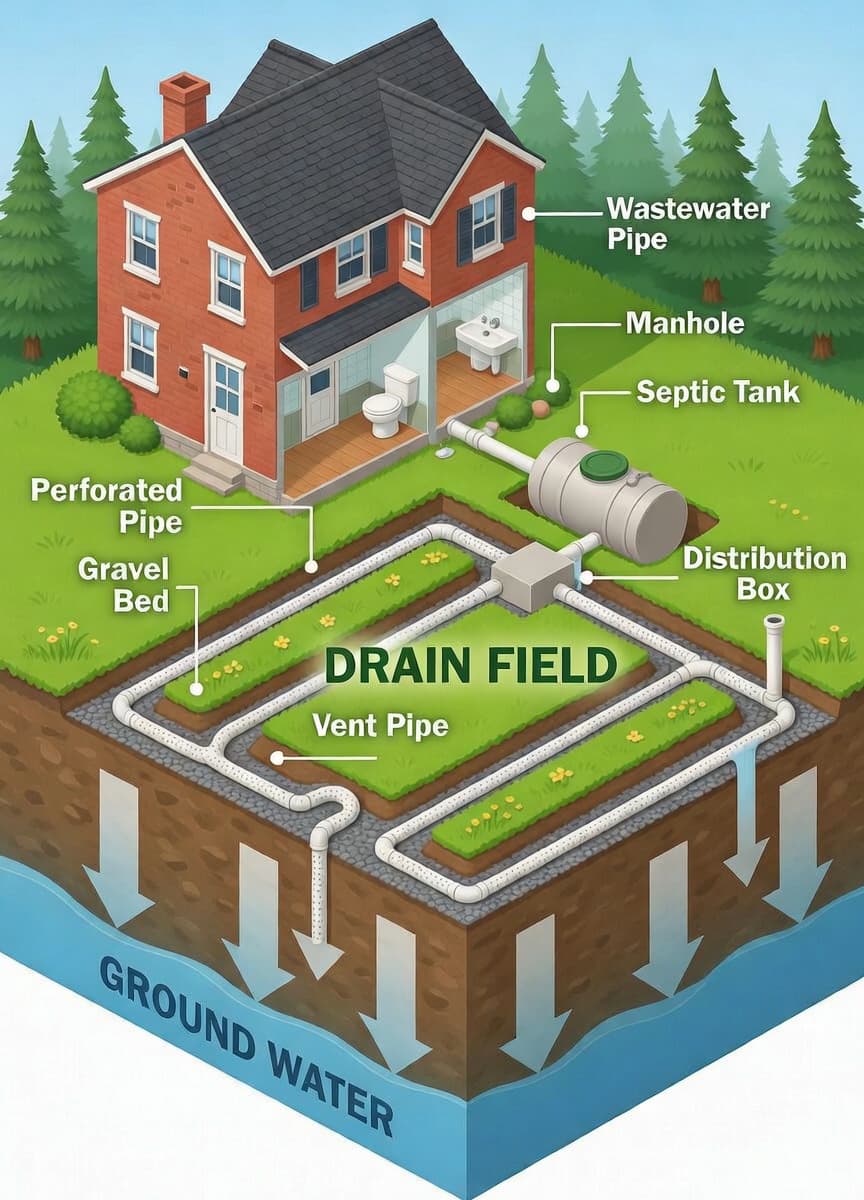
A typical drainfield layout showing the distribution box, perforated pipes, and gravel trenches.
The Seven Warning Signs
Earliest to Latest
1. Slow Drains Throughout the House
This is often the first sign, and it's the easiest to misdiagnose. If multiple fixtures — sinks, showers, toilets — are draining slowly at the same time, the problem is likely systemic, not a single clogged pipe. When the drainfield can't absorb effluent fast enough, the entire system backs up incrementally.
What it could also be: A full tank that needs pumping, a clogged effluent filter, or a blocked outlet baffle. These are cheaper fixes. Have the tank inspected first before assuming it's the drainfield.
What to do: Call a septic professional for an inspection. They'll pump the tank, check the filter and baffles, and assess whether effluent is draining properly to the distribution box and drainfield.
2. Gurgling Sounds in the Plumbing
Gurgling from toilets or drains when you run water elsewhere in the house means air is getting trapped in the plumbing because wastewater can't exit the system freely. This indicates a restriction somewhere downstream, often in the drainfield or the pipe connecting the tank to the drainfield.
What to do: Same as above. Inspection, pump the tank, check the filter. If those come back clean and the gurgling persists, the drainfield is the likely culprit.
3. Sewage Odor in the Yard
If you smell sewage outdoors near the septic tank or drainfield area, effluent is either surfacing or the system is producing gases that aren't being properly contained. A healthy drainfield is completely odor-free. Any noticeable smell is a sign that wastewater isn't being adequately absorbed by the soil.
What to do: Don't ignore this. Sewage gases contain hydrogen sulfide and methane, which are unpleasant and potentially dangerous in concentrated amounts. Have the system inspected promptly.
4. Unusually Lush or Green Grass Over the Drainfield
If the grass directly above your drainfield is noticeably greener, taller, or thicker than the surrounding lawn — especially during dry weather — it means effluent is reaching the root zone at or near the surface rather than percolating deep into the soil. The nutrients in wastewater are essentially fertilizing that strip of grass.
Why this matters: Many homeowners see this as a positive — great, free fertilizer. It's not. It means the soil is no longer absorbing effluent at the proper depth. The treatment process is compromised, and the situation will get worse.
What to do: This is an intermediate warning sign. The drainfield isn't dead yet, but it's struggling. Reduce water use, pump the tank, and have a professional assess whether the drainfield can be rehabilitated.
5. Wet, Soggy, or Spongy Soil Over the Drainfield
When the soil above the drainfield is consistently wet, soft, or spongy to walk on in dry weather, the drainfield has reached or exceeded its absorption capacity. Effluent is rising to the surface because the soil below can no longer accept it.
Temporary vs. permanent: If this happens after several days of heavy rain, the soil may be temporarily saturated and may recover once it dries out. If it happens during dry weather or persists after the rain stops, the drainfield is in serious trouble.
What to do: Stop using water immediately to reduce the load on the system. Have the tank pumped. If the problem is temporary saturation, give the drainfield several days to dry out. If the problem persists in dry conditions, the drainfield is likely failing or has failed.
6. Standing Water or Sewage Surfacing in the Yard
This is the most visible and alarming sign. Wastewater pooling on the surface above or near the drainfield means the soil has completely lost its ability to absorb effluent in that area. According to NC State Extension's septic failure research, surfacing effluent is a clear indicator that the drainfield's soil absorption capacity has been exceeded, either due to excess solids, soil compaction, or hydraulic overloading.
Health hazard: Standing sewage is a biohazard. Keep children, pets, and anyone else away from the area. Do not let it drain into any water feature, storm drain, or neighbor's property.
What to do: This is an emergency. Stop all water use in the house, pump the tank, and call a septic professional immediately. At this stage, the drainfield may need to be replaced.
7. Sewage Backing Up Into the House
When the drainfield completely fails, the entire system backs up. Sewage enters the home through the lowest drains — basement floor drains, ground-floor bathtubs, and toilets. This is the final stage of drainfield failure and means the system can no longer process any wastewater.
What to do: Follow the emergency steps in our septic backup guide. Stop all water use, avoid contact with sewage, call a professional immediately.
What Causes Drainfield Failure
In a cold-climate winter, a frozen drainfield can stop accepting wastewater and mimic permanent failure. A saturated field may need scheduled tank pump-outs until spring before its underlying condition can be evaluated.
Understanding the cause determines whether the drainfield can be saved or needs to be replaced.
Solids Escaping the Tank (Most Common Cause)
When the septic tank isn't pumped on schedule, sludge and scum accumulate until they overflow into the drainfield. These solids clog the gravel, soil pores, and perforated pipes. Over time, a thick layer of biological material called biomat builds up on the trench surfaces and seals the soil, preventing effluent from percolating. This is the number one cause of premature drainfield failure — and it is entirely preventable with regular pumping.
Hydraulic Overloading
Sending more water into the system than the drainfield can absorb overwhelms the soil's capacity. This happens from excessive water use (multiple loads of laundry in a row, leaky toilets, running fixtures) or from external water sources (roof runoff, sump pump discharge, surface water draining toward the drainfield).
Soil Compaction
Driving vehicles, parking, or placing heavy structures (sheds, pools, patios) over the drainfield compacts the soil and crushes the pipes. Compacted soil loses its ability to absorb water. This damage is usually permanent.
Tree Root Intrusion
Roots from trees and large shrubs seek out the moisture and nutrients in drainfield trenches. Once they infiltrate the perforated pipes, they block effluent distribution and can crack or collapse the pipes entirely.
Poor Original Design or Installation
Some drainfields were installed in soil that was too shallow, too dense, too permeable, or had a water table too high for proper treatment. These systems were undersized or poorly matched to their site conditions from the start. No amount of maintenance can fix a fundamentally flawed design.
Age
Even well-maintained drainfields have a finite lifespan, typically 15 to 30 years. Over decades, the soil's absorption capacity gradually diminishes as biomat naturally accumulates. Eventually, the drainfield reaches the end of its functional life.
Can a Failing Drainfield Be Saved?
Sometimes yes, sometimes no. Here's how to tell.
Potentially Fixable
- Temporary saturation from heavy rain or flooding. Reduce water use, pump the tank, and let the drainfield dry out. If absorption returns to normal, the drainfield is fine.
- Clogged effluent filter causing the tank to overflow into the drainfield. Clean or replace the filter ($50 to $200) and pump the tank.
- Early-stage biomat buildup. Some professionals offer drainfield rejuvenation techniques including soil aeration (fracturing compacted soil with pressurized air), jetting (flushing drainfield pipes to remove sediment), and bio-remediation (introducing bacteria to break down biomat). These cost $1,000 to $5,000 and work in some cases, particularly when caught early.
- Uneven distribution caused by a failing distribution box. If one section of the drainfield is overloaded because the D-box isn't distributing evenly, replacing the D-box ($500 to $1,500) can restore balance to the system.
Not Fixable — Replacement Needed
- Long-term clogging from years of solids entering the drainfield due to skipped pumping. Once the soil pores are sealed with compacted biomat and solid waste, they cannot be reopened.
- Crushed or collapsed pipes from vehicle traffic or structural weight. The pipes must be replaced.
- Severe root damage that has compromised multiple trench lines.
- Fundamental design flaws where the soil was never suitable for the system installed.
- A drainfield that has simply reached the end of its natural lifespan after 20+ years of service.
Symptom Quick-Reference Chart
Use this table to match your current symptoms to the most likely next step.
| Symptom or Condition | Likely Cause | Recommended Action | Replacement Needed? |
|---|---|---|---|
| Slow drains, multiple fixtures | Full tank, clogged filter, early drainfield stress | Pump tank, inspect filter and baffles | Not yet |
| Gurgling sounds in plumbing | Restriction downstream of tank | Pump tank, inspect outlet pipe and D-box | Not yet |
| Sewage odor in yard, no visible pooling | Effluent near surface, early absorption failure | Reduce water use, professional inspection | Possibly |
| Lush green grass over drainfield | Effluent reaching root zone, absorption slowing | Pump tank, assess drainfield load | Possibly |
| Soggy or spongy soil in dry weather | Absorption capacity exceeded | Stop heavy water use, professional inspection | Likely |
| Standing water or surfacing sewage | Complete absorption failure in affected area | Emergency pump-out, stop all water use | Very likely |
| Sewage backing up into house | Total system failure | Emergency service, stop all water use | Yes |
| Temporary wet soil after heavy rain | Hydraulic overload from saturation | Reduce water use, allow drainfield to dry | Not if it recovers |
| One drainfield section failing, others fine | Failing or unlevel distribution box | Replace D-box ($500 to $1,500) | Not if caught early |
| Pipes crushed or collapsed | Vehicle traffic or structural weight | Excavate and replace damaged lines | Partial or full |
Drainfield Replacement: What to Expect
If the drainfield needs to be replaced, here's the process and what it costs. A site evaluation and soil test (perc test) determines where the new drainfield can go. Most properties have a designated replacement drainfield area identified in the original septic permit. If no replacement area exists, the options become more limited and expensive.
| Item | Typical Cost |
|---|---|
| Site evaluation and perc test | $500 – $1,500 |
| Conventional drainfield replacement | $5,000 – $15,000 |
| Mound system (if soil conditions require it) | $10,000 – $20,000 |
| Alternative system (chamber, drip, sand filter) | $8,000 – $20,000 |
| Distribution box replacement | $500 – $1,500 |
| Landscaping restoration | $500 – $3,000 |
The total project typically takes one to three weeks from evaluation to completed installation, depending on permitting timelines in your area. For a deeper cost breakdown, see our guide on septic system costs.
Drainfield replacement typically costs $5,000 to $20,000 depending on system type, soil conditions, and regional pricing. For a planning estimate based on your specific situation, use our septic cost calculator before requesting installer quotes.
How to Protect Your Drainfield
Every cause of failure listed above is preventable except age. Here's how to maximize your drainfield's lifespan.
Pump your tank on schedule. This is the single most important thing you can do. Keeping solids out of the drainfield is the primary defense against premature failure.
Only flush appropriate materials. Everything that clogs the drainfield started as something flushed or poured down a drain that shouldn't have been.
Spread water use across the week. Avoid doing multiple loads of laundry in one day. Fix leaky toilets and faucets promptly.
Divert surface water away from the drainfield. Roof gutters, downspouts, sump pumps, and landscape grading should direct water away from the drainfield area, not toward it.
Never drive or park on the drainfield. No vehicles, no riding mowers, no heavy equipment. The soil compaction is permanent.
Never build structures over the drainfield. No sheds, patios, pools, decks, or driveways. You need the area clear for air exchange, evaporation, and future access for maintenance or replacement.
Plant only grass over the drainfield. No trees, shrubs, or deep-rooted plants within 30 feet of the drainfield perimeter. Roots will find the pipes.
Frequently Asked Questions
How do I know if my drainfield is failing?
How long does a drainfield last?
Can a failed drainfield be repaired?
How much does it cost to replace a drainfield?
Does homeowners insurance cover drainfield replacement?
What should I plant over my drainfield?
Glossary
Drainfield (leach field, absorption field)
The drainfield is the underground network of perforated pipes buried in gravel-filled trenches where septic tank effluent is distributed into the surrounding soil for final treatment and natural purification. It is the most expensive component of a conventional septic system to replace, with costs ranging from 5,000 to 20,000 depending on soil conditions and system type. See also Complete Septic System Guide and Drainfield Replacement Cost.
Biomat
A biomat is a dense layer of bacteria, organic solids, and biological slime that forms naturally on the bottom and sides of drainfield trenches as effluent passes through. A thin biomat is normal and actually aids in treatment by filtering pathogens, but a thick biomat caused by excess solids entering the drainfield from a neglected septic tank seals the soil and prevents effluent absorption, which leads to system failure. See also How Often Should You Pump Your Septic Tank and Best Septic Tank Treatments.
Effluent
Effluent is the partially treated liquid wastewater that exits the septic tank after solids have settled to the bottom as sludge and lighter materials have floated to the top as scum. Clean effluent that is low in solids flows to the drainfield and percolates safely into the soil, while effluent contaminated with solids from a tank that has not been pumped on schedule clogs the drainfield and accelerates biomat formation. See also Complete Septic System Guide and What You Can and Cannot Flush.
Perc test (percolation test)
A perc test is a soil evaluation that measures how quickly water drains through the ground at a specific location, used to determine whether a site can support a septic drainfield and what type of system is appropriate. It is required by most local health departments before a new drainfield can be installed or an existing one replaced, and the results directly affect what type of system can be permitted and how much it will cost. See also Septic System Installation Cost and Drainfield Replacement Cost.
Distribution box (D-box)
A distribution box is a small, watertight underground box that receives effluent from the septic tank outlet pipe and divides it equally among the multiple trench lines that make up the drainfield. When a D-box cracks, shifts, or becomes unleveled, it sends a disproportionate volume of effluent to one section of the drainfield while other sections sit underused, overloading part of the system and causing premature failure in that area. See also Septic System Repair Cost.
Hydraulic overload
Hydraulic overload occurs when the volume of water entering the septic system exceeds the drainfield's capacity to absorb and treat it, causing effluent to back up or rise toward the surface. Common causes include excessive daily water use, doing multiple loads of laundry in a single day, leaky toilets or faucets adding continuous low-level flow, and external water sources such as roof runoff or sump pump discharge draining toward the drainfield area. See also Septic System Maintenance Checklist and Septic Dos and Don'ts.
Soil compaction
Soil compaction is the permanent compression of soil particles caused by vehicle traffic, heavy equipment, or the weight of structures placed over the drainfield, which reduces the pore space that allows effluent to percolate through the ground. Unlike other forms of drainfield damage, soil compaction cannot be reversed without full excavation and soil replacement, making prevention through the permanent exclusion of vehicles and structures from the drainfield area the only viable strategy. See also Septic System Maintenance Checklist.
Root intrusion
Root intrusion occurs when the roots of trees, shrubs, or other deep-rooted plants grow into drainfield pipes and trenches in search of the moisture and nutrients in effluent, physically blocking flow and potentially cracking or collapsing pipe sections over time. The standard prevention guideline is to maintain a minimum 30-foot clearance between any tree or large shrub and all drainfield components, including the distribution box and connecting pipes. See also How to Find Your Septic Tank.
Related Guides
On theseptic.guide
Frozen Septic System
Find the freeze, compare thawing costs, and prevent a repeat next winter.
Septic Tank Backing Up Into House
What to do when sewage backs up into your home and how to prevent it from happening again.
Septic Smell in Your Yard
What causes sewage odor outside, how to trace the source, and when it signals a drainfield problem.
Slow Drains on a Septic System
How to tell whether slow drains are a plumbing issue, a full tank, or an early sign of drainfield failure.
Septic Tank Pumping Cost 2026
Real pricing by tank size and region, and why regular pumping is the single best way to protect your drainfield.
How Often Should You Pump Your Septic Tank?
Find your exact pumping schedule by tank size and household size.
Drainfield Replacement Cost
A full cost breakdown for conventional replacement, mound systems, and alternative technologies.
Septic System Repair Cost
What individual repairs cost, from D-box replacement to pipe repair to full drainfield rehabilitation.
Septic System Maintenance Checklist
The complete maintenance schedule for keeping your septic system and drainfield healthy long-term.
Complete Septic System Guide
How your entire septic system works, the role of the drainfield, and what proper maintenance looks like from start to finish.
From Our Network
Sump Pump Design Ideas for 2026
If your yard has drainage problems that are stressing your drainfield, a properly installed sump pump system can help redirect groundwater away from the absorption area.
Best Sump Pumps 2026
Reviewed and ranked sump pump options for homeowners managing water intrusion and yard drainage alongside a septic system.
Get Expert Septic Help
Connect with qualified septic professionals in your area. Free quotes, no obligation.
Get Homeowner Tips in Your Inbox
Septic maintenance schedules, pumping reminders, and troubleshooting guides from The Septic Guide — free to your inbox.
By subscribing you agree to receive emails from The Home Guide Network. We respect your privacy. Unsubscribe anytime. Privacy Policy